|
Nov 3, 2005
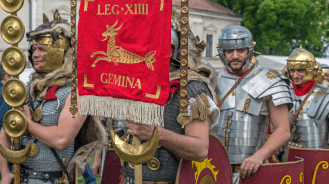
Rebellion and Pannonia Shortly after negotiating what would turn out to be a temporary peace arrangement with Decebalus and the Dacians, Domitian?s armies in Germania Superior at Mogontiacum (Mainz) rebelled. Under L. Antoninus Saturninus, two legions (XIV Gemina and XXI Rapax) revolted for reasons that are largely obscured and lost to history (thanks to the [...]
Oct 25, 2005
Decebalus and the War on the Danube After the recall of Agricola from Britain, accusations of jealousy plagued Domitian. Coupled with renewed fears of a tyrannical rule (his appointment as perpetual censor granting him complete dominion over the assemblies in AD 85 as an example), Domitian still needed a major military victory and/or a distraction. [...]
Oct 18, 2005
With the increasing popularity of the HBO dramatic series, we’ve added a simple HBO Rome Episode Guide. Along with a synopsis of each episode, we’ve included links to corresponding historical information.
Oct 17, 2005
Domitian and the Legions When Domitian came to power he did so with a great family pedigree of military success. Vespasian had proven himself in Britain, Germania and the east while Titus experienced similar conditions and continued his father?s work in Judaea…
Oct 8, 2005
Domitian’s Administration Domitian?s reign began with certainly as much promise as those of his father and brother before. He proved to be an excellent manager of imperial government and took a hand?s on approach to running the system. His Imperial court did consist of important members from the Senatorial body, future emperors Nerva and Trajan [...]
Sep 30, 2005
Domitian Born in Rome on October 24, AD 51, Titus Flavius Domitianus was the youngest son of Vespasian and Domitilla. He was raised in an era of great family mobility, as Vespasian gained several key appointments under both Claudius and Nero. However, despite these appointments (ie the proconsulship of Africa), Vespasian was under considerable financial [...]
Sep 22, 2005
Titus’ Reign After the disaster with Vesuvius and the Bay of Naples, Titus reacted quickly, visiting the area in person and confiscating properties of heirless victims for distribution to the disenfranchised. Survivors were relocated and a special Senatorial commission was arranged to provide whatever assistance they could. But, despite Titus? relatively short reign, this was [...]
Sep 15, 2005
Second Letter of Pliny Continuing Pliny’s letters to Tacitus regarding the eruption of Vesuvius… “My uncle having left us, I spent such time as was left on my studies (it was on their account indeed that I had stopped behind), till it was time for my bath. After which I went to supper, and then [...]
Sep 9, 2005
Vesuvius and the Destruction of Pompeii While Titus ascended to the Imperial purple without incident, his work was cut out for him to legitimize the Flavian dynasty. Despite Vespasian?s 10 year prosperous and stabilizing reign, the Roman Senate still resisted granting him deification. Because he was not a Julio-Claudian, his deification would require the creation [...]
Sep 6, 2005
Woman of Stone by Debra Tash Book review by forum member ‘Skarr’. In 148 BC, the praetor or Roman governor assigned to Macedonia, Quintus Caecilius Metellus, crushes the revolt in that province, putting to bed any dreams of Macedonian independence inspired by Andriscus, a pretender to the throne, who claimed to be the son of [...]
Aug 30, 2005
Jewish Wars At the end of the ?Year of the Four Emperors? in which Vespasian ultimately seized final authority, Titus was left with the obligation of completing his father?s prior task. Originally authorized by Nero to subdue the Jews several years of internal political strife and civil war limited Vespasian?s attention to that cause. With [...]
Aug 24, 2005
Titus Following up on the success of Vespasian would be no easy task, and while ancient accounts of Titus are somewhat mixed, he for the most part was remembered with the highest praise. Perhaps his short yet continuing stable reign after his father, followed by the terrifying reign of Domitian, left people with a certain [...]
Aug 15, 2005
Imperial Stability Immediately upon his senatorial confirmation as ?Emperor? (December of AD 69) Vespasian moved with extreme purpose on several fronts, but perhaps none more so than to legitimize his reign. With nearly 2 years of civil war having come to an end, certainly the people and the legions were tired of it, but proving [...]
|
|