|
Aug 26, 2004
As Julius Caesar aged into his Early Years, the political climate of Rome was in turmoil. By 88 BC, the rivalry between Gaius Marius and Lucius Cornelius Sulla was heating into open civil war. Attempts by Marius supporters to overturn Sulla?s command against Mithridates VI of Pontus, prompted Sulla?s subsequent march on Rome. Sulla took [...]
Aug 25, 2004
Western interest in the mountainous and coastal region of modern Turkey came with the conflicts between the Hellenistic World and the Persian Empire. Alexander the Great first brought western influence with his conquest in 333 BC but while this influence was lasting, Macedonian control was not. Upon Alexander?s death 10 years later in 323 BC, [...]
Aug 24, 2004
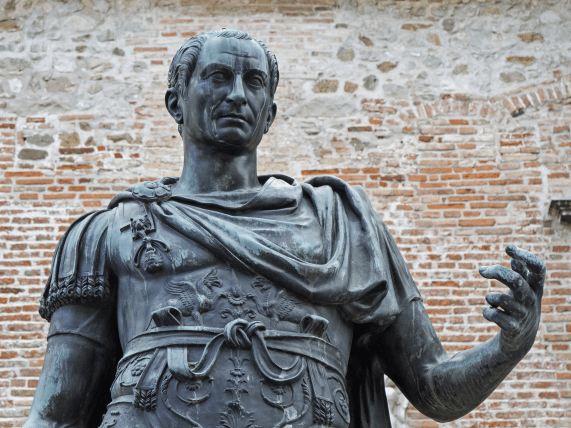
The Fall of the Republic chapter begins with a detailed look at the life of Gaius Julius Caesar. One of the most influential leaders in history, the career of Caesar shaped the History of Rome and the world. This ‘biographical’ review of Caesar will be displayed in many parts, detailing his early life, political career, [...]
Aug 23, 2004
In this chapter, the Fall of the Roman Republic the lives and impact of Caesar, Octavian, Antonius (Antony) and even Cleopatra, along with the continuing stories of men like Pompey, Crassus and Cicero will be examined. The Fall of the Republic was more than a single man or event. It was a culmination of several [...]
Aug 21, 2004
A nemesis to Cicero and a key political figure in the 60?s BC was L. Sergius Catilina. Like Crassus, Cataline profited enormously from the proscriptions of Sulla during his dictatorship, but Cataline was notorious for his brutality and unlawful methods. While a definite villain of the Late Republican period, he was also the victim of [...]
Aug 20, 2004
The latest addition to our Roman Province section is Aegyptus. The history of Egypt from the conquest of Alexander through the Ptolemic Dynasty and the emergence of direct Roman rule is covered.
Aug 19, 2004
Marcus Tullius Cicero was born in 106 BC, hailing from a local equestrian family in Arpinum. Both Cicero and Pompey, who became associates at a very young age, struggled to detach themselves from the Marian clan that was in the foremost position in the region. While both followed the footsteps of Marius to become novus [...]
Aug 18, 2004
After his victory over Mithridates, the opportunities for Pompey in the East were enormous. Armenia, Cilicia, Pontus, Bithynia, Mesopotamia and Judaea all fell under Roman sway with Pompey’s campaigns. Even the powerful Parthians had to take notice of Rome’s achievements.
Aug 17, 2004
The Roman Timeline 2nd Century AD has been added to our timeline section. This period of Roman History starts with the Dacian Wars of Trajan and end with Septimius Severus affirming his victory in the civil wars that followed the death of Commodus.
Aug 16, 2004
The Third Mithridatic War against Mithridates VI, King of Pontus, was really a continuation of the second. Lucullus, the Roman legate in charge of carrying out the war effort, was semi-successful, but ultimately unable to win a final victory. By 67 BC, he had been replaced by the Consul Glabrio, through the efforts of the [...]
Aug 14, 2004
Pompey arrived in his territorial command late in 67 BC with a large contingent of ships. His fleet was so large he was able to split the command between 13 naval legates responsible for various sections of the Mediterranean. 60 ships remained under his direct command, which he used as a mobile task force to [...]
Aug 13, 2004
Gnaeus Pompeius Magnus (Pompey the Great) was born in 106 BC in the northern Italian town of Picenum. Though not a native Roman family, the Pompeys were moderately successful at making inroads into Senate seats. His father, Pompey Strabo, was elected consul in 89 BC, and was an accomplished general who served Rome in the [...]
Aug 12, 2004
During and after the gladiator slave rebellion of Spartacus there was impending Trouble in the East. The menace of Cilician Pirates, resistance to Roman rule on Crete, and Rome’s old nemesis Mithridates VI of Pontus remained a threat. Following the joint consulship of Crassus and Pompey, Pompey would eventually be granted unsual imperium to deal [...]
|
|