|
Praetorian Guard
November 29, 2004
Praetorian Guard
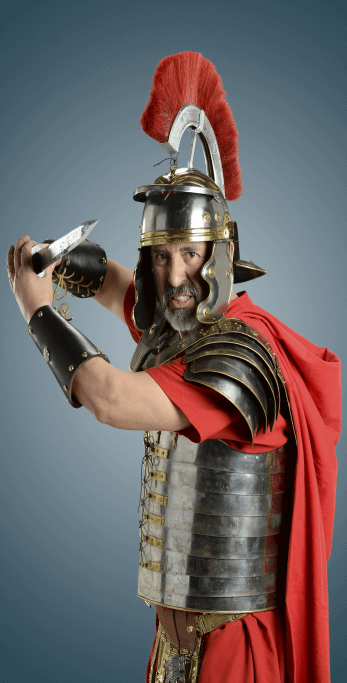
Evolving from the concept of a Legionary Legate’s personal bodyguard, under Augustus, the Praetorian Guard was established as the same, but instead were directly attached to the Emperor. The headquarters of the legion, or praetorium provided the namesake, and the practice was simply altered to encompass a much broader spectrum....
Prelude to War
November 27, 2004
Prelude to War
As Antony marched north to besiege Decimus Brutus in Cisalpine Gaul, Octavian, armed with the support of both Cicero and the Senate, readied his forces to follow. Having garnered the support of Cicero, though it was thought to be for the best interest of the Republic, Octavian actually secured his position as a political player of some importance. Despite attempts by the Senate to try and reconcile all the opposing factions, there was little chance now for resolution by peace....
Hibernia
November 24, 2004
Hibernia, Ancient Ireland as it was named by the Romans, existed as a relatively isolated corner of Celtic culture during the Roman era. Hibernia, however, had a long standing pre-Celtic culture dating back to 6000 BC. A race of what some relate to the Pictish tribes of Scotland, called the Fir Bolg, dominated the island in Ireland’s stone to late Iron Age periods. The first Celts arrived from mainland Europe, via Britain, likely beginning around 600 BC, and after a slow migratory trickle, began to flood the island between 350 and 150 BC. Bringing an advanced Iron Age culture, in comparison to Ireland’s earlier inhabitants, the Celtic culture slowly surpassed the previous one and the Celts were dominant by the first century BC...
By the way, Happy Thanksgiving to our American visitors.
Caesar’s Heir
November 23, 2004
Caesar's Heir
On March 15, 44 BC, the Roman world was shaken to it’s foundation with the assassination of Julius Caesar. Though the effect would prove to be staggering, (ie the plunge into yet another devastating civil war), no Roman was as profoundly effected as Gaius Octavius. Nearly 19 years old, Octavian was studying in Apollonia and awaiting the start of Caesar’s next campaign against Parthia. Octavian’s plan to join this campaign came to a crashing halt with the murder of his great uncle, and two equally possible roads soon opened to the young man....
The Roman Soldier
November 22, 2004
Another review has been completed for our Roman Books section, thanks to community member Ursus. Not only are relevant items available for further research throughout the site, but our books section includes an ever growing list of Roman related Fiction and Non-Fiction books, Movies and Games.
The Roman Soldier
Cappadocia
November 21, 2004
The central Asian province known as Cappadocia was rich in history, being the original home of the ancient Hittite culture. It was an inland territory, bordering several eastern provinces such as Armenia in the east, Mesopotamia, Cilicia and Syria to the south, Galatia to the west and Pontus to the north. The eastern region was largely mountainous, heavily influenced by volcanic activity, and consisted of flatter plains in the west, though situated on high plateaus....
Octavian
November 19, 2004
Octavian
Gaius Octavius was born on September 23, 63 BC, and though of distant relation to Caesar, his eventual rise to prominence was unexpected. He was the son of a ‘new man’ bearing the same name from Velitrae in Latium. His father had reached the rank of praetor before dying when Octavian was a boy of only 4 years old, just as Caesar was launching his war in Gaul....
Marcus Antonius
November 17, 2004
Marcus Antonius
After the death of Caesar, one man in particular stood in the best position to sieze control of unstable Rome. Antony proved a vital supporter in Caesar’s rise to power and would establish himself as one of the leading men of the later Republic. Antony, however, despite being a brilliant general, lacked the necessary political tools hold onto his precarious position...
Sitemaps
November 16, 2004
Due to the ever increasing amount of information, it is important to have various sitemaps to enhance the navigation throughout the site. We currently have several sitemaps built for this purpose: the main sitemap, the roman history sitemap, a glossary page, a book sitemap, a list of all maps as well as a travel info site map. We hope these will make it easier to find your way through UNRV Roman History.
Should you have difficulty finding what you are looking for don't hesitate to use the imbedded search engine, or post in our forum for navigation suggestions.
Aftermath
November 15, 2004
Aftermath
Following the assassination of Caesar, there was immediate panic on the Senate floor. Brutus attempted to address the Senate and give the reasons for the conspiracy, urging his fellow Senators to spread this great deed of liberty as one of honor. Those who weren’t involved however would have none of it. They fled the chambers, likely fearing for their own safety. Soon panic struck throughout the area, and the conspirators themselves raced off to the Capitoline Hill where they could safely hole up against the anger of the Roman mob...
Lycia
November 14, 2004
The ancient coastal region of southwest Turkey known as Lycia was bordered on all sides by massive mountain ranges, making it a uniquely independent state for much of its early history. The earliest inhabitants may have been native Anatolians mixed in with limited migrations from Crete. Its proximity to Greece made it a desirable location for early colonists, but the Lycians resisted such attempts. In centuries of Greek domination of Asia Minor only one important colony, Phaselis, was ever established among the Lycians...
Death of Caesar
November 13, 2004
Death of Caesar
On the morning of March 15, 44 BC, the Ides of March, Caesar awoke to find his wife Calpurnia in a near panic. According to the ancients, nightmares had plagued her the night before, warning her of impending danger to Caesar. This was to be the last meeting between Caesar and the Senate before he left for Parthia just 3 days later. He certainly wanted to attend the session and take care of finalizing his agenda, but his wife’s concern seems to have made an impact...
Book Give Away
November 12, 2004
UNRV History is pleased to announce it`s first book giveaway. Every Newsletter Subscriber is eligible for the contest.
The prize in question is the hard cover edition of Gods and Legions : A Novel of The Roman Empire by Michael Curtis Ford.
(click here for more info on the book)
We hope to present future give aways on a regular basis as a gesture of thanks to our subscribers and website visitors. Of course, that depends on the feedback of this one, so be sure to send in your entry.The drawing will be on Saturday, November 13, so act fast. We'll ask the winner for shipping details after the drawing!
Good luck and don`t forget to sign up for the newsletter if you haven`t yet!
regards the
UNRV History Team
Ides of March
November 11, 2004
Ides of March
The conspiracy against Caesar likely festered for a long time, but it only began to take on a legitimate threat in the early part of 44 BC. In a Senate famous for political wrangling and back-stabbing, a conspiracy of such grave magnitude could not have been kept secret for long. The urgency of the plot was not only the fact that Caesar was expected to leave Rome for Parthia on March 18, but that Caesar was expected to be named King of all the Roman provinces outside of Italy...
King Caesar
November 09, 2004
King Caesar
At the onset of 44 BC, the honors heaped upon Caesar continued and the subsequent rift between he and the aristocrats deepened. He had been named ‘Pater Patriae’ or Father of the Country and Dictator Perpetuus or Dictator for Life. This title even began to show up on coinage bearing Caesar’s likeness, clearly placing him above all others in Rome. Some among the population even referred to him as ‘Rex’ for King, but this Caesar refused to accept, at least publicly....
Gear and Tactics of the Republican Army
November 08, 2004
Gear and Tactics
Velites - The poorest citizen class allowed to serve was known by several names throughout Roman history, yet each played a similar part. The Velites (Ferentarii, Procubitores, or Leves in earlier times) were not organized as their own particular units but were attached to the Hastati Maniples. These units were lightly armed skirmishers who were deployed en masse on the battlefield in front of the heavier infantry lines...
Caesar the God
November 07, 2004
Caesar the God
Caesar returned to Italy in September, 45 BC, and among his first tasks was to file his will, naming Octavian as his heir. That out of the way, he returned to Rome approximately October 1. While away, the Senate had already begun heaping honors on Caesar. Whether Caesar started this process through his own supporters, or others did so trying to gain Caesar’s favor is unknown, but there the Senate went along with nearly every recommended honor. Even though Caesar didn’t proscribe his enemies, and in fact pardoned nearly every one of them, there seemed to be little open resistance to the great conqueror, at least publicly.
Republican Legion Organization
November 06, 2004
Roman Republican Legion OrganizationThere were 3 principal infantry classes within the Republican system, augmented with the basic skirmishing class, and a small detachment of cavalry. The Republican legion was generally comprised of between 4,000 and 6,000 men, in various levels of infantry, with 4,200 apparently being the optimal number....
Battle of Munda
November 05, 2004
Battle of Munda
In Spain, the sons of Pompey, Gnaeus and Sextus, along with Caesar’s former legate Titus Labienus had continued to resist Caesar’s dominance of the Roman world. The loyalty of the local tribes was mixed, but the Republican forces had little difficulty in raising new armies. In total, the Pompeian forces had recruited 13 legions along with an additional 6,000 cavalry and other auxilia. Caesar arrived in Spain in late November or early December of 46 BC, with 8 legions and 8,000 cavalry of his own....
Virgil & Vitruvius
November 04, 2004
The final two entries to our Roman Writers have been updated.
Virgil
Vitruvius
Caesar the ‘Dictator’
November 03, 2004
Caesar the Dictator
Caesar arrived back in Rome in July of 46 BC, this time with the task of settling both the political and social situations. Though many, like Cicero, tried to persuade Caesar to return the Republic to its previous form of government, Caesar had no intention of giving up his hard fought gains. Caesar knew the turmoil that was present in the provinces due to corruption and weak central authority, and also had lived his entire life through the instability of the Roman social system...
Roman Republican Legion
November 02, 2004
Roman Republican Legion
Prior to the reforms of Marius in the late 2nd and early first century BC, the Republican Roman Legion had a completely different organization than that which is commonly illustrated for the Imperial period. The earliest Roman army was based originally on the Greek Phalanx system, and the legion continued to evolve from that origin, and from elements of Latin tribes in Italy. By the time the Romans began to resist the yoke of Etruscan rule, the unique legionary system was firmly rooted....
Caesar in Africa
November 01, 2004
Caesar in Africa
Caesar left Sicily and for the shores of Africa with 7 legions totaling about 30,000 men and 2,600 cavalry in late December 47 BC. Initially landing with only 3,000 and a handful of cavalry, some contemporary writers have suggested that Caesar suffered a number of minor defeats while waiting for the bulk of his forces. Caesar, not surprisingly makes little mention of any trouble. Regardless, by early January 46 BC the rest of the fleet arrived, bringing Caesar to full strength....
|
|