Roman Medicine by Audrey Cruse
November 27, 2005
Another review has been completed for our Roman Books section, thanks to community member Pertinax. Not only are relevant items available for further research throughout the site, but our books section includes an ever growing list of Roman related Fiction and Non-Fiction books, Movies and Games.
Roman Medicine by Audrey Cruse
Nerva
November 23, 2005
Nerva
The place of M. Cocceius Nerva in history is largely that of an intermediary, filling the vacuum following the fall of Domitian and setting the stage for a golden era of Roman history as the first of the '5 Good Emperors'. Born between AD 30 and 35 of a richly traditional consular family, little of Nerva's early life is known, but the prestigious family had played key roles in both late Republican and early Imperial politics...
Ask The Expert - Dr Bryan Ward Perkins
November 21, 2005
We are happy to announce that Professor Dr. Bryan Ward-Perkins has agreed to answer questions from our forum members. Every forum member can ask one question only (to make you think hard), no follow up replies to keep the thread clean and to make it easier for the Professor to go through the questions. After a week or two (depending how many questions we have) Professor Dr. Bryan Ward-Perkins will answer some of those which are best suited to his area of expertise.
Professor Dr. Bryan Ward-Perkins is a lecturer in Modern History at the University of Oxford, and Fellow and Tutor in History at Trinity College. His research concentrates on the period of transition from the Roman world to that of the Middle Ages, above all in the Mediterranean region. He has published widely on the subject, most recently 'The Fall of Rome and the End of Civilization', and is a co-editor of The Cambridge Ancient History.)
If this "Ask the Expert" Experiment turns out to be the success we think it will be, we will approach further experts in roman history to make it an ongoing event at Unrv.com
You can ask your question at the Discussion Forum
The Five Good Emperors
November 17, 2005
The Five Good Emperors
The period of time ranging from Nerva to Marcus Aurelius has been generally referred to as that of the ‘5 Good Emperors.’ While the definition of ‘good’ is always subjective, there is little argument that this period provided the greatest stretch of uninterrupted power and prosperity for the Roman state...
Rubicon by Tom Holland
November 13, 2005
Another review has been completed for our Roman Books section, thanks to community member Pertinax. Not only are relevant items available for further research throughout the site, but our books section includes an ever growing list of Roman related Fiction and Non-Fiction books, Movies and Games.
Rubicon by Tom Holland
Reign of Terror
November 11, 2005
Reign of Terror
On the surface Domitian’s reign consisted of no more ‘terrorizing’ acts than the emperors that preceded him, but his relationship with the senate and aristocracy helped to foster a tarnished image. Additionally his strict moral policies, including religious censorship in the form of Jewish (which in Domitian’s view included Christians) taxation, helped establish an appearance of persecution that some later writers mistakenly focused on...
The Fall of Rome And the End of Civilization
November 08, 2005
We are happy to announce that our second Book Give Away has been reviewed!
Forum Member Skarr, who received a free copy of The Fall of Rome And the End of Civilization, just submitted to us his article.
The Fall of Rome And the End of Civilization by Bryan Ward-Perkins
The author addresses a simple question throughout this gem of a book, “Why did Rome fall?” Although only two hundred pages long, at the end of the book, I felt as if I had read the entire series of books on the fall of the Roman Empire by Gibbon. The author is a scholar and has done an extraordinary amount of research and as he says in his preface, the book took an “unconscionably” long time to research, write and get published. I can certainly imagine that, as each sentence in this book is a mine of information and is backed by historical references, which are often scant, fragmentary or even non-existent for many years in those crucial centuries that led to the fall of the Empire from the 4th century AD to the end of the 5th.
Rebellion and Pannonia
November 03, 2005
Rebellion and Pannonia
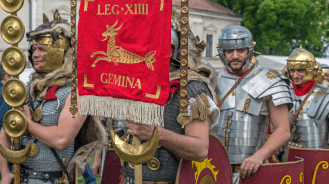
Shortly after negotiating what would turn out to be a temporary peace arrangement with Decebalus and the Dacians, Domitian’s armies in Germania Superior at Mogontiacum (Mainz) rebelled. Under L. Antoninus Saturninus, two legions (XIV Gemina and XXI Rapax) revolted for reasons that are largely obscured and lost to history (thanks to the later destruction of Saturninus personal documents), but the assumption has long stood that it was merely a local military revolt and not a wide spread conspiracy against the emperor...