

Titus (39 - 81 AD)
Emperor: 79 - 81 AD
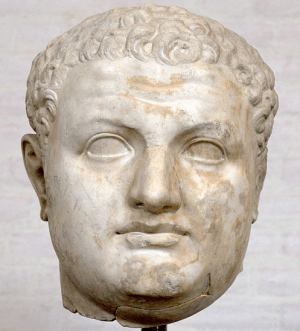
Following up on the success of Vespasian would be no easy task, and while ancient accounts of Titus are somewhat mixed, he - for the most part - was remembered with the highest praise.
Perhaps his short yet stable reign after his father, followed by the terrifying reign of Domitian, left people with a certain feeling of regret and nostalgia for the 'better' son.
Titus Flavius Vespasianus, the same namesake as his father, was born 30 December 39 AD in Rome under relatively modest circumstances (his mother, Domitilla, was of moderate station, being the daughter of a treasury clerk). While Vespasian became entrenched with the emperor Claudius, Titus too helped nurture the relationship. He developed a close friendship with Claudius' son, Britannicus, that would last until Britannicus' death/murder in 55 AD.
The rise of Nero would force the Vespasianus family to distance themselves from the Claudian faction, but Britannicus' memory was preserved, through Titus, years later in statues erected in his honor.
It is ironic that, had Britannicus lived and ascended to the 'throne' instead of Nero, Vespasian and Titus themselves may never have done so. However, they certainly would have continued on a prominent path in the Roman political and social order.
The early stages of the future emperor's career are rather murky, but he did serve in the early 60s AD in both Germania and Britannia (two provinces in which Vespasian had also served).
Cassius Dio tells us of Titus' valor in saving Vespasian's life while in Britain, but this seems an unlikely bit of propaganda. It does, however, help to illustrate the general level of fondness that both historian and citizenry seemingly held for Titus.
By the mid 60s AD, Titus was back in Rome, certainly advancing his career in the typical methods for a young Roman politician.
After a brief marriage to Arrecina Tertulla (who died shortly after), Titus married a noblewoman of prestigious lineage, Marcia Furnilla. Once again this marriage would be short-lived (her family's disfavor with Nero forced an early divorce), and Titus would never remarry.
In fact, tales of his debauchery would later feed fears of a second Neronian-type reign, but whatever his failings in that department, such escapades did not seem to persist once he rose to the highest prominence.
The year 66 AD introduced the stroke of fate that would eventually launch the Flavians to full imperial authority. Despite some personal animosity between Nero and Vespasian, Nero recognized Vespasian's pure military ability and appointed him to Judaea, where the Jews had been rioting in Cesarea and Jersusalem.
Accompanied by Titus (while the younger son, Domitian, remained in Rome), Vespasian performed as suspected, systematically reducing Jewish resistance. Titus was given command of Legio XV Appolinaris, and performed with competence.
Josephus, the Jewish historian who provides the greatest account of the wars, would later become a member of Vespasian's court and was decidedly pro-Flavian in his works. His praise of both father and son must be taken with 'a grain of salt', but does not alter the history of events or the final results.
The Jewish Wars
At the end of the 'Year of the Four Emperors' in which Vespasian ultimately seized final authority, Titus was left with the obligation of completing his father's prior task. Originally authorized by Nero to subdue the Jews, several years of internal political strife and civil war limited Vespasian's attention to that cause. With his rise and subsequent cessation of civil hostilities, the Roman armies in the east were free to focus on their goal.
Though previously Titus' role in putting down the revolt was mostly non-descript, such as capturing relatively unfortified towns, his obvious position as Vespasian's heir catapulted him into supreme command. Within short order he proved himself to be worthy of the promotion, at least from the Roman perspective.
Though his tactics would prove to be brutal, and some of his behavior frighteningly reminiscent of Nero's tumultuous reign, the Jews would quickly find themselves completely overwhelmed and outmatched.
After Vespasian left for Egypt, on his way to claiming the throne in Rome, Titus continued with the task of subduing Jewish resistance. While the countryside was mostly subdued without much difficulty (as most Jewish towns lacked walls and fortifications), Jerusalem was an entirely different matter.
Deeply embroiled in political, social and class disorder, Jewish zealots associated Roman rule with the elite Jewish aristocracy who failed to understand the concerns of the common people, and the city itself was a battleground before Titus even arrived.
Josephus, who largely praises his benefactors (Vespasian and Titus) in their conduct of the war, pins the blame of Jerusalem's ultimate capture solely on these zealots for breaking the peace and inviting a harsh response.
When Titus arrived, he found a city strategically positioned upon two hills and surrounded by three sets of walls. With four legions, he set about laying siege, and prepared for a decisive final battle.
While Titus proved himself an able military commander, using known siege techniques and strategies and applying them with success, he did little else to merit great praise. Despite the compliments of Josephus, the siege of Jerusalem was largely a learning experience for the future emperor, and his energetic leadership was marred only by bouts of inexperience.
Even so, in the spring of 70 AD, the Romans had breached the city's outer defenses within a span of four weeks. All that remained of resistance were those who had holed up within the Temple of Jerusalem, which occupied the center of the city.
Titus wisely ordered a circumvallation of the Temple to starve out and weaken those who remained. By the end of summer, after a few more grueling months, the Romans managed to breach the Temple's outer wall. In the assaults that followed, all resistance was slaughtered and the Temple itself (the center of the Jewish faith) was burned to the ground.
All that remained after Titus' brutal final victory was the single western wall, now known as the 'Wailing Wall', which is regarded as the holiest of places and where modern Jews both mourn the loss of the Temple and gather for prayer.
As a final insult to those who resisted Roman power, sacrifices to the pagan gods were made in the ruins of the Temple court as proof of Roman religious supremacy.
With the destruction of the Temple and the Jewish war behind him, Titus set about validating and securing his father's newly won throne in the eastern provinces by parading his legions and Jewish captives throughout the region.
While doing so, Titus developed a reputation for brutality (throwing prisoners to beasts and forcing them to fight in gladiatorial style) that led to comparisons with Nero. However, Titus' displays proved to be completely tactical in nature and, once the point was made, he seems to have discontinued such practices.
Other fears of Titus surfaced when he developed a relationship with the Jewish princess Berenice. The sister (or perhaps daughter) of King Herod Agrippa II was strongly allied to the Roman court, and she was deeply knowledgeable in eastern politics. On the surface, she seemed an excellent match for the future emperor, but her status as part of a foreign royal family harkened to the days of Antony and Cleopatra.
Despite having come to Rome with Titus in 75 AD, the general unpopularity of such a relationship forced Titus to eventually dismiss her when he came to power. The interesting point to be found here is that the general Roman population still did not view their own 'Emperor' as a king in the way foreign monarchs were.
The Princeps, even though it functioned with supreme power, still ruled under the guise of a Republican constitution, complete with such offices as Consul and Tribune of the Plebs. Titus himself held the Consulship eight times, indicating its importance at least from the perspective of public perception.
Upon completion of the Jewish Wars and his eventual return to Rome, Titus was groomed as Vespasian's obvious successor, and undertook important administrative tasks. In 71 AD, he celebrated a joint triumph with his father in celebration of the Jewish victory.
He was made joint Censor (responsible for the Census and maintaining the roles of the Senate and the Equite class), and in 72 AD took over the ultimate position of trust, the Praetorian Prefect. Within this role, Titus proved his loyalty beyond a shadow of a doubt (there was suspicion that he might try to hurry along his own accession), and took care of much of his father's 'dirty work'.
He knew also that his role as heir was secure, with Vespasian once commenting that 'either my son shall be my successor, or no one at all.' In June of 79 AD, that prophecy was realized and, upon Vespasian's death, Titus was immediately confirmed as the new Roman emperor.
The Destruction of Pompeii and Herculaneum
While Titus ascended to the Imperial purple without incident, his work was cut out for him to legitimize the Flavian dynasty. Despite Vespasian's 10 year prosperous and stabilizing reign, the Roman Senate still resisted granting him deification. Because he was not a Julio-Claudian, his deification would require the creation of a new cult and temple, measures which were surely unpopular.
Titus spent the first months of his reign issuing coinage and other propaganda tying both him and his father to the Julio-Claudians. While it was a lengthy process, the Senate finally relented, and Vespasian was deified some six months after his death.
Titus started the temple in his honor (that would eventually be finished by Domitian) that came to be known as the Temple of Vespasian and Domitian. The new emperor also completed the Colosseum and held festivals of 100 days to celebrate its opening. Other building projects, such as imperial baths, intensive road building and the Arch of Titus (for his victory in Judaea) helped to legitimize his reign.
Another important event during the reign of Titus was his handling of the eruption of Mt. Vesuvius. Though the Jews claimed that the disaster that struck was God's vengeance against Rome, Titus' speedy and exhaustive efforts at relief likely went a long way towards winning him a permanent place in the hearts of the people.
In the morning to early afternoon of 24 August 79 AD, just two months after Titus took over from his father, the eruptions of Vesuvius began and would extend for several days. To read more about the eruption of Mt Vesuvius and the destruction of Pompeii, please click here.
Titus' Reign
After the disaster of Vesuvius and the Bay of Naples, Titus reacted quickly, visiting the area in person and confiscating properties of heirless victims for distribution to the disenfranchised. Survivors were relocated and a special Senatorial commission was arranged to provide whatever assistance they could.
Unfortunately, despite Titus' relatively short reign, this was not to be the only disaster he faced. While in Campania, a destructive fire broke out in Rome and burned for three days, devastating the poorer quarters. Again, Titus responded quickly, dipping deep into the treasury to provide relief and assistance to the victims.
Certainly, considering the amount of money that was spent on relief efforts and on public works such as the Colosseum and the accompanying 100 days of games, Titus very well may have dipped into his personal fortune to ensure a solid financial footing for the empire.
Even with these expenditures, Titus (according to Cassius Dio), proved to be fiscally sound, "In money matters, Titus was frugal and made no unnecessary expenditure" and left the treasury in much the same state as he found it, with a healthy surplus.
In addition to these two natural disasters, the empire also faced a devastating plague at about the same time. According to Suetonius:
"For curing the plague and diminishing the force of the epidemic there was no aid, human or divine, which he (Titus) did not employ, searching for every kind of sacrifice and all kinds of medicines."
While one might think that the superstitious Romans would view the reign of Titus as a cursed abomination facing the punishment of the gods, his swift responses and deliberate actions seem to have endeared him to the people. Perhaps people simply lamented the reign of Domitian and wished for a return of Titus, sparking a nostalgic memory of him, or his reign was just too short to develop any particular negative attributes. Regardless, he was remembered with a sincere admiration.
Whatever reasons for Titus' seemingly popular status among the masses (the Colosseum and disaster relief) and the ancient historians (a far better alternative to Domitian), his reign was cut tragically short.
While it was the charisma of Vespasian that ended the civil war following Nero's death, it was Titus who continued the policies that strengthened the legions and the provinces, while legitimizing an alternative rulling order in a post Julio-Claudian Roman world.
Additionally, the reign of Titus and his untimely early death, followed by the unpopular reign of his brother, led the Roman emperors that followed into a path of chosen selective and adoptive succession, rather than dynastic rule.
The so-called '5 Good Emperors' must certainly be given credit for their own actions, but understanding the contributions of the transitional period of Vespasian and Titus is crucial to understanding the development of the following period.
Unfortunately for those who suffered under Domitian, but fortunately for the resulting reigns of Nerva, Trajan, Hadrian, Antoninus Pius and Marcus Aurelius, the reign of Titus lasted only a short 26 months.
During this time he fought varying illnesses and, according to the descriptions of Suetonius, faced several bouts of depression. Considering the pressures of the positions, coupled with the disasters that accompanied it, his health concerns are not surprising.
In the end, repeated treatments of cold baths (alleviation of fever) indicate the possibility that it was simple influenza or even a brain tumor (which may cause related symptoms) that ended his life prematurely. At the age of 41, on 13 September 81 AD, Titus passed (without a child heir) and left the mantle of government to his brother, Domitian.
Despite rumors of Domitian's actual involvement in Titus' death (poisoned fish according to Suetonius), logical observation does not support foul play. Although it is quite possible that reports of the brother's dislike of one another is entirely true, Domitian did have his brother promptly deified, and finished the yet uncompleted Arch of Titus in his honor.
Did you know...
The Baths of Titus, built between 79 and 81 AD (and completed at roughly the same time as the Colosseum) were relatively small but important, in that they were built on the site of Nero's Golden Palace, helping to eradicate his memory.
Did you know...
Emperor Titus apparently planned to marry Berenice, but the Romans' great dislike of the Jews forced him to withdraw. Titus' dilemma is the subject of Racine's play, Bérénice.
Did you know...
Terentius Maximus was a Roman also known as the False Nero who rebelled during the reign of Titus, but was suppressed. He resembled Nero in appearance and in action, as he was known to perform singing with the accompaniment of the lyre.