

Introduction
The Roman Empire consisted of a number of geographic territories known as provinces, each of which was governed by a provincial governor.
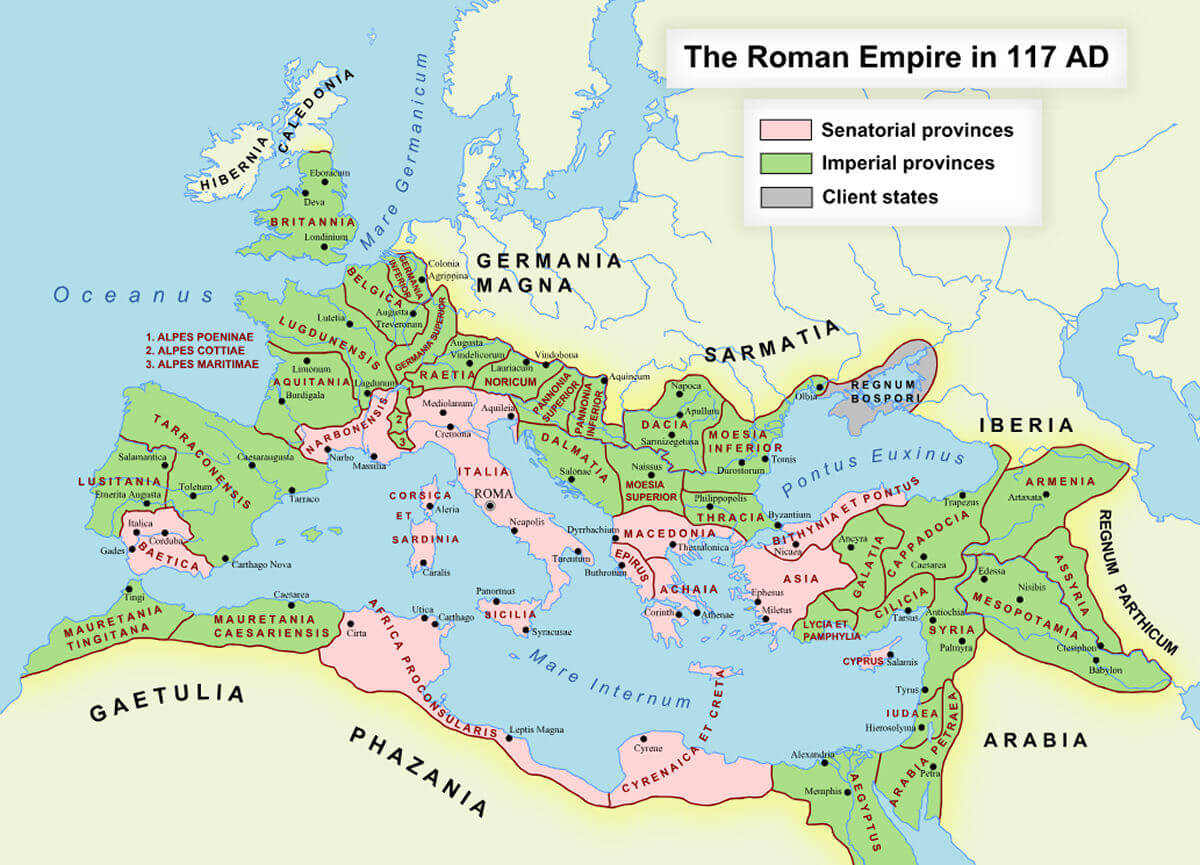
The provinces of the Roman Empire in 117 AD
Imperial Provinces Governed by Senators
The Emperor was the Proconsul of all provinces with any significant military force, with the exceptions of North Africa and Aegyptus. In the year 180 AD, there appears to have been 28 Imperial provinces.
Those provinces with at least one legion stationed in them had a Senatorial governor called a Legatus Propraetore Augusti (an Imperial Legate of Praetorian rank). The Imperial governors were technically below the level of a Senatorial Proconsul and had five Lictors instead of six.
This formal distinction had no real significance since the Legate was the representative of the governor, but officially they were lower in rank because they were subordinates of the Emperor, who was, theoretically, the actual governor.
In provinces with one legion, the Legate in charge of the province (normally of Praetorian rank) also controlled the legion himself. In provinces with more than one legion, like Germania, Syria and Cappadocia, each legion was commanded by its own Legate of Praetorian rank, while the province as a whole was commanded by a Legate of Consular rank who could dictate general control over the entire army stationed there.
These governorships were completely at the whim of the Emperor, and could serve anywhere from 1 to 5 years.
Imperial Provinces Governed by Equestrians
The Emperor also had under his control a number of smaller, but still potentially difficult, provinces that did not need an entire legion. These provinces were put under the control of governors of Equestrian status.
During the early Imperial period their title was Praefectus like that of the governor of Egypt, but later the title became Procurator. New conquests generally fell into this Equestrian category, but most were later changed in status to reflect varying conditions in Roman control.
Like the other Imperial provinces, the governors could serve any length of time up to 5 years or longer.
Much like the Senatorial province of Africa, the Equestrian province of Aegyptus was an exception to the rule of legions stationed only in Imperial provinces. Egypt was not a normal province like any other. It was considered the personal possession of the Emperor and its governor, the Praefectus Aegytpi, which was considered the highest ranking Equestrian post during the early Imperial period.
Later, the post would fall second to that of the Praetorian command, but its position was still very prestigious.
Duties of the Governor
The governor of any Roman province had four major tasks. First, he was responsible for taxes and financial concerns. As the Emperor's personal, or the Senate's financial, agent he had to supervise the local authorities and the private tax collectors. A governor could mint coins and negotiate with wealthy institutions like temples and money-lenders that could advance the money.
The second task was that of the chief accountant. He inspected the books of major cities and various operations, and supervised large-scale building projects.
Aside from these financial duties, the governor was also the province's supreme judge. The governor had the sole right to inflict the death penalty, and capital cases were normally tried before him. An appeal was not impossible, but getting to Rome and an audience with the Emperor was expensive. An appeal was unlikely to change matters anyway, as a Governor wouldn't generally take the chance of convicting someone in the first place who the Emperor would not like to be convicted. The governor was also supposed to travel through the main districts of his province to administer justice in the major towns.
Finally, as previously alluded to, he commanded an army. In the more important provinces, this could consist of legions; but elsewhere, there were only auxiliaries. As a part of his standing orders, the governor had the authority to use his legion to stamp out organized brigands in the area without the need for Imperial approval.
Every governor had at his disposal a various number of advisers and staff, who were known as his Comites ("companions"), the number of which depended on his social standing and rank. Military Legates relied heavily upon their Tribunus Augusticlavii, and others could have Senatorial Quaestors or non-magistrate Procurators.
Did you know...
During the Roman Republic, tax revenue collection was left to "publicani", so called because they won by highest bid the contract to collect the revenues. It was the governor's responsibility to keep the publicani within the bounds of the "lex provinciae", so that they did not exploit the helpless provincials too mercilessly.