

By 3000 BC, civilization on the Aegean peninsula had advanced to an extremely high level in comparison to other western cultures. The Bronze Age people were divided into two easily identifiable cultures, the Cretan or Minoan on the Island of Crete, and Helladic or Mycenaean which developed on the mainland continent. Cretan culture and trade maintained early superiority in the Mediterranean until around 1500 BC, when this eventually began to shift to the Mycenaeans.
A series of tribal invasions by from the north in the late 3rd millenium BC began to alter the landscape of what would eventually become Greece. The most prominent of the invaders were known as the Achaeans (from where Achaea/Graecia/Greece takes its name), and they established their dominance of the Peloponnesus. Additional invaders included the Ionians who settled near Attica and mixed with the local Mycenean population, and the Aeolians who settled near Thessaly.
The mainland Achaeans began to dominate the region and by around 1500 BC they absorbed the civilization of Crete. However, the Dorians who resided in the mountainous regions of Epirus (modern Albania) slowly began to push south using advanced military technology (primarily iron weapons). These invading Dorians defeated the Achaeans and settled with and around their conquered subjects principally in such places as Sparta and Corinth. It is quite possible that The Trojan War preserved in literary history by Homer in the Iliad was partly as a result of the Dorian conquests.
The Dorians, though advanced in military means bringing with them the iron age were more primitive from a social and cultural perspective than the tribes they conquered thereby ushering in what could be labelled as a sort of Greek Dark Age. As a result of the political chaos that ensued individual cities began to establish their own methods of control and the city-state or polis concept was born. Perhaps as a precursor of much later feudal Europe, the ancient people located as near to these fortified towns (Acropolis) as possible. Athens which had been the center of the now evolving Mycenaean culture quickly established itself as a leader among the city-states.
At the conclusion of this migratory turmoil in the Aegean, the Greek people began to develop an awareness of their cultural superiority. Though still fractured by political rivalry and allegience to various city-states, they would eventually come to be collectively known as Hellenes (from the name of a small tribe in the region). Although these small Hellenic states maintained independence from one another and in fact engaged in wars of their own, they developed politically along a similar path. The local monarchies were slowly supplanted and replaced, between 800 and 650 BC, by oligarchies. These aristocratic ruling factions were rather short lived and were subsequently replaced by dissatisfied noble rivals and common people of wealth who were called tyrants. Ironically, this age of the Greek tyrants (about 650 to 500 BC) was one of great advances made in Hellenic civilization. Unlike the English connotations for the word tyrant, the title of tyrant in its Greek context meant that power was simply seized by unlawful measures, rather than that it was an abusive or oppressive dictator or monarchy. Many pf the leaders in this era were both very popular and beneficial to the development of Greek civilization as a whole.
Between the 8th and 6th centuries BC, Athens and Sparta emerged as the two dominant cities of Greece. Each developed and dominated its own league of neighboring cities. Sparta was a militarized state and established its status mainly by conquest keeping it's subject cities on a short political leash. Athens on the other hand accomplished the same goal of unification via diplomacy accomplished as a large part via citizenship inclusion. The Kingdom of Athens was abolished in 683 BC by its oligarchic nobility, known as the Eupatridae, who governed Athens for little more than a century. This government gradually evolved into that of an elected government and by 502 BC Athens was governed through a democratic constitution. The beginning of democratic rule ushered in the of the greatest period of Athenian history, called the Golden Age of Greece. Agricultural development and trade grew exponentially and the center of ancient art and education migrated from Asia Minor to Athens.
In the mid 6th century BC, Greek colonies and coastal islands in Asia Minor were conquered by the Persians. In 499 BC, the city of Ionia was assisted by Athens and Eretria and revolted against this Persia rule. The rebels had some early success but were eventually eliminated by King Darius I in 493 BC. A year later Darius' son-in-law Mardonius led an enormous Persian fleet to punish Greek interference in Persia's affairs, but most of the ships were wrecked en route. Undaunted, Darius sent ambassadors to Greece, requiring submissive tribute from all the Greek city-states but Sparta and Athens refused killing the Persians in defiance. Darius prepared a second invasionary force in 490 BC and after besieging and destroying Eretria resistance the Persian army marched towards Athens. Led by Militiades, an Athenian army that was one-third the size of its enemy repulsed the invaders in an overwhelming victory.
Again not to be denied, Darius immediately began preparation a third expedition. His son, Xerxes I, who succeeded his father in 486 BC, formed one of the largest armies in ancient history and by 481 BC the Persians crossed the Hellespont and marched south into the Greek mainland once again. The Persians first met resistance in 480 at Thermopylae, where Leonidas I of Sparta and several thousand warriors valiantly defended the narrow pass which provided a stalwart position to rebutt the massive invasionary force. The defection of a local shepherd and his knowledge of hidden passes in the mountains gave the Persians access to the rear of the Spartan position and aware of his eventual destruction Leonidas ordered the bulk of his own force to withdraw. He and a force of 300 Spartans remained to cover the withdrawal and to resist the Persian advance to the very end. After a gallant effort the Greeks (outnumbered by the Persian army of over 2 million) were finally defeated but the cost to the invaders in numbers and moral was immense. The victorious Persians continued to Athens where they sacked the city. The Persian fleet meanwhile pursued a Greek fleet to the island of Salamis where the tide was turned in favor of the Greeks. Fewer than 400 Greek ships, under the Athenian admiral Themistocles, defeated 1200 Persian vessels and the Persian King Xerxes, who had watched the battle from a golden throne on a hill overlooking the harbor withdrew to Asia. A year later 479 BC, the remaining Persian forces in Greece were defeated at Plataea, and Greece was free from foreign dominance.
In light of its great naval victory, Athens developed a fleet that gave the city the same military dominance at sea that the Spartans enjoyed on land. Athens, with the ability to strike swiftly by sea, began to exert control over the other city-states in a military fashion similar to its Spartan rivals. The Athenians began to demand heavy tributes from these new conquests and their formerlly allied cities. The city-state of Naxos attempted to withdraw from the alliance of cities formed against the Persians, called the Delian League the city was destroyed in retribution.
Since the mid 6th century BC (550) the Peloponnesian League had been formed under the supremacy of Sparta as a rival to Athens. In 431 BC as Athenian power and influence grew and Athens had assisted the city of Corcyra in a war against the Spartan ally of Corinth, the a great war between the two Greek rivals was begun. The Peloponnesian War was the struggle between those two city states that had dominated Greek politics for several centuries. It lasted until 404 BC and resulted in eventual Spartan supremacy over its rivals. Upon its victory, Sparta formed an oligarchic government known as the Thirty Tyrants to rule Athens and similar forms of oppressive governments were formed in the city states throughout the region. Despite previous Athenian aggression and domination of its neighbors, Spartan rule soon proved itself to be a far less welcome alternative. Three decades later, in 403 BC, the Athenians under Thrasybulus revolted and defeated the garrison that had supported the Spartan developed oligarchy restoring independent rule to Athens. In light of the success of Athens in throwing off the Spartan yoke, many other cities attempted the same, resulting in a state of perpetual resitance to Spartan rule over the next few years.
Despite this, Sparta maintained control and the Greek cities sought help from their traditional enemy in Persia. As a result, in 399 BC, the interference of Persians in the affairs of cities on the Asia Minor coast led to the arrival of a Spartan army. Though this army was successful against Persian defenders it was unable to complete its tasks due to new revolts closer to home in Greece. The army was withdrawn from Asia Minor in 395 BC to put down a coalition of Argos, Athens, Corinth and Thebes who collectively had developed enough power to give the Spartans cause for concern. However, the Corinthian War only developed into several small conflicts that lasted for the better part of the next decade. In 387 BC Sparta grew weary of the conflict and allied with Persia to establish some sense of control. Together Sparta and Persia concluded the Peace of Antalcidas (or the King's Peace from the Persian perspective)which allowed autonomous city-state rule in Greece and allowed the Persians to take control of the Asia Minor coastal cities. By the terms of the Persian-Spartan settlement, the entire west coast of Asia Minor was ceded to Persia, and the city-states of Greece were made autonomous. Despite this agreement, in 382 BC Sparta invaded Thebes and captured the city of Olynthus. The Theban general Pelopidas who was not surprisingly supported by the Spartan rival of Athens, led a revolt in 379 that forced the Spartan occupiers to withdraw. War between Sparta and Athens in alliance was renewed eventually ending at Leuctra in 371 BC. Thebes so completely dominated the war that Spartan domination in the area was brought to an end. As a result of its victory over Sparta, a third regional power emerged and Thebes grew into the leading Greek city-state of the time. The other cities seemed to resent this change in the status quo and resisted their new found power. Athens, the ally who helped Thebes achieve its supremacy, refused entirely to recognize Theban authority and eventually even became an ally of Sparta in 369 BC. Unfortunately for Thebes its position in Peloponnesian affairs was dependent upon the authority of Epaminondas himself. When he was killed in the Battle of Mantinea in 362 BC Thebes reverted to its former position as one city among many.
During this period of military and political turmoil in Greece, Macedonia, Greece's decidedly contemptible northern neighbors, took advantage and expanded its own territories. By 359 BC King Philip II annexed Greek colonies on the coast of Macedonia and Thrace and moved his borders to the south. Within two decades, by 338 BC, Philip and Macedonia were established as the political and military authority. A year later in 337 BC Philip declared war on Persia, reigniting old rivalries but was assassinated before an invasion could be mounted. His death gave rise to his son, Alexander, soon to be called "the Great."
Establishing his authority in the wake of his father's death by 334 BC Alexander led the invasion of Persia that had been planned by Philip. Over the course of the next 10 years his conquests extended Greek (Hellenistic) influence, civilization and language throughout a Macedonian empire. This empire extended as far east as India and as far south as Egypt and throughout the entire Greek world. By the time of Alexander's death in 323 BC and in association with centuries of continued Hellenistic successor Kingdoms, Greek culture had been and would continue to spread and take hold throughout the eastern world.
Following the death of Alexander his empire collapsed as an entity controlled by a single authority, and his Macedonian generals began to partition its pieces among themselves. Political rivalries and attempts for complete domination resulting from these divisions not only led to reoccuring wars between such states as Seleucia, Ptolemaic Egypt and Macedonia, but resulted in a debilitating series of civil wars in Greece. By 290 BC, the north central Greek cities formed the Aetolian league and Peloponnesian cities formed the Achaean League shortly thereafter. Both alliances were established as a counter to Macedonian domination, but inevitable rivalries destabilized the effectiveness of the leagues. This political instability and near constant state of war predictably weakened Greek power at just the time that a new power Rome, was rising to the west.
By 215 BC Rome began to take an active interest in the Greek political situation. Philip V of Macedonia allied himself with Carthage against Rome during the Punic wars not only as an opportunity to expand his own borders but as a counter to Roman influence. However, the Romans along with the support of the Aetolian League who had resented the domination of Philip, overcame the Macedonian forces in 206 BC and established a permanent presence in Greece. A short time after, Scipio Africanus defeated Hannibal at Zama effectively ending the Second Punic War, Rome, this time with the support of both the Aetolian and Achaean city state leagues, defeated Philip in 197 BC. Macedonia was completely defeated and brought under precarious Roman authority in agreement for peace, and the independence of Greece from Macedonia was secured. Unfortunately for the Greek states, however, they soon found that they had exchanged one master for another. In one last desperate attempt to free themselves in 149 BC, the members of the Achaean League resisted tribute demands from Rome. In response, the Romans, under Lucius Mummius led legions into Greece and destroyed Corinth in 146 BC. As a result the city leagues were abolished and Greece passed completely into the power of Rome, which united Macedonia and Greece into a single Roman province.
For some six decades after Roman control was established, Greece was effectively governed by their western neighbors. Some cities, such as Athens and Sparta, even retained a semblence of freedom. However, by 88 BC the ROman civil wars between Marius, Sulla and Cinna and the rise of Mithridates VI Eupator, king of Pontus in the east would shake the established order of the east. Mithridates invaded Roman controlled territories with the support of many of the Greek cities who, much like previous reactions under Macedonian rule, had grown tired of Roman authority. Roman legions under Lucius Cornelius Sulla forced Mithridates out of Greece and Asia Minor crushing the rebellion of Greek city states in the process. Athens was sacked in 86 BC and Thebes suffered the same fate a year later. Roman retribution against all the rebellious cities was destructive and overwhelming. The campaigns in Greece by Sulla and his lieutenants left much of Greece in utter ruin. As a result, the economic and military capacity of the collective city states virtually disentegrated. Athens did remain a center of philosophy and learning and would continue to be a destination for Roman aristocrats for centuries to come, but commercial capacity and political influence were reduced to nonexistence.
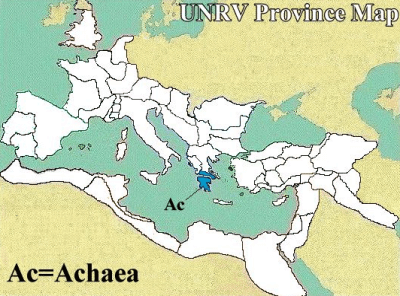
After the defeat of Antonius and Cleopatra, the first Roman Emperor Augustus in massive reforms of Roman government separated Greece from Macedonia and established Achaea as its own administrative province in about 22 BC. Over the next century and a half the ancient glory of Greece would be slowly rebuilt, culminating during the reign of Hadrian between 117 and 138 AD. Along with the Greek scholar Herodes Atticus, a great patron of the arts and Greek culture the emperor Hadrian undertook an extensive rebuilding program. He beautified Athens, which included the temple of Zeus and the great ivory and gold statue of the leading Olympian god, and restored many of the ruined Greek cities to their original lustre. Greece not only stood as a cultural icon of ancient times, but provided that culture as a deeply rooted foundation of the later eastern empire and the Byzantines. It remained a part of the Roman or Byzantine Empires until the 11th century AD.
The Greeks had a fairly complex system of trade and commerce in place throughout most of their civilization. Many raw materials, like copper, lead and iron were available in Achaea, though the mining of these metals was overshadowed by other provinces, like Hispania, Britannia, Noricum, etc. Of agricultural items, major imports included olives, along with olive oil, wine and honey.
Nearly any household luxury item was produced in Greece. Precious oils, powders, perfumes, cosmetics, linens, pottery, paints, furniture and many other goods were all manufactured in Greek factories and workshops. Artisans and craftspeople of all kinds labored in Greek cities. Doctors, philosophers and educators in Roman society were also very often of Greek origin. Marble was also found in Greece and was exported for building projects. Sculpture and other works of art were also highly sought after by wealthy people all over the Roman world.
Did you know...
Achaea was the region in southern Thessaly and the northern coast of the Peloponnesus.
Did you know...
The Regions of Ancient Greece were areas identified by the Ancient Greeks as geographical sub-divisions of the Hellenic world. These regions are identified in the works of ancient historians, geographers and in the legends and myths of the Ancient Greeks.
Did you know...
Those who marched against Troy were called Achaeans. The Achaeans came originally from Thessaly, in mainland Greece, and settled in Argos and Lacedaemon (southern Peloponnesus). In the 13th century the Principality of Achaea was founded in Greece after the Fourth Crusade.
