

For more than five centuries, Rome maintained standing armies scattered across three continents. Legions guarded the Rhine and Danube, garrisoned Britain, marched through deserts in Syria, and campaigned in the mountains of Spain and Armenia.
Supplying these forces was not a side concern or an afterthought - it was one of the central pillars of Roman power. Conquest was only possible because Rome developed systems capable of feeding, paying, equipping, and replacing hundreds of thousands of soldiers over enormous distances.
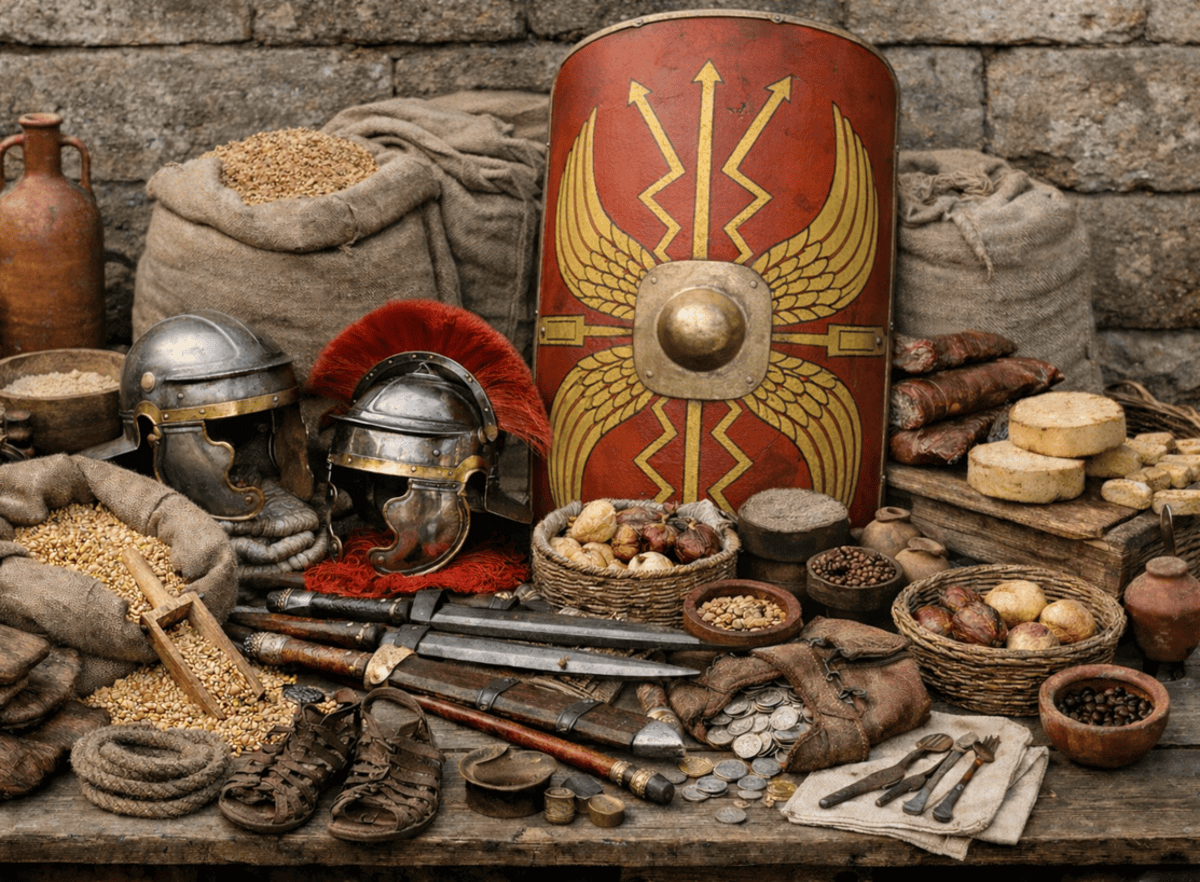
Roman military success is often explained in terms of discipline, tactics, and engineering skill (Related Page: Engineering Marvels of the Roman Army). All of that mattered, but behind every victory stood a vast logistical machine. Armies that cannot eat, march, or receive pay do not fight for long, no matter how brave or well-trained they are. Rome understood this earlier and more thoroughly than any ancient state before it.
The Scale of the Challenge
At its height in the second century AD, the Roman army consisted of roughly 25–30 legions, supported by a similar or larger number of auxiliary troops. This meant somewhere between 300,000 and 450,000 men under arms at any given time.
These soldiers were not concentrated in one place. Instead, they were distributed along vast frontiers, stationed in permanent forts, temporary marching camps, and provincial capitals.
Each soldier required:
- A daily food ration (primarily grain)
- Clothing and footwear
- Weapons and armor
- Pay in coin
- Replacement equipment
- Animals for transport and cavalry
- Medical supplies and tools
Supplying even a single legion of around 5,000 men was a major undertaking. Supplying dozens of legions simultaneously, year after year, demanded organization on a scale unmatched in the ancient world. This logistical system had to cover not only food, weapons, clothing and transport animals, but also the bandages, surgical instruments, medicines and hospital stores needed for treating wounded soldiers in the Roman army.
Standard Rations and Military Diet
Grain as the Foundation
The Roman military diet was based primarily on grain (frumentum), most commonly wheat, which formed the caloric foundation of a soldier's rations. A legionary typically received a regular grain allowance, often reconstructed by modern scholars as around 30–35 kilograms per month, though exact quantities could vary by period, region, and operational circumstances.
This grain was normally issued unprocessed rather than as baked bread. Soldiers ground it themselves using hand mills and prepared it either as bread or as porridge (puls). Food preparation was organized at the level of the contubernium (the basic eight-man tent group) whose members shared cooking equipment and divided food-related tasks. Rather than each soldier baking individually, one or two men within the group typically undertook grinding and baking for the whole unit.
Issuing grain instead of bread reduced spoilage, simplified transport, and allowed rations to be stored safely for long periods in military granaries (horrea). Grain was calorie-dense, relatively durable when kept dry, and familiar across much of the Mediterranean world. It was also well suited to Rome's fiscal and logistical systems, as it could be easily taxed, stored, and redistributed at scale—making it an ideal staple for sustaining armies across a vast empire. For a closer look at the regular food allowances and practical ration system behind this process, see our page on the rations issued to Roman soldiers. For a fuller look at the actual meals behind these supply systems, including bread, porridge, meat, cheese, wine, vinegar drinks and local foods, see our article on what Roman soldiers ate.
Supplementary Foods
While grain formed the core of the ration, it was supplemented with:
- Olive oil
- Wine or vinegar (posca)
- Salt
- Meat (fresh or salted)
- Cheese
- Vegetables and legumes when available
Meat was not necessarily a daily ration but appeared regularly, especially in frontier zones with good grazing land. Hunting and local purchases also supplemented official supplies.
Permanent Forts and Supply Depots
Forts as Logistical Hubs
Roman forts were not just defensive structures; they were supply centers. Permanent forts along the frontiers contained:
- Granaries
- Armories
- Workshops
- Storehouses for equipment and clothing
Granaries were carefully designed with raised floors, ventilation, and thick walls to keep grain dry and safe from pests. Archaeological remains from Britain, Germany, and the Danube region show just how standardized and carefully planned these buildings were. Alongside these storage buildings stood the barrack blocks where soldiers slept, cooked, stored equipment, and lived in their contubernium groups, a subject explored further in our article on the living quarters inside a Roman fort.
Centralized Storage and Redistribution
Supplies were often stockpiled during peacetime or favorable seasons. From these depots, food and equipment could be redistributed to marching units or forward camps during campaigns. This allowed Rome to absorb shocks such as poor harvests, disrupted trade, or sudden military emergencies.
Roads, Rivers, and Sea Lanes
Roman Roads and Overland Transport
Roman roads are justly famous, and their military purpose cannot be overstated. Built to standardized widths and gradients, these roads allowed wagons, pack animals, and marching troops to move quickly and predictably.
Overland transport was expensive and slow compared to water transport, but roads were essential for:
- Moving supplies between inland forts
- Reaching mountainous or landlocked regions
- Maintaining year-round access where rivers froze or flooded
Supply wagons were often drawn by oxen or mules, and distances were carefully planned around daily marching limits.
Rivers as Logistical Arteries
Wherever possible, Rome relied on rivers. The Rhine, Danube, Rhône, Po, and Nile functioned as natural highways. Transporting grain by boat was far more efficient than hauling it by cart.
Frontier zones were deliberately organized around rivers. Forts were positioned to take advantage of water transport, and fleets of military supply ships operated on major waterways.
The Role of the Mediterranean Sea
The Mediterranean was the backbone of imperial logistics. Grain from Egypt, North Africa, and Sicily fed not only the city of Rome but also armies across the empire. Coastal shipping allowed vast quantities of supplies to move relatively cheaply and safely.
The Roman navy, while not as celebrated as the legions, played a crucial role in protecting these sea lanes and ensuring that supplies arrived on time.
Provincial Taxation and Military Supply
Tax in Kind
One of Rome's great logistical strengths was its taxation system. Provinces were often required to pay part of their taxes in kind rather than in cash. This meant grain, livestock, textiles, and other goods could be redirected directly to military use.
Frontier provinces, in particular, were organized to support nearby garrisons. Local communities supplied food and materials, reducing the need to transport everything from Italy or distant regions.
Military Supply as an Economic System
The presence of a legion transformed local economies. Farmers produced surplus grain knowing there was a guaranteed buyer. Merchants followed the army, selling goods and services. Veterans settled nearby, further integrating military supply into provincial life.
In this way, Rome did not merely extract resources - it created regional supply networks tied directly to the army.
The Annona Militaris
State-Controlled Logistics
By the late Empire, military supply became increasingly centralized through a system known as the annona militaris. This was a state-controlled requisition system that collected food, animals, and equipment specifically for the army.
Rather than relying solely on market purchases, the state directly allocated resources to military units. This system ensured reliability, even during times of crisis or inflation.
Advantages and Tensions
The annona militaris allowed Rome to sustain large armies even when coinage was unstable. However, it could also place heavy burdens on local populations. Requisitions were sometimes unpopular and could provoke resistance if abused.
Despite these tensions, the system reflects Rome's recognition that military supply was too important to be left entirely to market forces.
Weapons, Armor, and Manufacturing
From Citizen Equipment to State Supply
In the early and middle Republic, Roman soldiers were citizen militiamen who were largely responsible for equipping themselves. Arms and armor were acquired privately and reflected a soldier's wealth, with heavier equipment reserved for those of higher property classes. Centralized state production was minimal, and standardization was limited.
As Rome expanded and warfare became more frequent and professionalized, this system evolved. By the late Republic and early Empire, the state increasingly assumed responsibility for equipping its armies, though production remained a mixture of private workshops and state oversight.
State and Private Production
Roman arms and armor were produced in both private workshops and, increasingly, in state-controlled facilities. By the late Empire, large imperial arms factories (fabricae) operated in key cities, producing standardized weapons and equipment for the army. This growing standardization simplified logistics, training, and resupply, ensuring that soldiers across the empire were equipped in broadly similar ways.
Repair, Maintenance, and Recycling
Rather than discarding worn equipment, Roman armies emphasized repair and reuse. Permanent forts contained workshops staffed by skilled soldiers and civilians, where weapons were reforged, armor repaired, and leather goods patched or replaced. Metal was routinely recycled, and damaged equipment was returned to service whenever possible (Related Page: "Recycling and Reuse in Ancient Rome").
This emphasis on maintenance significantly reduced the logistical burden of constant replacement and allowed Roman units to remain operational far from major manufacturing centers for extended periods.
Pay, Coinage, and the Soldier's Economy
Regular Pay as a Logistical Tool
Roman soldiers were paid regularly in coin. This was not just a matter of morale; it was a logistical strategy. Paid soldiers could purchase food and goods locally, supplementing official rations and supporting local economies.
Pay also encouraged loyalty and discipline. A well-paid army was less likely to mutiny and more willing to endure hardship (Related Page: Military Pay and Rewards in Ancient Rome).
Donatives and Bonuses
Emperors frequently issued donatives (cash bonuses) to secure loyalty, especially during accessions or crises. While expensive, these payments reinforced the bond between army and emperor and kept the military system functioning smoothly.
Campaign Logistics and Marching Armies
Temporary Camps
On campaign, Roman armies built fortified marching camps every night. These camps included designated areas for supplies, animals, and equipment. The practice allowed armies to operate safely in hostile territory and maintain orderly logistics.
Foraging and Requisition
During campaigns, armies supplemented their supplies through foraging and requisition. Roman commanders planned routes carefully to pass through fertile regions or friendly territory whenever possible.
However, Rome generally preferred planned supply lines over uncontrolled foraging, which could provoke local resistance and undermine long-term stability.
Flexibility Across Different Environments
Deserts, Mountains, and Forests
Rome fought in environments ranging from deserts to rain-soaked forests. Supply strategies adapted accordingly:
- In deserts, water storage and animal transport were critical.
- In mountainous regions, pack animals replaced wagons.
- In forested zones, local timber was used for construction and fuel.
This flexibility was one of Rome's greatest strengths. The army was not tied to a single logistical model, but could adapt to local conditions.
Logistics as a Strategic Advantage
Rome did not conquer and hold an empire through bravery alone. It did so by mastering the unglamorous but essential art of supply. Roads, rivers, granaries, taxation systems, pay structures, and administrative oversight formed the invisible framework that kept legions fed, equipped, and loyal.
Rome's enemies often matched its soldiers in courage and sometimes in tactical skill. What they could not match was Rome's ability to sustain long-term operations. Many opposing armies depended on seasonal campaigning and local foraging. Roman forces could remain in the field for years, supported by stable supply networks.
Wars were won not just on the battlefield but through endurance. Rome could absorb defeats, replace losses, and continue fighting. Logistics made that possible.
This logistical sophistication allowed Rome to project power across vast distances and sustain military dominance for centuries. Long after individual emperors rose and fell, the supply systems they inherited continued to function, holding the empire together.
In many ways, Rome's greatest military achievement was not a single battle or campaign, but the creation of a system that made all of those battles possible.
Recommended Book:
Related Pages:
- Roman Military Rations
- What Did Roman Soldiers Eat?
- A List of the Legions of the Roman Empire
- Inside a Roman Barracks

Frequently Asked Questions
What did Roman soldiers eat most often?
The core of a Roman soldier’s diet was grain, usually wheat, issued as unprocessed grain rather than baked bread. This was supplemented with olive oil, wine or vinegar (posca), salt, cheese, vegetables, and meat when available.
Did Roman soldiers bake their own bread?
Food preparation was typically organized at the level of the contubernium, the basic eight-man tent group. Rather than each soldier baking individually, the group shared cooking equipment and divided tasks, with one or two men grinding grain and preparing food for the group.
How were Roman armies supplied over long distances?
Rome relied on a combination of permanent supply depots, road networks, river transport, and maritime shipping. Rivers such as the Rhine and Danube and the Mediterranean Sea allowed bulk supplies to be moved far more efficiently than overland transport alone.
Did Roman provinces have to supply the army?
Yes. Provinces were often required to pay part of their taxes in kind, providing grain, livestock, textiles, and other goods. Frontier provinces in particular were structured to support nearby garrisons, integrating military supply into local economies.
What was the annona militaris?
The annona militaris was a late Roman system of state-controlled requisition that collected food, animals, and equipment specifically for the army. It allowed Rome to sustain large forces even during periods of economic instability.
Were Roman weapons and armor standardized?
Standardization increased over time. Early Republican soldiers equipped themselves privately, but by the Imperial period the state played a major role in supplying arms. By the late Empire, large state-run factories produced standardized equipment, simplifying logistics and maintenance.
How did Roman armies remain supplied during campaigns?
On campaign, Roman armies relied on a combination of pre-stocked supplies, supply convoys, and controlled requisition. Commanders planned routes carefully to ensure access to food and transport, avoiding reliance on uncontrolled foraging whenever possible.

Legions of Rome: The Definitive History of Every Imperial Roman Legion
by Stephen Dando-Collins
Featuring more than 150 maps, photographs, diagrams and battle plans, Legions of Rome is an essential read for ancient history enthusiasts, military history experts and general readers alike.