

Bartering Goods Soon Became Impractical
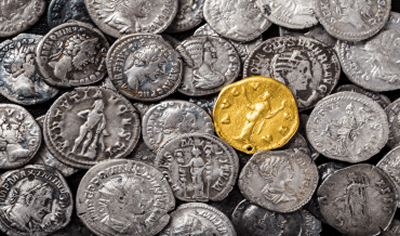
The Roman economy, from its founding and establishment as a Republic, through to the fifth and fourth centuries BC was a system of barter and community trade. All manner of trade goods, farm products, livestock and services were used as a means of exchange.
As Rome grew, and the need for a system other than barter with it, lumps of bronze and other base metals began to be used in lieu of the exchange of one good for another.
These lumps, called Aes Rude (raw bronze), could be used not only as coinage, but also - in large enough quantities - they could be melted down for the manufacturing of various metal tools and objects.
The First Roman Coin... and the Difficulty of Giving Change!
As time passed and the circulation of Aes Rude became more common, the Romans and their neighbors began to rely on this simple system of economic transfer.
The first true Roman coin, the Aes Signatum (signed bronze), replaced the Aes Rude sometime around the start of the 3rd century BC.
These were more than simple lumps of metal, in that they were cast, had a regular and discernable rectangular shape and were stamped with raised designs.
The Aes Signatum carried a particular value and were cast with marks indicating the government authority. Each was cast at a weight standard of 1,600 grams so weighing by traders would not have to be done at each transaction.
This rather hefty weight, however, along with the single denomination made giving change a fragment cutting affair. This system obviously carried inherent problems and would very quickly be in need of a replacement.
Coins in Different Denominations Made Trading Much Easier
Within only a few years of the introduction of the Aes Signatum, a new more clearly defined, and easily traded form of coin replaced it.
The Aes Grave (heavy bronze), appearing sometime around 269 BC, came in several denominations, making them more functional and popular. Allowing for several varieties surely increased the circulation of coinage in ancient Rome and also made trading with other civilizations more practical.
The Aes were molded with carvings of exotic animals or gods, and later were commonly issued with a ship's prow.
This coinage was likely the primary issue in Rome until about 215 BC, and it would eventually evolve into the base unit of Roman currency, the As.
Roman Silver Coins
Overlapping the circulation of the Aes Grave, was the introduction of silver coinage.
During the 3rd century BC, Roman moneyers were forced to become more compliant with other cultures for ease in trade. The Greeks had been producing silver coins since the 7th century BC, and silver was the basis of their system. The Romans imported Greek artisans and began minting silver coins of their own, albeit with a style heavily influenced by Greece.
The first of these silver coins produced for Rome were a series of didrachms (called quadrigati for the inclusion of the four horsed chariot imagery) minted during the outbreak of war with Pyrrhus. These coins were struck in Neapolis and were most likely made to be compliant with the trading specification of the Greek colonies in southern Italy.
These were later replaced by a coin of roughly half the size (3.4 grams) called the victoriatus to commemorate the defeat of Carthage in the Punic Wars.
The Silver Denarius
The denarius - the silver coin that would become the mainstay of the Roman economy - was first struck in 211 BC and was valued originally at 10 asses (As).
Approximately a century later, in 118 BC, it was revalued at 16 asses to reflect the shrinking size of the bronze and copper As.
Gold Coins
Minting of highly valued gold coinage in the Republic was only done in times of dire need.
The aureus was the primary gold coin of the Roman Empire and was introduced in the late Republic period during the time of the Imperators.
The aureus carried a fixed value of 25 denarii and its larger value would ease the burden of money transfers during times of war.
The Silver Content of the Denarius Declines in Purity Over Time
While the denarius remained the backbone of the Roman economy for five centuries, the silver content and accompanying value slowly decreased over time.
This debasement of the metal purity in coins fluctuated with the strength of the Empire and was mainly an indication of the state lacking precious metals, reduced treasury, and inflation.
When first introduced, the denarius contained nearly 4.5 grams of pure silver and remained that way throughout most of the Republican period.
With the establishement of the Imperial system, the denarius remained fairly constant under the Julio Claudians at 4 grams of silver.
With the accession of Nero, however, the content was debased to 3.8 grams, perhaps as a reflection of the high cost of rebuilding the city and his palace, after the fires.
The Silver Antoninianus
By the reign of Caracalla in the early 3rd century AD, the denarius had dipped to less than 50% purity.
In 215 AD, he introduced the Antoninianus, commonly referred to as the "radiate" due to the obverse images of the emperors with a radiate crown. The 60% pure silver Antoninianus was valued at two denarii, but contained no more than 1.6 times the amount of silver of the denarius.
The savings for the treasury by issuing a double value coin with less than double the silver content is obvious.
As the number of antoninianii increased, the minting of denarii decreased, until it ceased to be issued in significant quantities by the middle of the third century AD.
The Cost of War Led to the Debasement of Silver Currency
The mid third century AD saw the outbreak of anarchy.
After the reign of Gordian III (238-244 AD), Persians and Germanics began to invade the frontier of the empire. Plus, a succession of Legionary Legates fought a progressive fifty-year civil war and large armies were raised.
The treasury needed increasing amounts of silver to fund them. Mints were set up close to the armies so that the soldiers could be paid, but the demand for silver debased the coinage once again.
By the reign of Valerian (253-260 AD), the antoninianus was only 20 - 40% silver. When Valerian was captured by the Sassanians, his son, Gallienus, issued bronze antoninianii with a silver coating. His need of coinage was so desperate that he was minting up to one million coins per day.
Emperors Aurelian and Diocletian Attempt to Tackle the Debasement Issue
This constant debasement of Roman coins was finally countered by Aurelian in 274 AD. He set the minting standard for silver in the antoninianus at twenty parts copper to one part silver, and the coins were actually stamped as containing that amount.
Aurelian's reform had little effect, however, and coins continued to be minted with a lesser level of purity.
In 301 AD, true reform came to the minting process with the ascension of Diocletian.
He developed a strict system of purity standards with the gold Aureus struck at 60 to the pound, a new silver coin struck at the old rates during the reign of Nero, and a new large bronze coin that contained two percent silver. He eliminated the Antoninianus and replaced with it several new denominations like the Argenteus and the Follis.
Roman Coins at the End of the Empire
Within a couple of decades, Constantine would come to power and the empire would see its final changes in the monetary system, before its fall.
The gold Solidus and silver Siliquae were introduced at this time and themes on coinage slowly began to take on a new dimension. Coins were minted with idealistic portraits and not the customary true imagery of the emperor.
With the moving of the capital to Byzantium, a Greek influence returned to many issues, and even slight references to Christianity were made. The inclusion of the Christogram, while not completely replacing the images of the Roman pantheon, marked a distinct change in the religion of the state.
By the fall of the west in 476 AD, the distinction between Roman and Barbaric issues is non-existent, and Byzantine coinage replaces Roman as the currency of the Mediterranean.
Roman Coin Denominations
Roman coins were minted in many different denominations and various types were added and eliminated through the centuries.
During the Republic and earlier Imperial periods, Roman coins had an intrinsic value that related directly to metal purity content comparable to other denominations.
In the late empire though, the value of various issues are much more difficult to determine as in many cases, we don't even know the issued names of many bronze coins.
The following lists break down the most common denominations by the period in which they were issued.
Early Republic
| Aes Grave Series introduced 290 BC | |
| Denomination | Relative Value |
| As | 12 Uncia |
| Semis | 6 Uncia |
| Triens | 4 Uncia |
| Quadrans | 3 Uncia |
| Sextans | 2 Uncia |
| Uncia | Base Unit |
Mid Republic
The following were key monetary units just before and after the introduction of the Denarius:
| Denomination | Introduction |
Metal | Value |
Quadrigatus |
c. 270 BC |
Silver |
15 asses |
Denarius |
217 - 211 BC |
Silver |
10 asses |
Victoriatus |
c. 221 BC |
Silver |
5 asses |
Sestertius |
c. 211 BC |
Silver |
2.5 asses |
Dupondius |
c 290-280 BC |
Bronze |
2 asses |
As |
c. 290-280 BC |
Bronze |
Base Unit |
Semis |
c. 290-280 BC |
Bronze |
1/2 as |
Quadrans |
c. 290-280 BC |
Bronze |
1/4 as |
Sextans |
c. 290-280 BC |
Bronze |
1/6 as |
Late Republic to Early Empire
| Denomination | Introduction |
Metal | Value |
| Aureus | 1st Cent. BC |
Gold | 25 Denarii |
| Quinarius Aureus or Halbaureus | 1st Cent. BC |
Gold | 12.5 Denarii |
| Denarius | 217 - 211 BC |
Silver | 16 asses |
| Quinarius | 101 BC |
Silver | 8 asses |
| Sestertius | Augustan Reforms of 23 BC |
Brass | 4 asses |
Dupondius |
Augustan Reforms of 23 BC |
Brass | 2 asses |
| As | Augustan Reforms of 23 BC |
Copper | Base Unit |
| Semis | Augustan Reforms of 23 BC |
Brass | 1/2 ass |
| Quadrans | Augustan Reforms of 23 BC |
Copper | 1/4 ass |
Late Imperial - Constantine to the Fall of the Empire
Value of the denominations and corresponding sizes remained fairly constant in this period. The noted exception is the introduction of the bronze AE series in which the relative values are virtually unknown.
| Denomination | Metal | Weight or Size | Value |
| Solidus | Gold | 4.5 gm | 24 Siliquae |
| Semissis | Gold | 2.25 gm | 12 Siliquae |
| Scripulum | Gold | 1.7 gm | 9 Siliquae |
| Miliarense | Silver | 4.5 gm | 1/18 Solidus |
| Siliquae | Silver | 3.4 gm | 1/24 Solidus |
| AE 1 | Bronze | 25 mm | Unknown |
| AE 2 | Bronze | 21 - 25 mm | Unknown |
| AE 3 | Bronze | 17 - 21 mm | Unknown |
| AE 3/4 | Bronze | 16 - 18 mm | Unknown |
| AE 4 | Bronze | Less than 17 mm | Unknown |
Related Pages:
- Constantine the Great: The Coins Speak
- Roman Numerals: Numbers and Counting in Ancient Rome
- Roman Taxes: Taxation in Ancient Rome
Did you know...
The emperor Nero (reigned 54-68 AD) lowered the weight of gold and silver coins and reduced the fineness of the silver. Successive emperors, always in need of money, continued this debasement until, by the reign of the emperor Caracalla (198-217 AD), the denarius was barely 40% silver.
Did you know...
The biblical quote of Jesus "Render therefore unto Caesar the things that are Caesar's and unto God the things that are God's" refers to the highly collectible 'tribute penny' of the emperor Tiberius.
