

Ancient Rome was not a quiet city. It was a place of density, friction, and constant movement, where daily life unfolded at close range and rarely out of earshot. We cannot assign a precise decibel level to ancient Rome, and any attempt to do so would be speculative. But we can describe the nature and persistence of the noise with confidence.
Modern visitors often encounter Rome through its ruins: broken marble, open air, and wide pedestrian spaces that encourage the illusion of calm. The lived city of antiquity was the opposite. Streets were narrower, buildings were taller, people lived closer together, and the activities that made the metropolis function - transport, trade, construction, and public entertainment - generated sound from morning until late at night.
At its height in the early Empire, Rome may have held close to a million inhabitants, making it the largest city in the Mediterranean world. A population of that size required constant supply and continuous labor, and those necessities produced noise as a byproduct of survival.
There was no modern insulation, no regulated zoning to separate workshops from bedrooms, and no expectation that nighttime automatically meant silence. In many districts, the loudest hours were not the ones when the sun was up, but the ones when the streets were dark and heavy wagons finally had room to move.
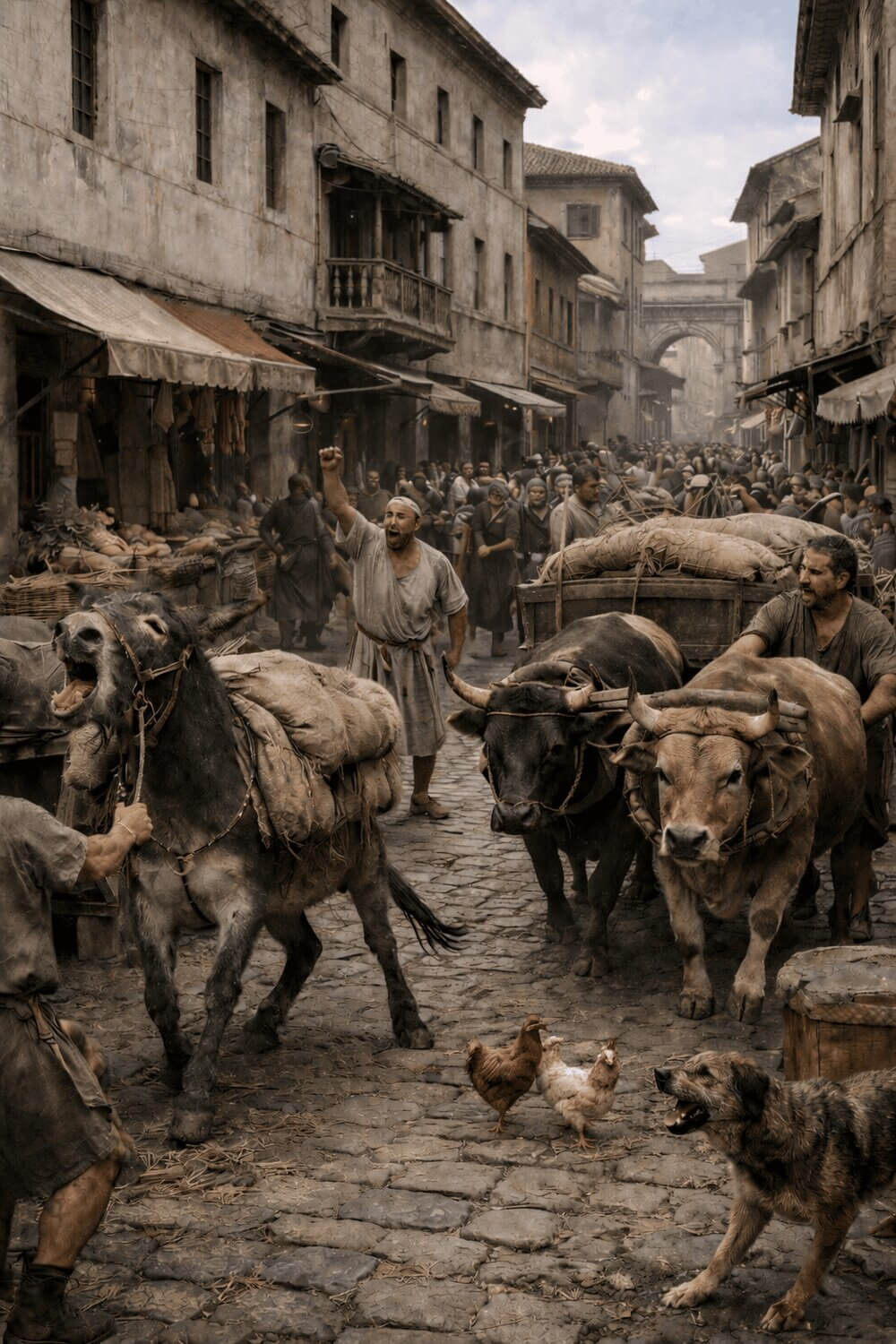
This article explores what made Rome so noisy, what kinds of sounds dominated different neighborhoods, and why the city's rhythms prevented it from ever truly sleeping. The evidence comes less from measurement than from description. Roman writers complained, joked, and reflected on the relentless din around them, while archaeology and urban geography help explain why so much of that sound would have been amplified rather than absorbed. Taken together, they point to a city whose "background noise" was not incidental, but structural.
The Urban Soundscape: Why Rome Amplified Noise
Rome's architecture and street plan did not merely contain sound; it encouraged it to linger. In many districts, streets were narrow corridors lined with tall buildings, and this created a canyon effect in which voices and impacts echoed upward and bounced between walls. Stone paving amplified the sharp percussion of footsteps and hooves, while the rigid surfaces of brick, plaster, and marble reflected noise rather than softening it. Even ordinary movement, such as walking, carrying water jars, opening shutters or dragging goods produced constant small impacts that added up in crowded environments.
Many Romans lived in insulae (multi-story apartment buildings), often above street-level shops, taverns, food stalls, and small workshops. The walls and floors of these buildings were rarely designed for privacy or quiet. Sound traveled through timber beams, along stairwells, and across shared courtyards, meaning that the noises of neighbors were part of everyday existence. A quarrel on the ground floor could be heard several levels up. A baby crying above could keep a tenant below awake. Rome's density ensured that few households controlled the sound around them.
Rome also lacked the modern assumption of private interior life, and a lot of social activity spilled outdoors. People sat near doorways, spoke in courtyards, and conducted business in public view. That cultural habit, combined with the physical constraints of crowded housing, meant that noise was part of how community life operated.
The problem was that it was not optional. You could not choose a quiet block in the way a modern person might choose a quieter neighborhood. In many cases, you lived where rent allowed, and then you endured whatever sounds came with it.
Noise in Rome was therefore not simply an annoyance, it was a consequence of how the city functioned. The same conditions that made Rome prosperous and energetic - population concentration, mixed-use streets, public commerce, and a constant flow of labor - also made it acoustically oppressive. In a metropolis where space was scarce and activity was constant, quiet was not the default state. It was a rare and temporary interruption.
Streets by Day: Voices, Crowds, and the Business of Living
During the daytime, Rome's streets were filled with foot traffic. People walked to markets, temples, law courts, baths, workshops, and patron's houses, while enslaved laborers and porters carried goods through the crowds.
The human voice was central to this environment. Without printed signage, mass advertising, or fixed price labels, commerce depended on shouting. Vendors called out prices and claimed superiority over rivals. Buyers haggled loudly. Assistants repeated offers, pushed through crowds, and argued with competitors who encroached on their space.
Markets were among the loudest daytime environments because they concentrated people and economic urgency in tight quarters. A fish seller might shout the freshness of his catch; a baker might advertise warm bread loaves; a cloth merchant might exaggerate the quality of imported fabrics. The sounds of trade were layered: metal coins clinking, weigh scales scraping, baskets thumping onto stone, animals bleating as they were brought in for slaughter, and the constant hum of conversation. A busy Roman market was not a quiet place of browsing. It was a competitive arena in which attention was won through volume and persistence.
Night Transport: Why the Loudest Hours Could Be After Dark
One of the most important reasons Rome "never really slept" is that heavy transport often moved at night. Roman authorities, seeking to reduce congestion and improve the flow of pedestrians during the day, restricted wagons and carts in certain parts of the city while the sun was up.
That policy did not reduce the need for goods to enter and circulate within Rome; it simply shifted the movement into the evening and overnight hours. In practice, this meant that residents who hoped for quiet after dusk often experienced the opposite: the arrival of large, creaking vehicles moving through narrow streets.
The satirist Juvenal complained bitterly about this, presenting Rome's nocturnal traffic as a kind of urban torture. His descriptions evoke the grinding of wheels on stone, the shouts of drivers urging animals forward, and the chaos created when wagons became stuck or collided in cramped streets. Even allowing for exaggeration, the complaint is revealing. It suggests that nighttime noise was not a rare disturbance but a routine feature of city life, severe enough that an author could assume readers would recognize it immediately.
A wagon moving through a paved Roman street would have produced multiple kinds of sound at once: the percussive striking of wheels, the creak of axles, the shifting and thumping of cargo, and the vocal noise of men and animals navigating obstacles. Mules and oxen brayed, snorted, and resisted. Drivers shouted commands, cursed, or argued with pedestrians who refused to move quickly enough.
In a modern city, those sounds might be absorbed by distance or masked by engines and insulation. In ancient Rome, they were thrown back by walls and carried upward into apartments, making sleep a matter of endurance rather than expectation.
Workshops in the City: Industry Without Zoning
Rome's noise was not only generated by transport and crowds. It was also produced by work, and much of that work occurred inside the urban core rather than outside of it. The modern separation between industrial and residential space barely existed for many residents. Small-scale manufacturing, repair, and processing took place at street level, often with living quarters above. This meant that the sound of labor - hammering, grinding, sawing, pounding, scraping - was part of the everyday atmosphere of many neighborhoods.
Bakeries are a good example. Feeding Rome required enormous quantities of grain, and that grain had to be milled. Large rotary mills turned by animals produced a steady grinding noise that could carry through walls and across courtyards. Fullers, who cleaned and processed cloth, engaged in labor that was both physically intense and acoustically intrusive, involving trampling, rinsing, beating, and the movement of wet fabric. Metalworkers produced sharp, repetitive clanging that would echo. Construction crews, constantly rebuilding and repairing in a city vulnerable to fire and collapse, added their own rhythms of impact and shouting.
Noise from work was therefore not limited to business districts. It was embedded within residential life. A tenant might live above a shop that opened early, below a family with children, beside a workshop, and near a tavern, all within the same building or block. In such conditions, quiet was not merely hard to find, it was structurally incompatible with the way the city fed itself and sustained its economy.
The Public Baths: Social Noise as a Feature, Not a Flaw
Public baths were among the most popular institutions in Roman life, and they were also among the loudest. These were not silent spaces for private relaxation. They were communal environments where people exercised, socialized, negotiated, gossiped, and displayed status. A large bath complex could hold hundreds or even thousands of visitors over the course of a day, and its architecture of vaulted ceilings, hard surfaces, pools and colonnades, encouraged echoes. Water splashed. Voices carried. Movement was constant.
Seneca, writing about life in Rome, described living above a bathhouse and being subjected to an almost comical range of noises: grunting athletes, slapping massages, shouted conversations, splashing bathers, and the cries of vendors passing by outside. His point was partly philosophical (he was using noise as a metaphor for distraction and the difficulty of achieving calm in the city) but the detail is practical. It tells us that baths were not quiet and that their sound could spill into surrounding residences.
In a letter to Lucilius (number 56), Seneca writes:
Beshrew me if I think anything more requisite than silence for a man who secludes himself in order to study! Imagine what a variety of noises reverberates about my ears! I have lodgings right over a bathing establishment. So picture to yourself the assortment of sounds, which are strong enough to make me hate my very powers of hearing! When your strenuous gentleman, for example, is exercising himself by flourishing leaden weights; when he is working hard, or else pretends to be working hard, I can hear him grunt; and whenever he releases his imprisoned breath, I can hear him panting in wheezy and high-pitched tones.
Or perhaps I notice some lazy fellow, content with a cheap rubdown, and hear the crack of the pummelling hand on his shoulder, varying in sound according as the hand is laid on flat or hollow. Then, perhaps, a professional (sports commentator) comes along, shouting out the score; that is the finishing touch.
Add to this the arresting of an occasional roisterer or pickpocket, the racket of the man who always likes to hear his own voice in the bathroom, or the enthusiast who plunges into the swimming-tank with unconscionable noise and splashing. Besides all those whose voices, if nothing else, are good, imagine the hair-plucker with his penetrating, shrill voice, – for purposes of advertisement, – continually giving it vent and never holding his tongue except when he is plucking the armpits and making his victim yell instead. Then the cake seller with his varied cries, the sausageman, the confectioner, and all the vendors of food hawking their wares, each with his own distinctive intonation.
The bathhouse was also a social stage. People did not whisper because they were not expected to. Many came precisely because it was a place of conversation and visibility. In that sense, noise was not an accidental byproduct. It was evidence that the baths were functioning as intended: as public spaces in which Roman urban life was performed in front of others.
Entertainment Venues: The Roar of the Crowd
If everyday Rome was loud, public entertainment could be deafening. The Circus Maximus, used for chariot racing, drew enormous crowds, and chariot factions inspired intense loyalty. Spectators shouted, sang, cursed rivals, and surged emotionally with the race. The collective noise of tens of thousands of people reacting at once would have created a physical sensation like a rolling force. Rome's entertainment culture did not encourage quiet spectatorship, it encouraged participation.
Related Page: Chariot Racing in Ancient Rome
Amphitheaters produced their own acoustic intensity. Gladiatorial games were not solemn athletic contests; they were dramatic spectacles that involved blood, fear, triumph, and shame, and crowds responded loudly to what they saw. Approval and disapproval were expressed by sound. A fighter's courage could be rewarded with cheers; perceived cowardice might be punished by jeers.
In a society where reputation and honor mattered deeply, public noise functioned as a collective judgment. Even emperors and elite sponsors paid attention to audience response, because crowd sentiment could carry political weight.
Theaters, festivals, and religious processions added music, chanting, and ritual cries to the city's soundscape. Rome's public calendar included frequent celebrations, many of which involved movement through the streets with musical instruments and crowds.
Religion and Ceremony: Sound as Power and Precision
Roman religious practice also contributed to noise, though in a different way. Many public rituals involved spoken formulas, priestly declarations, and the participation of onlookers. Music and trumpet signals often accompanied state ceremonies, especially those linked to military life or civic authority. Processions for festivals created moving clusters of sound as crowds gathered, shouted, and reacted.
At the same time, Roman religion had a strong concern with correct performance. Ritual words had to be spoken properly, and unwanted interruptions could be seen as ominous or invalidating. This is telling because it implies that uncontrolled sound was common enough to be a genuine problem. If a sudden shout or accidental noise could disrupt a rite, then maintaining ritual order required conscious effort against the normal chaos of public space.
In other words, Rome was noisy enough that moments of enforced silence were exceptional, and their exceptionality was part of their meaning. Quiet was not the baseline; it was a carefully produced condition, achieved briefly in a city that usually resisted it.
Taverns, Crime, and Night Disturbance
At nighttime, taverns remained active, especially in busier districts. Drinking and gambling produced laughter, shouting, and sometimes violence. Prostitution, common in many parts of the city, generated movement and conflict, particularly when clients were drunk. Even if most residents tried to sleep, enough people stayed awake to keep sound in circulation.
Crime and fear also contributed to nighttime noise. A city with limited lighting and crowded streets offered opportunities for theft and assault, and victims could cry out. Dogs barked. Watchmen and patrols called the hours or confronted suspicious figures. In some neighborhoods, these sounds might have been sporadic, but across the city they were constant in aggregate. Someone, somewhere nearby, was awake.
Animals Everywhere: The City Was Not Fully Human
Rome's soundscape was also shaped by animals in a way modern cities rarely experience, because animals – as we've seen - were not occasional presences, but indispensable components of urban life.
Donkeys and mules hauled goods through crowded streets, oxen pulled heavy wagons when brute strength was required, and dogs roamed neighborhoods as both scavengers and informal guards. Livestock destined for market or slaughter were driven through the city in steady numbers, especially near commercial districts, adding a restless and unpredictable layer to the urban environment.
These creatures were never silent background features. They brayed, barked, bleated, squealed, and resisted, and their movements could turn an already noisy street into a scene of sudden disorder.
The point is not merely that animals were present, but that Rome's daily logistics depended on them. Transport relied on animal power, and transport was constant; markets relied on the steady movement of animals and animal products, and markets were among the loudest spaces in the city.
In narrow streets where pedestrians, porters, and carts competed for space, even a single animal panicking or refusing to move could trigger a chain reaction of shouting drivers, shoving crowds, collisions of wheels and baskets, spilled cargo, and frayed tempers. One startled mule could disrupt an entire block.
Rome's sound was therefore not only mechanical and human, but also stubbornly biological: the city's noise carried the strain, fear, and resistance of animals pressed into the same dense and demanding environment as its people.
Could Anyone Find Quiet?
Some could. Most could not.
Wealthy Romans often maintained residences that were structurally better built, more spacious, and less directly exposed to street-level commerce. They could also retreat to suburban villas or countryside estates, and Roman literature frequently idealizes rural quiet as restorative.
This contrast of city noise versus rural peace appears repeatedly because it expressed a real experience of relief. Quiet was something to be sought, not something automatically provided by nightfall.
For ordinary residents, however, the city's noise was unavoidable. Work, transport, entertainment, density, and social habits all produced sound, and the architecture of the city amplified it. The best one could often do was adapt: sleep in fragments, accept disturbance as normal, and treat loudness as the cost of living near opportunity, food supply, and public resources.
Conclusion: A City That Could Not Afford Silence
Ancient Rome never really slept simply because it could not. The city's survival depended on continuous movement and constant supply, and the mechanisms that made that possible created noise as an unavoidable consequence. Daylight brought crowds, commerce, and public life; night brought transport, taverns, and disturbances that penetrated thin walls and echoed through narrow stone and brick streets. The city's architecture intensified sound rather than absorbing it, and the lack of zoning ensured that industry and residence collided in the same spaces.
Rome's noise was therefore not simply a matter of inconvenience. It was a revealing feature of how the metropolis worked. It tells us that Roman urban life was lived in public, at close range, and under conditions of perpetual friction. The city was vibrant, productive, and spectacular... but it was also exhausting. If you wanted quiet, you had to buy it, escape for it, or create it through rare moments of enforced ritual order. Otherwise, you lived inside the roar.
And that roar, in many districts, never truly stopped.

Frequently Asked Questions (FAQs)
How loud was ancient Rome compared to a modern city?
We cannot measure ancient Rome in decibels, but ancient sources make clear that the city was persistently noisy. The difference from many modern cities was not just volume but proximity: sound echoed along narrow streets, traveled easily through apartment buildings, and mixed commerce, animals, and transport into a single continuous soundscape.
Why were Roman streets so noisy at night?
In many areas, heavy wagons and carts were restricted during daylight hours to reduce congestion, which pushed large-scale deliveries into the evening and overnight. Iron-rimmed wheels on stone paving, animals straining at loads, and shouting drivers created disruptive noise that carried upward into nearby apartments.
Did Romans complain about noise pollution?
Yes. Roman writers—including satirists and moralists—complained about sleeplessness, street disturbance, and the sensory overload of city life. Their exaggeration is literary, but it rests on recognizable realities of congestion, crowd noise, and nighttime transport.
What did ancient Rome sound like at night?
Nighttime sound in Rome often included wagon wheels grinding over stone, teamsters yelling, animals braying, and tavern noise spilling into the street. In crowded districts, barking dogs, arguments, and sudden commotions could break out with little warning, especially where lighting was limited.
Were Roman apartment buildings (insulae) noisy inside?
Very. Many residents lived in multi-story insulae with thin walls, shared stairwells, and shops or workshops at street level. Everyday sounds—footsteps, conversations, domestic arguments, crying children, and nearby commerce—carried easily between units and floors.
Were public baths loud in ancient Rome?
Public baths were famously noisy social spaces rather than quiet retreats. Visitors exercised, talked business, gossiped, and moved constantly through echoing rooms where hard surfaces and vaulted ceilings helped sound carry.
How did Romans sleep if the city was so loud?
Many likely adapted through exhaustion, irregular sleep, and timing—resting when the street happened to be calmer rather than expecting silence every night. Wealthier Romans also had better-built homes or could escape to suburban and rural villas, but ordinary tenants had limited control over their sound environment.
Were animals a major source of noise in Rome?
Yes. Donkeys, mules, oxen, dogs, and livestock were integral to transport and markets, so their sounds were routine rather than exceptional. A startled or stubborn animal in a narrow street could trigger shouting, delays, and collisions that amplified noise quickly.
Did Rome have quiet neighborhoods?
Some areas were likely calmer than major commercial routes, market zones, and entertainment corridors, but true quiet was hard to guarantee in a dense, mixed-use city. Proximity to deliveries, workshops, taverns, and thoroughfares mattered more than any formal separation of noisy and quiet districts.
