

When we imagine ancient Rome, we often picture emperors, senators, gladiators, or legions on campaign. Yet the Roman world was sustained not by spectacle or conquest, but by millions of ordinary households going about the routines of daily life. For most Romans, history unfolded not in marble forums or triumphal processions, but around the hearth, in cramped insulae apartments, busy workshops, farms, and noisy streets.
To understand Roman society properly, we need to step inside the home and follow a family through an ordinary day. How did they wake, eat, work, raise children, worship, argue, and sleep? What did family life feel like for freeborn citizens, women, children, slaves, and the elderly? While no single household can represent all Romans, the sources allow us to reconstruct a broadly typical rhythm of daily domestic life across the Roman world, especially in urban Italy.
These details provide useful context for understanding how the Roman middle class lived between wealth and poverty, including evidence about occupations, urban housing, family structure, debt, and social ambition in ancient Roman society.
This article explores how a Roman family lived day to day, from dawn to nightfall, revealing a world that is at once alien and surprisingly familiar.
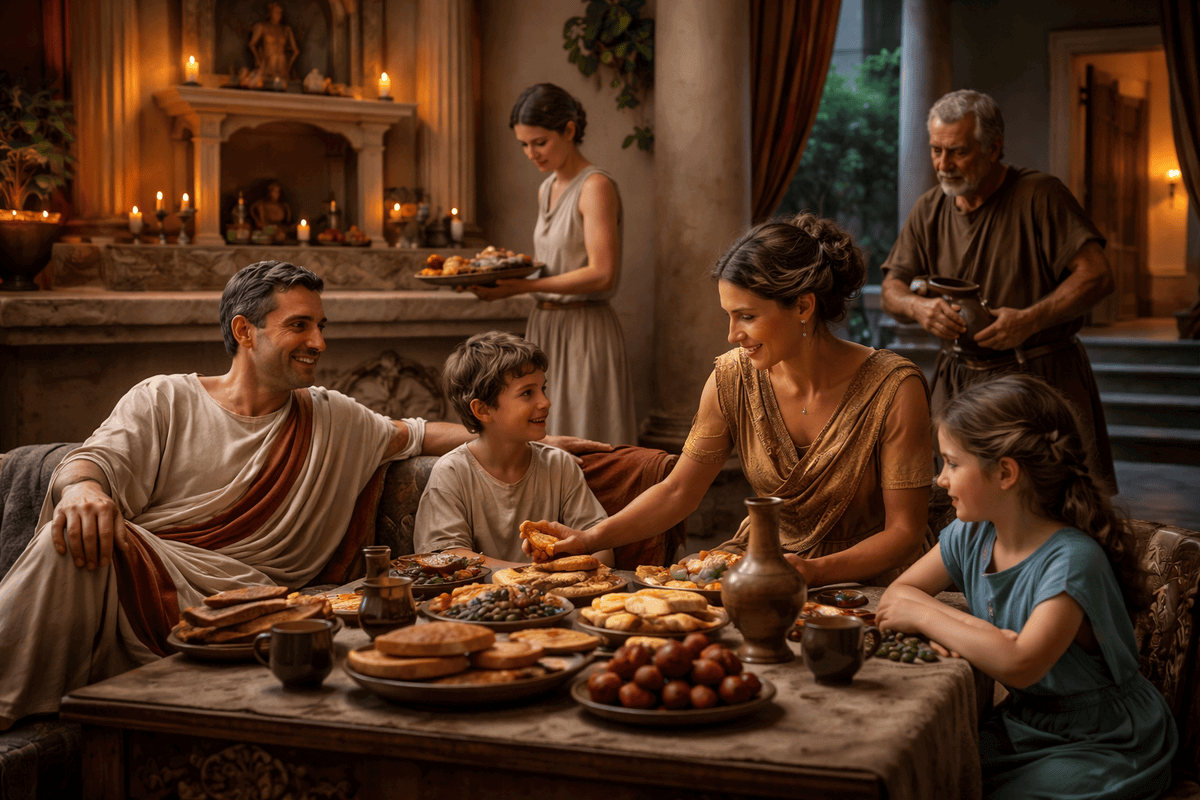
The Roman Household: Who Lived Together?
The basic unit of Roman society was the familia; a term far broader than the modern idea of a small, immediate family. A Roman household might include:
- A married couple and their children
- Unmarried adult sons or daughters
- Elderly parents or relatives
- Enslaved men, women, and children
- Freedmen and freedwomen who remained attached to the household
- Apprentices, clients, or dependents
At the legal and symbolic center of the household stood the paterfamilias, the senior male head. He exercised patria potestas (legal authority) over his children, slaves, and household property. This authority was extensive in law, though in practice tempered by custom, affection, and social expectations.
Roman women were legally subordinate to male guardians but often managed the internal life of the household. Children were raised in close proximity to adults and slaves alike, growing up in a world with little privacy by modern standards.
Most Romans did not live in detached houses. In cities such as Rome, the majority of families lived in apartment buildings (insulae), often several stories high, which were noisy, and prone to fire. Wealthier families lived in private townhouses (domus) or rural villas, where daily life followed similar rhythms but with greater space and comfort.
Dawn: Waking with the Sun
Roman days began early. Without artificial lighting beyond oil lamps, activity followed the sun. At first light, households stirred awake (Related Page: "What Time Did Romans Wake Up - And Why?").
In a modest urban apartment, the family might rise together in a single room. Beds were simple: wooden frames with rope or leather supports, topped with thin mattresses stuffed with straw, wool, or feathers. Slaves often slept on pallets or on the floor, sometimes in corridors or near their assigned workspaces.
Morning routines were brief. Washing involved cold water poured from a basin; full bathing was reserved for later visits to public bathhouses. Clothing was put on quickly: tunics for men and women, with cloaks added for warmth. Shoes were simple leather sandals or boots.
Breakfast (ientaculum) was light and utilitarian. Many Romans ate:
- Bread or flat cakes
- Cheese
- Olives
- Fruit, such as figs or apples
- Occasionally leftover food from the previous evening
For poorer families, breakfast might be little more than bread dipped in wine or water. Wealthier households might add honey, eggs, or cold meat, though extravagance in the morning was frowned upon.
Roman children ate alongside adults. There was no separate "children's food" culture; youngsters shared what the household could afford.
Morning Work: The Household Disperses
Once fed, the household divided according to roles and obligations.
The Adult Male
For freeborn men, mornings were the most active part of the day. Depending on status, a man might:
- Open a workshop or stall
- Travel to the forum for business, legal matters, or politics
- Visit patrons or clients
- Supervise agricultural work if living in the countryside
Artisans worked long hours: bakers, metalworkers, cobblers, and potters often labored from dawn until evening. Shopfronts typically opened onto the street, blurring the boundary between home and work.
Elite men followed a different rhythm. Early mornings were devoted to receiving clients in the salutatio, a formal daily gathering in which dependents, freedmen, and social inferiors visited their patron's house. These visits were not purely ceremonial: clients sought legal assistance, financial help, recommendations, political backing, or simple protection, while the patron reinforced loyalty and displayed his social standing. The salutatio functioned as a visible exchange of support and obligation, underpinning the personal networks that sustained Roman politics, business, and social order.
Women's Work
Roman women across all social classes were expected to be responsible for the domestic sphere, but what this meant in practice varied greatly with wealth and status. Elite women were not typically engaged in routine manual labor. Instead, they managed the household as an economic and social unit, overseeing food supplies, storage, finances, and the work of enslaved servants, as well as directing childcare and education within the home.
In contrast, women in poorer households performed much of this work themselves. They cooked, cleaned, fetched water, prepared food, spun wool, produced textiles, and washed and maintained the family’s clothing, while also caring for children and elderly relatives. Many lower-class women worked outside the home as well—selling goods, assisting in family workshops, or laboring in markets and small businesses - often out of economic necessity rather than choice.
Roman moral ideals praised female modesty, industry, and devotion to the household across all classes. In reality, however, daily life was shaped less by ideology than by circumstance. Wealth determined whether a woman supervised domestic labor or carried it out herself, but responsibility for the household remained a defining feature of Roman womanhood.
Slaves and Dependents
Enslaved members of the household rose early and worked constantly. Duties varied widely:
- Cooking and cleaning
- Childcare and education
- Manual labor or skilled trades
- Running errands through the city
Slaves lived intimately alongside their owners, sharing living space and daily routines. Some formed close emotional bonds within the household, while others endured harsh discipline. Roman family life cannot be understood without acknowledging the omnipresence of slavery.
Children and Education
Children were everywhere in Roman homes. Infant mortality was high, but those who survived early childhood were integrated quickly into family life.
Early Childhood
Babies were cared for primarily by mothers or wet nurses. Swaddling was common, and infants spent much of their time carried or placed in cradles.
Young children played with simple toys: balls, dolls, hoops, and knucklebones. Play occurred wherever space allowed—courtyards, streets, workshops—under minimal supervision.
Schooling
Education depended on family means. Many children, especially from poorer households, received no formal schooling and learned trades directly from family members.
Wealthier families sent boys—and sometimes girls—to small local schools or tutors, where instruction focused on basic literacy and numeracy. Lessons began early in the morning and focused on:
- Reading and writing
- Basic arithmetic
- Memorization and recitation
Education was disciplined and often harsh. Corporal punishment was accepted, and schoolrooms were noisy, crowded spaces.
Girls were less likely to receive advanced education, but many learned to read and write at home, especially in elite families.
Midday: Food, Rest, and the Heat
By midday, activity slowed. The Roman climate, particularly in Italy and the Mediterranean provinces, encouraged a pause during the hottest part of the day. While Romans did not observe a formal "siesta" in the modern sense, the rhythm of daily life often included a noticeable midday lull, with work resuming later into the afternoon or early evening.
The Midday Meal
Lunch (prandium) was modest and informal, especially when compared to the evening meal. It typically consisted of cold or easily prepared foods such as bread and cheese, vegetables or legumes, fruit, and leftovers from the previous night. For many Romans, prandium was eaten quickly and without ceremony.
Families did not necessarily eat together at midday. Artisans and laborers often ate where they worked, while members of wealthier households might eat at different times depending on their duties. Enslaved members of the household generally ate separately from their owners, receiving rations rather than sharing the family table. While trusted or high-status household slaves might occasionally dine alongside free members - particularly in smaller or more intimate households - shared meals were the exception rather than the rule and reinforced clear social boundaries.
Rest and Routine
After lunch, some Romans rested briefly before returning to work. This was not universal napping, but a general slowing of activity during the peak heat of the day. Shops and workshops might close temporarily, reopening later in the afternoon, and city streets often grew quieter for a time—a pattern not unlike that still seen in parts of southern Europe.
In rural households, agricultural labor continued as needed, shaped more by seasonal demands than by the clock. In cities, however, the afternoon marked a transition away from sustained manual labor and toward bathing, social visits, and leisure, setting the stage for the evening's activities.
Afternoon: Social Life and the Baths
As the heat of the day eased, Roman life shifted again. For many, the afternoon marked a transition away from sustained labour toward lighter work, errands, social obligations, and leisure. This part of the day was flexible rather than fixed, shaped by occupation, status, and location.
Some Romans returned to workshops or shops that had closed during the midday lull, while others visited friends, conducted informal business, attended legal matters, or took part in religious or civic activities. Leisure and work were not sharply separated, particularly in urban settings where social interaction and economic exchange often overlapped.
The Baths
One of the most distinctive features of Roman afternoon life was the public bath, but it was not the only form of recreation, nor was it necessarily a daily routine for everyone. Many Romans visited the baths several times a week rather than every day, fitting visits around work, finances (even small entrance fees mattered), and personal preference.
Bathing typically took place in the later afternoon, especially for men, and served multiple purposes beyond cleanliness. A visit to the baths might include light exercise, washing and oiling the body, time spent in warm or hot rooms, and extended conversation. These routines also overlapped with shaving and grooming, since hair, beards, body care, and public appearance all formed part of the same wider culture of daily self-presentation. Baths were important social spaces where news was exchanged, relationships maintained, and business quietly discussed.
Women also used the baths, usually at different times of day or in separate facilities, and children typically accompanied adult family members rather than bathing independently.
For those living in cramped apartment buildings, the baths offered warmth, water, and space unavailable at home.
Preparing for the Evening
While some members of the household were occupied outside the home in the afternoon, domestic activity continued. In wealthier households, enslaved servants began preparing the evening meal under supervision, while elite women focused on household management rather than hands-on cooking. In poorer households, women typically undertook much of this work themselves, often while also caring for children or managing small-scale economic activity.
Fuel was precious, and cooking was time-consuming and potentially dangerous. Meals were prepared over charcoal braziers or small hearths, frequently in confined and poorly ventilated spaces. In dense urban neighborhoods, accidental fires were a constant risk, shaping both household routines and city regulations.
By late afternoon, attention increasingly turned toward the evening meal, which would bring the household together and mark the social heart of the day.
Evening: The Main Meal and Family Time
The evening meal (cena) was the centerpiece of Roman domestic life and the most socially significant moment of the day. Unlike breakfast or the midday meal, cena was unhurried and communal, marking the point at which work largely ceased and the household gathered together. For many Romans, especially those who spent the day dispersed across workshops, streets, and public spaces, it was the primary occasion for shared time.
What Did Romans Eat?
Diet varied sharply by wealth and location, but most Roman meals were built around simple staples. Bread made from wheat or barley formed the foundation of the diet, accompanied by pulses such as lentils and beans, vegetables like cabbage, onions, and leeks, olives, olive oil, and fish. Fish was more commonly eaten than meat, particularly in coastal regions and cities with good market access.
Meat was expensive and therefore infrequent for poorer households, often reserved for festivals or special occasions. Wealthier families, by contrast, enjoyed more elaborate fare. Their meals might include multiple courses, seasoned sauces, imported spices, exotic ingredients, and carefully prepared dishes designed to impress guests as much as to satisfy hunger. For elites, the cena was not only a meal but a display of status, refinement, and generosity.
Eating Together
In modest households, family members typically ate seated or standing, sharing food from common dishes in a confined space. Meals were practical and social rather than ceremonial. In wealthier homes, diners reclined on couches in the dining room (triclinium), served by enslaved attendants. The arrangement of seating itself reflected hierarchy, with places assigned according to age, gender, and status.
Children were present at the evening meal and observed adult behavior closely. They were expected to remain quiet and attentive, learning social norms through participation rather than instruction. Conversation ranged widely: practical household matters, neighborhood gossip, stories from the day's work, and moral lessons conveyed through anecdotes and example. The cena thus served as a key setting for socialization and the transmission of values.
Entertainment and Conversation
After eating, households often remained active rather than retiring immediately to sleep. Families might talk at length, tell stories, listen to music or poetry, or play simple board games and dice. In some cases, especially in towns and cities, members of the household might attend public entertainments if time and money allowed.
Roman evenings were typically lively and communal. Multiple generations, slaves, dependents, and visitors might all share the same space, and noise carried easily through thin walls and crowded streets. Privacy, as we understand it today, was limited. The household functioned as a shared social environment rather than a collection of private retreats, and the evening meal stood at its emotional and cultural center.
Religion in Daily Life
Religion was woven into the daily rhythm of Roman household life rather than confined to specific times or places. Acts of domestic worship often took place at natural points of transition in the day, particularly in the morning before work began and in the evening as the household gathered.
Most homes contained a household shrine (lararium), usually located in a prominent but practical space such as the kitchen or main living area. Here, members of the household made simple, frequent offerings to protective spirits and ancestral gods. These rituals might include a small portion of food set aside from a meal, the burning of incense, or brief spoken prayers for protection, health, and prosperity.
Such acts were often informal and collective. In the evening, especially around the time of the main meal, the household might pause briefly to acknowledge the gods before eating. In the morning, a quick offering or prayer could mark the start of the day. Religion in this sense was habitual and practical, embedded in routine rather than separated from it as a distinct activity.
Beyond daily observance, major festivals and holy days punctuated the Roman calendar and temporarily reshaped household routines. Work schedules shifted, additional food was prepared, gifts were exchanged, and families took part in public ceremonies and celebrations. These occasions reinforced both religious identity and social cohesion, linking the private household to the wider civic and sacred life of the community.
Nightfall: Sleep and Silence
As darkness fell, activity gradually diminished, though rarely all at once. Oil lamps provided only limited light, and fuel was costly, so most households avoided unnecessary illumination. Streets grew darker and more dangerous after sunset, and many Romans preferred to remain indoors once evening routines were complete.
Before sleeping, households took practical precautions. Doors and shutters were secured, valuables gathered, and cooking fires carefully extinguished to reduce the risk of accidental blaze. Sleeping spaces were then arranged, often within the same room used for daytime activities. Beds were simple and functional, while enslaved members of the household typically slept on pallets or in corridors close to their assigned duties.
Sleeping arrangements varied widely depending on wealth and housing. In modest households, particularly those living in apartment buildings, there were often no separate bedrooms. The same room used for eating, working, and socializing during the day also served as a sleeping space at night, with beds or pallets arranged wherever space allowed. In wealthier homes, separate sleeping rooms (cubicula) were available, though these were typically small and simply furnished. Enslaved members of the household, as mentioned earlier, usually slept on pallets or benches in corridors, doorways, or work areas, close to the duties they were expected to perform.
In urban apartment buildings, night was seldom quiet. Sounds carried easily through thin walls: neighbors arguing, animals moving below, carts rumbling through the streets, and revelers returning late from taverns or public entertainments. Fire, theft, and structural collapse were persistent fears, particularly in the taller insulae, where poor construction and overcrowding increased the danger.
Sleep itself was lighter and more fragmented than modern patterns. Without artificial lighting or clocks to regulate rest, Romans often slept in stages, waking during the night before returning to sleep. Some rose briefly to talk, pray, or tend to small tasks before resting again. In wealthier homes, night watchmen or household slaves might remain awake to guard against fire or intruders.
By dawn, the household would stir once more, and the cycle of daily life would begin again—shaped by habit, obligation, and the shared rhythms of family and community.
Ordinary Lives and the Bonds of Family
Roman family life was not cold or mechanical, despite the formal hierarchies that structured it. Legal authority rested with the paterfamilias, but daily life was shaped as much by affection, habit, and mutual dependence as by power. Within the household, emotional bonds mattered deeply, even when they existed alongside inequality and coercion.
Parents mourned the loss of children with striking intensity, as surviving epitaphs and memorials reveal. Husbands and wives could express affection, partnership, and shared responsibility, particularly in managing households and raising children. Enslaved members of the household often formed close attachments as well—sometimes treated with familiarity and trust, sometimes exploited or abused—reflecting the moral contradictions at the heart of Roman domestic life.
Discipline was firm, but the household also functioned as a moral and social training ground. Children learned Roman values not through formal instruction alone, but by observing daily routines: work done at dawn, meals shared in the evening, respect shown to elders, and obligations honored within the family and beyond. Through repetition, these habits shaped character and identity.
It was this pattern of ordinary days that sustained the Roman world. While emperors rose and fell and armies marched across frontiers, millions of families followed the same rhythms of sunlight and labor, food and rest, duty and care. Their lives were crowded, noisy, and physically demanding, yet rich in human interaction and meaning.
In that sense, the true foundation of Rome was not marble monuments or imperial power, but the quiet persistence of household life - people waking at dawn, raising children, honoring their gods, and going to sleep hoping for another ordinary day.

Frequently Asked Questions (FAQs)
What did a "typical" Roman family look like?
In Roman terms, the familia was often broader than the modern household. Depending on wealth and location, a household might include parents and children, elderly relatives, enslaved people, freedmen and freedwomen attached to the household, and other dependents. In cities, many families lived in apartment buildings (insulae), while wealthier households lived in a private townhouse (domus) or rural villa.
What time did Romans usually wake up?
Most Romans rose early, often around first light. With limited artificial lighting, daily routines were strongly shaped by daylight, and many households began moving as soon as the sun was up, especially in towns and cities where work and errands started early.
This wider context helps reveal what a typical Roman workday was like, from dawn starts and seasonal hours to the daily routines of elites, craftsmen, laborers, women, and slaves in ancient Rome.
What did Roman families eat day to day?
Diet varied by class, but everyday staples included bread, legumes (such as lentils and beans), vegetables, olives and olive oil, fruit, and fish. Breakfast (ientaculum) and lunch (prandium) were usually simple, while the evening meal (cena) was the main social meal. Meat was expensive and therefore less common for poorer families, often appearing mainly on festivals or special occasions.
Did Roman families usually eat together?
Not always. Breakfast and lunch were often eaten quickly and separately, especially for those working outside the home. The evening meal was the likeliest time for the household to gather, though eating arrangements still reflected status—particularly in wealthier homes, where enslaved servants served food and seating could follow hierarchy.
What was the salutatio and why did it matter?
The salutatio was a formal morning gathering in which clients and dependents visited an elite patron. Clients might seek legal help, financial assistance, recommendations, political backing, or protection. In return, the patron gained loyalty and public prestige, reinforcing the personal networks that underpinned Roman politics, business, and social life.
Did Romans go to the baths every day?
Many Romans visited the baths frequently, but daily bathing was not universal. For many people, going several times a week was more typical, fitted around work, proximity, and cost (even small entrance fees mattered). The baths were important not only for hygiene but also for relaxation, conversation, and informal business.
Did children use Roman bathhouses, or were they adults-only?
Children could use the baths, and they were not strictly adults-only spaces. In practice, children typically accompanied adult household members rather than bathing independently. Women often used the baths at different times or in separate facilities, and children generally followed the adult schedule rather than having dedicated "children’s sessions."
Did Roman families have separate bedrooms?
It depended on wealth and housing. Many modest urban families lived in one or two rooms, especially in apartment buildings, so the same space used by day for eating or work also served for sleeping at night. Wealthier households often had separate sleeping rooms (cubicula), though these were typically small and simply furnished rather than modern-style private retreats.
Did Roman women do all the household labor themselves?
Expectations were broadly "domestic," but reality depended on class. Elite women generally managed the household—overseeing supplies, finances, and enslaved servants—rather than doing routine manual work. In poorer households, women often performed cooking, cleaning, textile work, childcare, and errands themselves, and many also worked outside the home in markets, stalls, and family businesses.
How did religion fit into a Roman family’s daily routine?
Domestic religion was woven into everyday life rather than confined to a single "religious hour." Many households kept a lararium shrine and made small offerings or brief prayers at natural transition points, often in the morning before work and in the evening around the main meal. Festivals and holy days could reshape routines more dramatically through extra food, visits, and public celebration.
