

Introduction
The bloody conflict known as The Truceless War of 241-237 BC (also known as The Mercenary War), fought between Carthage and it's mercenary armies following the First Punic War, is one of the lesser known conflicts fought in the ancient world, mainly due to the fact that all Carthaginian accounts were likely destroyed along with the city in 146BC.
However, Polybius' account of the war did survive, which is used below as the primary source in summarising this conflict and its key battles.
The key figure brought to prominance as a result of the eventual Carthaginian victory was Hamilcar Barca, father and mentor of Hannibal. Hamilcar's ultimate victory allowed him to completley re-organise the mercenary armies and also secure a foothold in Spain, which would prove to be Carthage's greatest military resource.
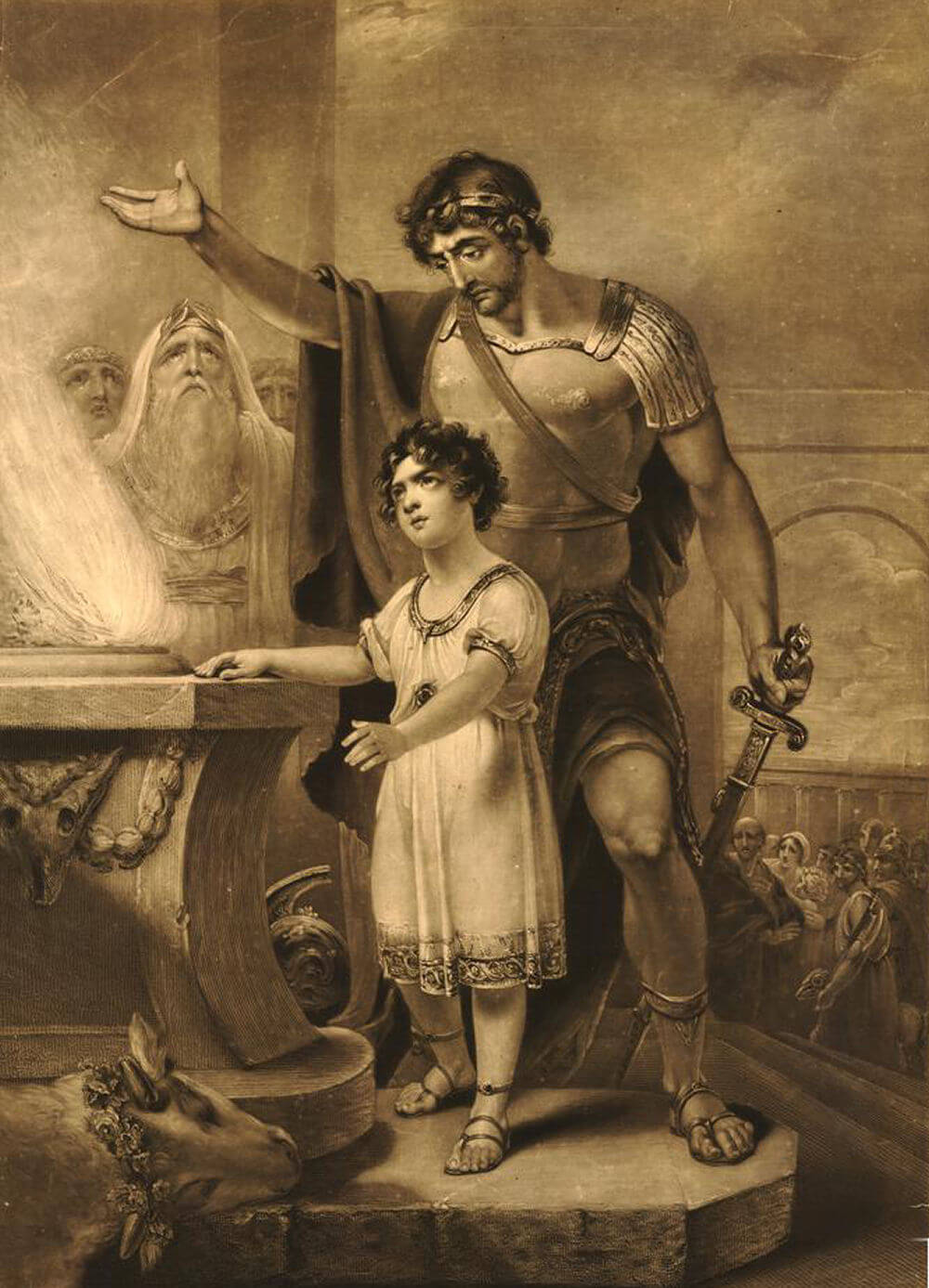
'Hannibal as a Child' by Charles Turner (1774-1857)
The Truceless War (241 - 237 BC)
The Carthaginian army was one of the most diverse and complex factions in military history. Apart from its officer corps, the entire army consisted of mercenaries drawn from all over the ancient world.
It consisted of Spaniards, Libyans, Numidians, Italians, Greeks, and Gauls. There was no common language or religion, yet they managed to fight together as a powerful unit, and were at times the best of their class in the entire ancient world.
The reason for its reliance on mercenaries rather than its citizens to make the bulk of the army rested on the fact that Carthage's indigenous population was relatively small, and an army of professional soldiers was in all ways superior to that of a conscripted one.
Furthermore, Carthage was the wealthiest trading state in the Mediterranean and could easily afford to pay for its vast mercenary armies, but after their humiliating defeat by Rome in the First Punic War, everything changed.
While Carthage had officially surrendered following its defeat at the Aegates Islands, Hamilcar's 20,000 strong mercenary army had been victorious in Sicily and they were to return to Carthage as champions.
Upon their return, the Carthaginian senate found that its treasury was close to bankruptcy because of the large cost of the war and the reparation payments forced upon them by Rome.
Unable to pay its army, the mercenaries became restless and started to openly rebel in Carthage. The Senate then ordered the army to be moved out of Carthage and into the nearby town of Sica, where they were promised payment upon their arrival.
This promise never eventuated, and when the Carthaginian commander, Gisgo, met with them to negotiate further, the angry mercenaries kidnapped him and his entourage whilst withdrawing from Carthage's service.
Seeing Carthage helpless and without an army, the two mercenary captains, Spendius and Mathos, now declared war against their previous employers. Word spread quickly of the rebellion and many Numidian and Libyan tribes joined the mercenaries. The "Truceless war" as it became known, had begun.
There was now no Carthaginian army to face the mercenaries. Mathos set up the rebel base at Tunis and quickly besieged the cities of Utica and Hippacritae, whilst Carthage itself was completely surrounded on land.
The Carthaginian senate appointed Hanno the Great ("Great" for his African conquests during the First Punic War) to raise and field a new army, which he accomplished with remarkable efficiency, creating a well-disciplined citizen militia.
After it had been supplemented with siege weapons and elephants, he led a successful attack on the rebel army, besieging Utica.
But Hanno's success was short lived; the war-hardened rebels quickly regrouped and wheeled around to counter-attack at Hanno's camp, routing the militia and seizing his artillery and supplies. Hanno himself managed to escape with a few shattered remnants of his army.
The Senate now looked to Hamilcar Barca and pleaded with him to take command. Hamilcar agreed, but found his position far from encouraging; Mathos continued his sieges of Utica and Hippacritae whilst thousands of Numidians, encouraged by the mercenary victory at Utica, revolted and joined the rebel army.
Hamilcar managed to string together a small militia force composed of the citizenry, but it was his superior generalship skills which would turn the tide. In the summer of 240BC, Hamilcar sneaked his army out of Carthage under cover of night and led a daring attack on Spendius' troops on the Bagradas River. Despite been outnumbered, he cleverly routed the rebel force and won a major victory for Carthage.
Following his success, a Numidian prince named Narava took to Hamilcar's side with an addition of 2,000 cavalry. Hamilcar then engaged the rebels at Hippacritae where he was victorious again, killing 10,000 and capturing 4,000.
However, in an attempt to win favor with the rebels, his prisoners were pardoned and released while others freely turned over to Hamilcar's side and strengthened his ever-increasing army.
With the war now entering its third year, Mathos and Spendius grew exasperated as they had never expected the conflict to become so drawn out. Worse still, Hamilcar was threatening to undermine the entire rebellion by offering friendship to his captured foes. This they could not allow, and they required a means to aggravate him.
With Gisgo still in their possession, Mathos had him and 700 other Carthaginians brutally tortured. Their hands and feet were amputated, their knees smashed and their eyes burned out, before being thrown into a trench to die.
Upon hearing the news, Hamilcar responded by capturing more rebels and having elephants stamp them to death. It was by these, and more atrocities to follow, that the rebel conflict became known as The Truceless War.
While Carthage now looked to be the dominant power on the battlefield, the war quickly slid back in favor of the rebels. Hamilcar and Hanno became involved in a bitter feud over military management, while the cities of Utica and Hippacritae sided with the rebels and slaughtered their Carthaginian garrisons.
With the financial support of these cities, the rebel recruitment base increased dramatically. Their cause had also been joined by a Libyan chief called Zarzas, whose own forces supplemented the rebel army to create a force in excess of 50,000 men.
The Carthaginian senate quickly grew weary over Hanno and Hamilcar's arguing, and Hamilcar was chosen as the sole commander of the army with Hannibal (not his son) appointed as his deputy.
Hamilcar immediately took to harassing the rebel army, but as he was heavily outnumbered, he refrained from pitched battle. Instead, he fought a brilliant campaign of attrition, outmarching and outwitting the rebels while scouring the countryside, attacking their supplies. Eventually, the rebels began to starve.
In 239 BC, in the most brilliant engagement of his career, Hamilcar eventually forced almost the entire rebel army into a boxed canyon known as "The Saw" and fortified the high ground. The starving army of over 40,000 men was eventually forced to surrender, and their leaders - Spendius, Autaritus and Zarzas (Mathos managed to escape) - were captured, while their entire army was executed.
Now, all that separated Hamilcar from victory was Mathos and his smaller army at Tunis. Hannibal was to take command here and, prior to the battle, he had Spendius, Autaritus and Zarzas crucified on a hill so that the rebels could see.
But the rebels had their vengeance. They smashed through Hannibal's defense and stormed his camp, capturing Hannibal, and, after taking their own leaders down from the crosses, had Hannibal and his officers crucified in their places.
The following year, Rome capitalized on Carthage's internal crisis and, in clear violation of the peace treaty with Carthage, seized the island of Sardinia. Hamilcar was outraged and demanded it back, but Rome threatened war and more reparation payments should Carthage resist.
With Carthage still struggling for military resources and rebel armies still in the field, Hamilcar was forced to accept. But it was because of this that Hamilcar swore to forever hate Rome, and he would pass this hatred onto his son, Hannibal.
But for now, Hamilcar turned his attention to the rebels and assembled another militia army, bringing his forces up to 20,000. While Mathos still outnumbered him, his troops were now primarily composed of Libyans and most of his veterans had been killed at The Saw. Hamilcar engaged Mathos at Leptis, where his forces were smashed and he was captured.
With their armies defeated and their leaders dead or captured, the war was won, and Hamilcar was hailed as the savior of Carthage.
Despite the atrocities of The Truceless War, Carthage would continue to rely on mercenaries for its army. Hannibal Barca and his mercenary army would be the terror of Rome in the following years.
But payment was never again an issue. Following his victory at Leptis, Hamilcar established Carthaginian power in Southern Spain and proceeded to greatly increase Carthage's wealth from its numerous valuable resources. As a consequence, he could easily afford to recruit the best soldiers in the world for a new army.
Major Battles
Bagradas River, 240BC
Carthaginian Victory
Carthaginian Strength: 10,000 militia, 500 cavalry and 70 elephants commanded by Hamilcar Barca
Mercenary Strength: 15,000 infantry commanded by Spendius
Needing a way to bypass the rebel armies who were guarding the Bagradas River, Hamilcar and his men discovered that they could cross the river mouth at low tide without being seen.
Making the crossing under cover of night, the militia arrived behind the 5,000 rebel guard the next morning. Informed of Hamilcars sudden advance, Spendius immediately marched out another 10,000 men to join the guard force and overwhelm Hamilcar's inexperienced citizen militia.
Hamilcar started the battle by ordering a faked retreat, and the over-anxious rebels were lured into a disorderly pursuit. All at once, Hamilcar turned and ordered an elephant charge which, literally, crushed Spendius' attack. While Hamilcars militia held the line, his cavalry hacked at the rebel flanks.
The rebel army never managed to regain control after Hamilcar's sudden onslaught and soon retreated having lost half of their infantry. Bagradas marked Carthage's first success of The Truceless War, and also marked the second occasion it had achieved victory at the river, the first been against Rome in 255 BC.
Carthaginian Casualties: About 500 infantry killed
Mercenary Casualties: 6,000 infantry killed and 2,000 men captured
The Saw, 239BC
Carthaginian Victory
Carthaginian Strength: 10,000 Infantry and 2,000 cavalry commanded by Hamilcar Barca
Mercenary Strength: 50,000 infantry commanded by Spendius, Zarzas and Autaritus
In 239 BC, Hamilcar's forces succeeded in destroying the supply lines of the rebel army, who now amassed in excess of 50,000 men. While the rebels had been besieging Carthage, the cessation of supplies threatened to starve them, and they were forced to withdraw. The rebels then began a tiresome pursuit of Hamilcar's army, which constantly managed to evade the rebels.
Despite been badly outnumbered and incapable of a pitched contest, Hamilcar devised a plan to destroy the rebels at a box like canyon known as "The Saw", which allowed easy entry but made escape extremely difficult.
Hamilcar ambushed the marching rebel army in the rear, and in their panic managed to herd the greater part of the enemy into the canyon while entrenching on the high ground, sealing them in.
The rebels now faced certain starvation, and turned to cannibalism as thousands began to die. Their commanders Spendius, Autaritus and Zarzas came forward to discuss terms of surrender with Hamilcar, but they were subsequently seized and imprisoned.
Fearing the worst for their own fates, the mercenaries made a desperate attempt to escape the canyon but, their efforts failed. Then, in his most ruthless show of butchery, Hamilcar ordered the execution of the starving 40,000 rebels, who were left.
The result of massacre at The Saw was that the mercenary army strength was drastically decreased, and that Carthage had overcome its greatest challenge of the war.
Carthaginian Casualties: Unknown, minimal
Mercenary Casualties: 45,000 infantry killed
Did you know...
The First Punic War had scarcely finished before Carthage created for itself an impossible situation with its mercenaries, resulting in the so-called Mercenary War, which allowed the Romans the opportunity to seize Sardinia, an event that Polybius thought was the chief cause of the Second Punic War. Some time after the revolt had begun in North Africa, perhaps in 239 BC, the Carthaginian mercenaries in Sardinia revolted, inviting the Romans to "interfere" on the island.