

Introduction
As governor of Illyricum and the Gallic provinces in 58 BC, Legio VI was one of the garrison units that Julius Caesar had at his disposal. Raised in Cisalpine Gaul in 52 BC, Caesar's Sixth Legion served with him during his entire career as Consul and Dictator, and was withdrawn to Hispania in 49 BC.
Caesar took Legio VI to Alexandria to settle the dispute in Egypt between Cleopatra and Ptolemy. Alexandria was under siege and the legion was almost wiped out, losing almost two thirds of its entire manpower.
Caesar eventually triumphed when reinforcements arrived, and during this campaign the 6th Legion seems to have earned the name "Ferrata" (Ironclad).
The legion was apparently disbanded in 45 BC, establishing a colony at Arelate (Arles), but was re-formed by Lepidus the following year and given over to Marcus Antonius the year after that. Following the defeat of the Republican generals Cassius and Brutus in successive battles at Philippi in 42 BC, a colony was again formed from retired veterans of the 6th, at Beneventum. In 41 BC, however, some remaining members of Legio VI Ferrata seem to have been taken by Antonius to the East.
Another Legio VI that was originally stationed in Hispania evidently saw action at Perusia, in central Italia, also in 41 BC. This in itself is difficult to explain, since veterans of the 6th were supposed to have been either retired or sent east with Antonius. It seems that Octavian had no reservations about using duplicate legionary numerals already in use by Antonius.
Antonius had serving with him V Alaudae, VI Ferrata and X Equestris, but Octavian's army included a V (the later Macedonica), VI Hispaniensis (the later Victrix) and X (Fretensis).
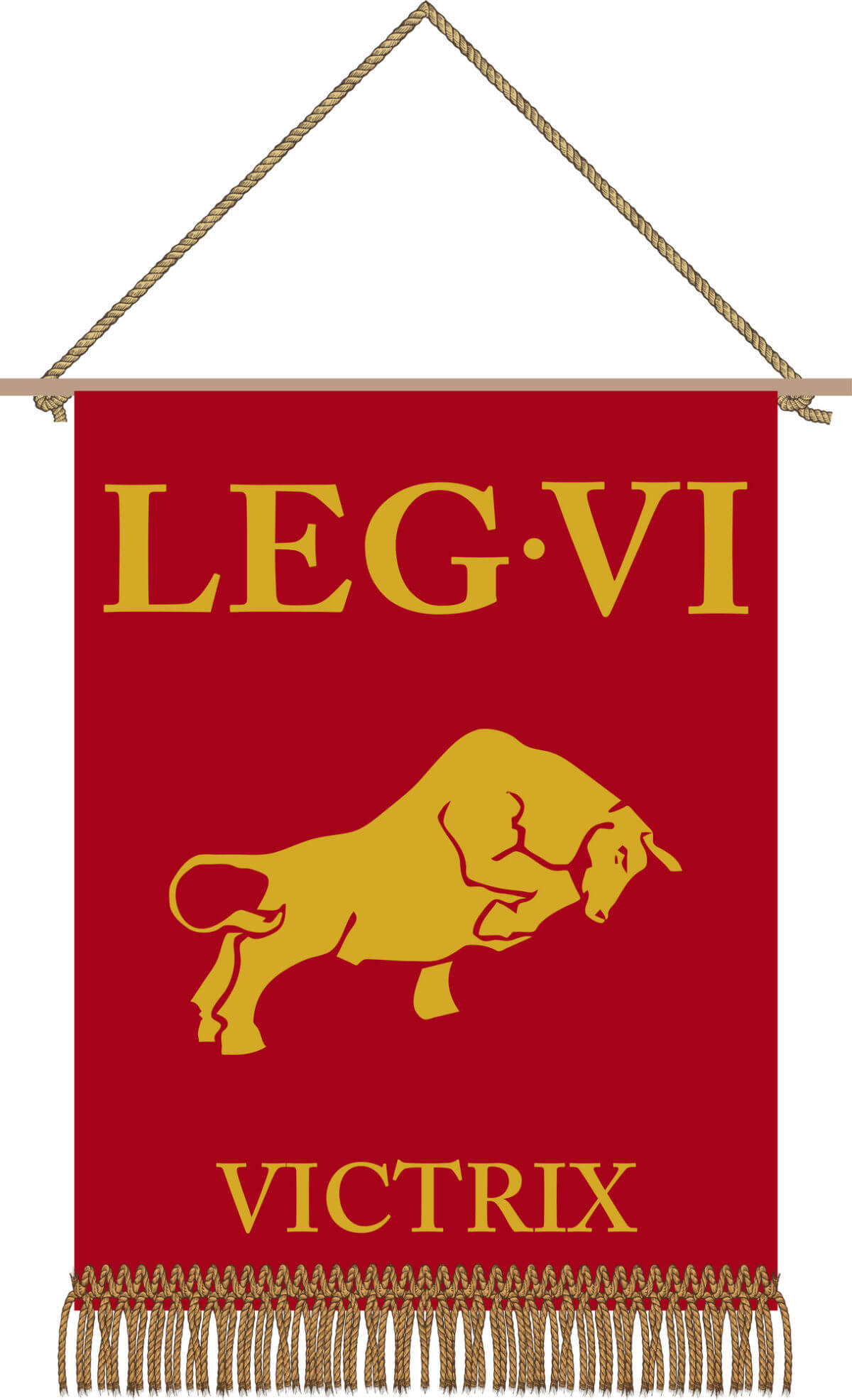
Of Octavian's legions, V and X, and less certainly VI, used the bull emblem on their legionary standard, which would normally indicate a foundation by Caesar; but the true Caesarian legions with these numerals (Alaudae, Ferrata and Equestris) were apparently with Antony.
It seems safe to say that Octavian used some of the retired veterans of Caesar's Sixth Legion at Beneventum to form the core of his own Sixth Legion used at Perusia. It is very possible then that both Legio VI Hispaniensis (Victrix) and VI Ferrata originated from Caesar's Sixth Legion.
At the battle of Actium in 31 BC, Antonius' VI Ferrata was severely defeated by Octavian's forces, including his version of the 6th. Following Actium, another colony of veterans seems to have been created at Byllis, probably together with soldiers from other legions, and the remainder of VI Ferrata was moved to Syria, where it was to remain. At this point Legio VI Victrix, still called Hispaniensis, seems to have been returned to Hispania.
Hispania Campaigns
After his victory over Antonius, the-newly appointed Emperor Augustus sent his general, Marcus Agrippa, against the Cantabrian and Asturian tribes of Spain. Between 27 and 13 BC, Agrippa's campaign was to be very costly in terms of Roman manpower. He had the use of seven legions during these campaigns, of which only four survived; II Augusta, IV Macedonia, VI Hispaniensis, and X Gemini.
The pacification of the Spanish tribes was complete, however, as the strength of the resident garrison was reduced after the Varus disaster in 9 AD, by the removal of Legio II Augusta to Germania. Three legions were left to secure Spain: IV Macedonica, VI Hispaniensis and X Gemina.
Little is known of the actual garrison points of the legion during this time, but Colonia Caesarea Augusta (present-day Zaragoza) was probably established in 19 BC by veterans from legions IV, VI and X. Legio VI does seem to have been based somewhere near Asturia, prior to Nero's reign in the 60's AD.
During the reign of Nero, Legio VI was the only legion left in Hispania, and seems to have been moved to present-day Leon. The title of "Victrix" could have been endowed at some point during this time period. As the only active legion in Hispania, they were responsible for quelling the entire region. They very well may have been granted the title for exemplary service as an independent legion.
Civil War
In the summer of 68 AD, the Emperor Nero committed suicide, after external pressures forced him to believe that his position in Rome had become untenable. The Senate elected Servius Sulpicius Galba to be the next emperor; the wealthiest citizen in Rome, he had a distinguished military and government career, and was serving as governor of Spain at the time.
The 73 year old man was proclaimed Emperor at the camp of Legio VI Victrix. Galba left Spain for Rome, with a newly raised Legio VII Galbiana, and left VI Victrix to garrison Hispania.
When Galba reached Rome, he sent VII Galbiana on to the Danube frontier, leaving himself without close by loyal troops. Unfortunately, Galba's old-fashioned virtues of thrift and discipline sat poorly with the Roman power culture that had so recently been corrupted by Nero. He was assassinated by the Praetorian Guard in January of 69 AD. His only defender was a Centurion named Sempronius Densus, who tried to hold off the revolting guardsmen with his vitis (vine staff), before being cut to pieces.
In the ensuing civil war that followed between Otho, Vitellius and the eventual victor, Vespasian, Legio VI maintained control of Hispania. Unfortunately, the war had left the Rhine border of Germania dangerously exposed, and the Batavian tribes revolted.
Batavian Revolt
At first, the Batavians under a leader by name of Civilis, enjoyed some moderate success. By 70 AD, however, the new emperor Vespasian sent a large expeditionary force to the north. VI Victrix was one of the legions involved, under the command of Sextus Caelius Tuscus. At Xanten, the Romans were victorious in a hard-fought battle, which was commemorated in an inscription that mentions both the new emperor and the commander, Tuscus.
After the quelling of the Batavians, VI Victrix remained along the Germanic border and was stationed in Novaesium (the present-day city of Neuss, Germany).
Saturninus and Domitian
In 89 AD, Antonius Saturninus, the Roman governor of Upper Germania, led a revolt against Emperor Domitian. The legions of Lower Germany remained loyal, and VI Victrix - which was at this time stationed in Vetera, near Xanten - was instrumental in the defeat of the rebels.
As a reward for this decisive action and loyalty, VI Victrix was awarded the additonal title of Pia Fidelis Domitiana (faithful and loyal to Domitian). With the death of Domitian in 96 AD, the Domitiana element of the title was dropped.
Dacian Wars
During the Dacian wars of the Emperor Trajan, units of VI Victrix were sent to the Danube, which were almost unguarded, as its traditional garrisons were fighting in Dacia. One inscription suggests that it was part of a combined force with I Minervia and X Gemina from Bonn and Nijmegen.
Vexillations (detachments) from IX Hispania in Britannia may have been sent as reinforcements to the 6th home base camp at Vetera.
Transfer to Britannia and Hadrian's Wall
In 122 AD, Emperor Hadrian sent Platorius Nepos, along with the 6th Legion, from Germania to the Salway/Tyne frontier in Britannia. It seems to have traded places with the previous occupant, Legio IX Hispana, which was sent to the Rhine border.
Favored by Vespasian for their construction work on the Rhine frontier, Legio VI Victrix was stationed at Eburacum (York) and was set to work immediately on construction of Hadrian's Wall. Among its first achievements was the construction of the Tyne Bridge at Pons Aelius (Newcastle).
While detachments of Legio II Augusta and XX Valeria Victrix built the western wall, Legio VI built the entire eastern portion. Additionally, Victrix built a temple to Neptune at Pons Aelius. When completed, Hadrian's Wall stretched the entire length of northern England and served as a fortified security perimeter against northern tribes. Manned by auxiliary troops in its several interspaced forts, the wall was a base from which cohorts could move out and engage enemies to the north.
Antonine Wall
The same three legions - II Augusta, VI Victrix and XX Valeria Victrix - built the Antonine Wall further north, starting about 140 AD. This wall did not prove successful, and was largely abandoned twenty years after its construction. The wall, much smaller in size and fortification than Hadrian's Wall, stretched from Edinburgh to Glasgow in present-day Scotland. At some point during or after the construction, Legio VI, under Julius Verus, erected a dedication to Mars Ultor (the Avenger) at Corbridge.
Widespread revolt among the Picts and Celts occurred between 155 and 158 AD, requiring heavy fighting by the legion. Losses were great, and the Romans were forced to abandon the wall and fall back to the more substantial Hadrian's Wall.
Clodius Albinus, Septimius Severus and the Caledonia Campaigns
In 196 AD, the then governor of Britannia, Clodius Albinus, made an attempt at the throne. Bringing the three British-based legions along, he fought several engagements with the forces of Emperor Septimius Severus. In 197 AD, Clodius was defeated decisively and the three legions, including Legio VI, were sent back to Britannia.
Upon its return to Eburacum, Legio VI found the city overrun and parts of Hadrian's Wall in terrible disrepair. Over the next few years, the invaders were pushed back across the wall, and repairs were completed by 205 AD.
In 208 AD, Severus personally came to Britannia and led a campaign against the northern Caledonian and Maetae tribes. Severus used troops from Legio VI for these expeditions, which lasted until his death at Eburacum in 211 AD.
No major formation battles were fought in these campaigns and Roman losses were very heavy as a result, but the tribes had to yield territory, and eventually come to terms. Those tribes rose again, however, and the following year Severus' son and successor, Caracalla, mounted yet another expedition which proved successful in maintaining peace for much of the rest of the century.
At some point during these campaigns, Legio VI was awarded the additional title of 'Britannica' by either Severus or Caracalla. By now, its complete honorific name was "Legio VI Victrix Pia Fidelis Britannica".
Carasius, Allectus, Constantinus Clorus and Withdrawal
A long period of relative peace followed the Severan dynasty, but disruption came again in 287 AD, when Carasius set himself up as Emperor of Gaul and Britain. He was then murdered by Allectus who, in turn, was defeated by Constantinus Clorus.
During this civil war, the northern frontier was once again stripped of troops and overrun by northern tribes. Legio VI Victrix returned and, like in the past, had to rebuild their base at Eburacum and damaged sections of Hadrian's Wall.
The situation in Britain would be stabilized again over the next seventy years, and Britain maintained a great deal of prosperity.
By 367 AD, however, Picts, Scots, and Saxons combined in an assault on Roman Britain, and would once more overrun the northern defenses. Eburacum and Hadrian's Wall yet again had to be restored, for what would be the final time. The Emperor Valentian sent his general, Theodosius, with an army strong enough to re-establish Roman authority.
Britain returned to its previous prosperity, but barbarian invasions throughout the rest of the empire began to take its toll. Attacks from various quarters of Europe forced the Emperor Honorius to withdraw most of the combat troops from Britain in 403 AD, including Legio XX Valeria Victrix.
A fragment of Legio VI was left at Eburacum when Roman rule in Britain came to an end in 410 AD, to try and maintain a semblance of order. The legion was soon attacked again by the northern tribes and asked for help from Rome, only to be told by Honorius that no help would be coming.
At this point, the history of Legio VI Victrix was moving into its final stage, and any remnants of Legio VI that were unable to escape would have been either killed or incorporated into the new post-Roman Britain. 400 years of Roman authority had come to an end, ushering the dark ages into Europe.
Did you know...
Boudicca, Queen of the Iceni, led a revolt against Roman occupation of Britain in 60-61 AD. It was the efforts of Legio II Augusta which eventually secured the province for Roman rule.


Legions of Rome: The Definitive History of Every Imperial Roman Legion
by Stephen Dando-Collins
Featuring more than 150 maps, photographs, diagrams and battle plans, Legions of Rome is an essential read for ancient history enthusiasts, military history experts and general readers alike.