

When Rome went to war, an enemy fortress was nothing more than an obstacle to be overcome. Roman legions carried with them field artillery which meant they were well equipped to deal with opposing fortifications.
Their policy of having artisans and sappers in the ranks meant that any unit could build defenses and attack those of the enemy.
It seems that their greatest enemy was often time.
The Survey
The first task was to survey the enemy defenses. The Roman commander would be looking for weak spots and places where the defenders were vulnerable.
In particular, the gate would be studied, as breaking through there might be easier than pulling down a wall.
There were risks, as a quick witted enemy might ambush the Roman commander, as happened to Titus at Jerusalem.
The Camps
Once at the scene, the Roman legions encamped. Marching forts were established, and sometimes extra redoubts were created as guardposts in cases where the circumvallation (surrounding wall - see below) was a long one (Julius Caesar had eight camps and twenty-three redoubts at Alesia for instance).
These men needed food, water, timber, and feed for their animals. This entailed foraging parties who would find it increasingly hard to find what they needed, thus requiring a speedy close to the siege. A Roman advantage here was logistics, something they had a particular talent for.
At the Siege of Massada in 72 AD, the Romans were camped in a dry desert which was hot by day, cold by night. It took four hundred donkey loads a day to supply the Tenth Legion and the thousands of Jewish slaves labouring for them.
The Circumvallation
The third task was to create some form of circumvallation - a surrounding wall. This might be a simple ditch, a wooden stockade, or something more like the comprehensive defense that Caesar built at Alesia.
The object of these surrounding defenses was to protect the legionaries and to make sure that no defenders got out.
Building them quickly was vital. At Jerusalem in 70 AD, the men assigned to build the defense were attacked and almost routed. Caesar, too, found it necessary to build in haste at Alesia when he discovered an army allied to the besieged Gauls was heading his way.
He had another circumvallation fourteen miles long built around the first but facing outward, with ditches and a moat fed by local streams. So extensive in fact, that Caesar had trouble finding enough men to man the ramparts, although he no doubt exaggerated his reports of them.
The Siege of Numantia in 134 BC was even more impressive, yet a Numantine soldier named Retogenes, aided by five friends and five servants, climbed the circumvallation, slew the sentries, and stole a horse to summon help. He and four hundred volunteers were betrayed for fear of reprisals.
Such walls were usually effective. Spartacus was trapped by a wall built by Crassus across the toe of Italy. Making his escape, Spartacus apparently lost up to twelve thousand men for only a handful of Roman casualties.
Earthworks were made by men with nothing more than pickaxes and baskets, yet ditches up to nine feet deep are recorded as being built in very short periods of time. Wooden stockades varied in height too, although between six and twelve feet in height would be typical.
Although Roman carpentry was well up to the task, it should be remembered that they were building with unseasoned timber. Right from the start maintenance was required to prevent weak spots or collapses. Julius Caesar had his men forage for one months supply of timber before the arrival of the allied Gaul army at Alesia.
At the Siege of Masada there were no local forests, so a wall of loose rocks and stones was built instead, even though the defenders had little chance of descending from the plateau to attack. Stone walls of a permament nature sometimes had a shallow earth buttress, both to enable easy defence and to reinforce the wall.
In defence the Romans were steadfast, but they rarely had to suffer any prolonged sieges due to superior communications. There were exceptions though. The Romans defending Pevensey in the 5th century AD were unable to prevent Saxons from butchering the local population and plunging the area into relative darkness for six hundred years.
The Plan
Having arrived and established themselves, the Roman commander then needed to consider how the siege would be conducted.
The key to siegecraft is patience. However, Roman commanders wouldn't usually wait for the enemy to surrender. It was poor strategy to have their army camped in one place for long periods on campaign, therefore it was more expedient and satisfying to accept the higher casualty rates of a direct assault.
Information about your enemy was very important. This was obtained from prisoners, deserters, and travellers. Knowing the state of the enemy could open up a successful plan to end the siege without too much effort.
At Jerusalem, Titus originally hoped the ordinary citizens would force a surrender due to starvation, although finally he chose to commit his men to a hard fought assault.
Caesar knew the Gauls besieged at Alesia were short of food, and since the end of the campaign was in sight, he felt no inclination to waste his men in a direct attack.
Roman commanders had little time for the subtleties of psychological warfare. Intimidation was clearly important. If the enemy surrendered quickly they were generally well treated, but for those who showed defiance, Rome would show no mercy.
The Arsenal
Ballista or Carroballista - Basically a large crossbow powered by twisting ropes made of sinew, horsehair, or leather.
It was smaller weapon than the catapult (onager) and was used to kill and injure the enemy soldiers advancing or those within a fort, trying to sustain a siege.
The ballista came in a range of sizes with varying ranges. A ballistae bolt could be fired anywhere from 300 yards (275m) to 550 yards (500m). It was loaded with a 3 ft (100cm) bolt that could be fired at up to 115 mph (184 kph). The effect of impact could be devastating.
Intended for battlefield support but equally at home keeping defenders heads down. Often mounted on platforms near the wall.
Catapulta - Like a ballista but using a long arm to hurl stones instead of firing them directly. Of a similar size to ballistae.
Fire - A useful tool, commonly used to burn down gates, or indiscrimately razing buildings to the ground. 'Greek' fire doesn't appear in the accounts of sieges.
Grapple - A metal hook for pulling down walls. Clearly the quality of the wall dictated how effective this method could be. The pulling power was provided by men or animals.
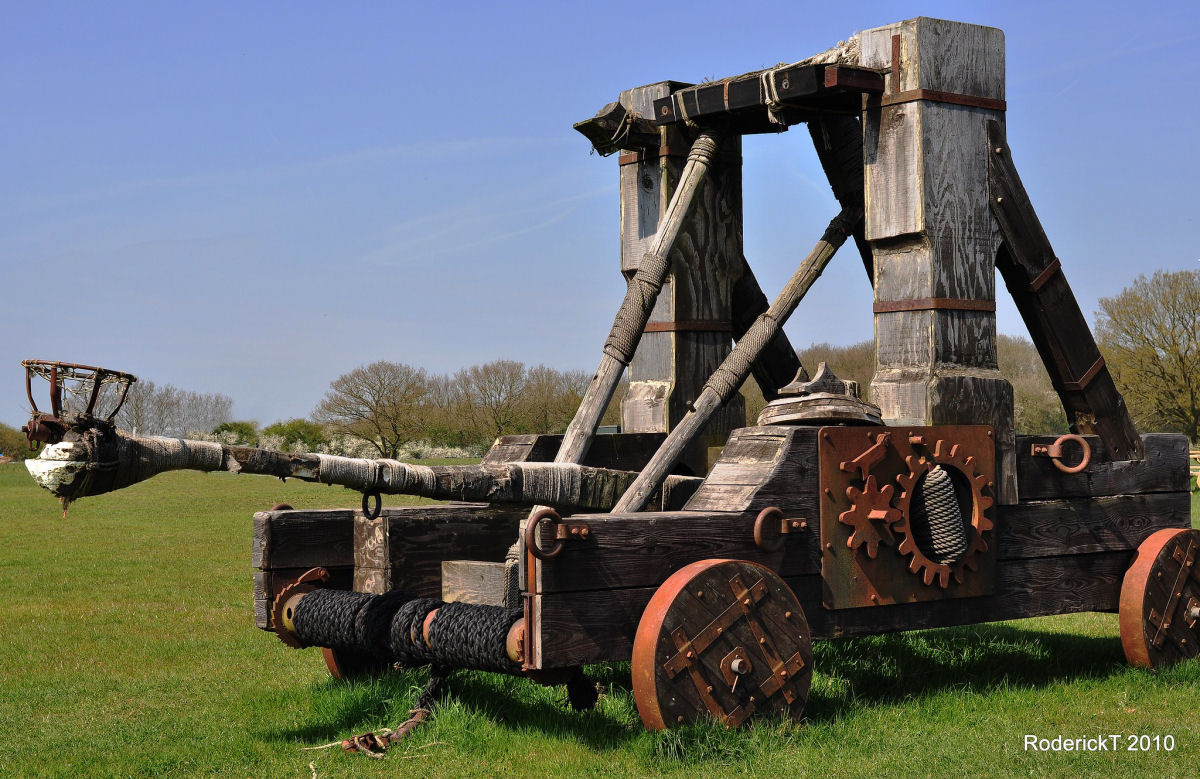
Onager - The Roman catapult. The onager, Latin for 'wild ass', was a very large and cumbersome piece of equipment.
It could fire rocks of up to 150 lbs (70 kgs) to be used to smash through walls and fortifications. It could also be loaded with the equivalent mass of smaller stones or fiery pitch to use against enemy troops or to bombard the inside of a fort.
Its range was much shorter than that of the ballistae and could be in danger of attack by enemy bowman during a siege.
Ram - A large tree trunk, usually tipped with iron, suspended on chains or ropes.
Siege Tower - A rarely used alternative to platforms. A three storey wooden tower on wheels pulled toward the walls to allow a small drawbridge to reach the tops of enemy walls. Animal skins soaked in water provided protection from fire. Sometimes ballistae were mounted on the top level.
These towers required levelled ground before they could be wheeled into battle.
Totellon - A long lever or primitive crane used to deliver basket loads of soldiers onto the enemy ramparts.
Roman Artillery
It is difficult to determine the exact number of field artillery pieces that would accompany a legion, but Vegetius Renatus in his Epitoma Rei Militaris, from the time of Valentinian, makes some suggestions that are accurate enough for this article.
His writings make it safe enough, without being horribly inaccurate, to assume that each centuria of the legion would be provided with a carroballistae.
An additional 10 onagri would be assigned, 1 to each cohort. There is some argument that the 10 onagri would simply replace 10 of the carroballistae for a total of 59 artillery pieces in the legion but again, the difference regarding this particular outline is irrelevant.
The pieces would be drawn, mounted on a carriage, by either oxen or mules and each required 10 artilleryman (Libritors) to operate.
Each piece would apparently fall under the command of the centurion within each century that it was assigned to.
The Siege
The worst danger for the Romans at this point would be boredom. Barbarians of all cultures showed native cunning when besieged by the legions. Ambushes, night attacks, and ruses are recorded. Titus very nearly executed his officers for allowing themseves to be humiliated by Jews pretending to surrender at Jerusalem, not to mention being personally threatened by ambush.
The entire reason for Caesar's extraordinary circumvallation at Alesia was the night forays and escape attempts by desperate Gaul horsemen. A young Jew stole water from under the noses of Roman guards at Jerusalem.
Platforms were often built close to the enemy wall to allow the soldiers to fire on the defenders with some equality. Remarkably, ballistae were sometimes mounted on these wooden constructions even under fire from the enemy. Not suprisingly, the Romans suffered considerable casualties building them.
The stone throwing engines such as onagers or ballistae were usually sited between two or three hundred yards of the wall. The ordinary field artillery fired stones that had little effect on stone walls. However, at Jerusalem, stone throwers forty feet high were built that fired missiles in excess of one hundred pounds.
When the defenders set sentries to spot the missiles and warn everyone to take cover, the Romans began painting the bright limestone rocks black.
Julius Caesar records the hundreds of Gaulish 'Oppidum' forts he assaulted in a ten-year campaign, an indication of the poor quality of their walls. Titus, on the other hand, despaired of breaking down the sturdy walls of Jerusalem that measured up to 105 feet high and 15 feet thick.
Siege mining wasn't popular with Roman commanders. There was little call for it, plus it was too slow. It wasn't always effective either, as Titus found at Jerusalem when the walls refused to cave in. An alternative was a grapple that was used to pull the tops of walls down.
If these methods failed then it was a ram that broke through. In order to get a such a ram up to the walls of Massada, an earth ramp had to be built by the Jewish slaves that can still be seen today. To protect the men working the ram, it would be covered by a mantlet or cover known as a 'tortoise'.
The Assault
The Romans were keen to conduct warfare with aggression, and siegecraft was no exception. Soldiers could be rewarded with medals for being the first man through a breach for instance. Once inside, the men would typically kill anyone they found. Women, children, and old men were often butchered, whether they cried for mercy or not.
Diversionary attacks were essential, too. Ladders would be set against the walls, gangways dropped from platforms, totellons loaded and employed to clear the ramparts. Siege towers were brought up to the wall. Artillery would aim to keep defenders from mounting organised resistance. Roman success was not a forgone conclusion. The defenders of Jerusalem caused the Roman assault to fail at least three times.
At Massada the assault was slowed by a hastily built inner wall. The Romans destroyed this by setting fire to the wooden baulks supporting it, but the fire raged out of control. Had it not been for a favourable wind the Roman siege engines would have burned too. It was with some astonishment that legionaries who broke into Massada discovered the enemy had already committed mass suicide.
Jerusalem in 70 AD was a large and extremely strong walled city that took four months to conquer. Massada two years later was a masterpiece of siegework against a stout isolated castle. Although it reportedly lasted 2-3 years, modern research suggests a much shorter period of 2-3 months.
Aftermath
Retribution was immediate. Survivors commonly had their right hands amputated so they could never again wield swords against Rome. Barabarian looters were slain on the spot. Soldiers, however, carried off booty at will. It's recorded that in Syria the value of gold plummeted by half following the siege of Jerusalem. Often the city or fort was demolished, sometimes with orders that it never be rebuilt.
Thousands of Jews were sent for hard labour in Egypt because the legions had grown tired of the killing, although many were sent to the provinces for the arena. Only the young were sold as slaves. Vercingetorix finally surrended Alesia to Julius Caesar when the food ran out. He was taken to Rome in chains and ritually strangled six years later.
Sources
- The War With Hannibal - Livy
- The Civil War - Caesar
- The Gallic War - Caesar
- The Jewish War - Josephus
- Rome and her Enemies - Ed. Jane Penrose
- Greece and Rome At War - Peter Connolly
- Roman Warfare - Adrian Goldsworthy
- The Roman War Machine Vol 1+2 - History Channel Video
Did you know...
The Siege of Numantia was the first notable military endeavour by Gaius Marius.
Did you know...
Ancient artillery can be divided into two primary groups: torsion and non-torsion.