

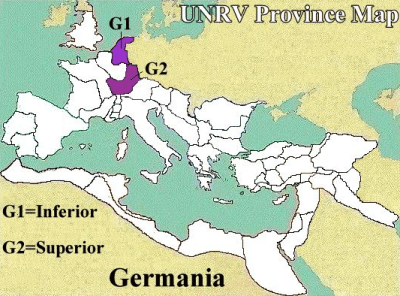
Germania Inferior and Germania Superior
From the third century BC onwards, the Germanic world was continually affected by migrations that would continue to gain momentum and significance as time advanced.
Rome's first major contact with Germanic people came in the late 2nd Century BC, when members of the Cimbri and Teutoni tribes wandered en masse into Southern Europe and Gallia.
These migrations were neither simple warrior-raids nor armies on the march, as the Romans were accustomed to, but the complete relocation of entire tribes of people.
Displacing Celtic tribes as they moved, the force of these "first-contacts" was a harbinger of what would come over the next several centuries.
In 113 BC, the Cimbri and Teutoni defeated a Roman army under Gnaeus Papirius Carbo in Noricum. They then pushed west of the Rhenus and threatened the territory of the Celtic Allobroges.
A request to settle the land was refused by Rome, and in 109 BC they again defeated another Roman army under Marcus Junius Silanus in southern Gaul.
They didn't follow up by pressing further and disappeared from Roman influence, but by 105 BC, the Cimbri King Boiorix and the roving Germans returned. They crushed the armies of Mallius and Caepio at Arausio (Orange), killing over 60,000 Roman Legionaries.
Again they turned away from Italia, the Teutoni settling in southern Gallia and the Cimbri moved towards Hispania. Driven from Hispania by the Celtibereans, the two tribes reunited and by 103 BC were again moving against Italia.
Fortune had run out for them, and in 102 BC, the Teutoni were defeated by Gaius Marius at Aquae Sextiae, losing over 100,000 men.
The Cimbri succeeded in passing the Alps and driving Q. Lutatius Catulus across the Po River, but in 101 BC Marius overthrew them on the Raudine Plain near Vercellae. Their king Boiorix was killed and the whole army of over 60,000 men was destroyed.
Relative peace between Rome and the Germanic tribes would reign until the campaigns of Caesar some 50 years later in Gaul. During his conquests he was forced to make three separate campaigns against the Germans. The Germanic Suebi tribe crossed the Rhenus River and had invaded Celtic lands earlier, before Caesar's arrival.
In 58 BC, a Celtic request for help gave Caesar the excuse he needed to begin his campaigns in Gaul. Caesar, with his Germanic allies the Ubii routed the Seubi and sent them back across the River.
In 55 BC the Germanic Tencteri and Usipii tribes arrived along the banks of the Rhenus and overtook the Menapii. Caesar bridged the Rhenus and along with his Legate, Labienus, drove them out by defeating their Prince, Induciomer.
Caesar bridged the Rhenus again, in 53 BC, to pursue the Germanic tribes who had aided the Celts in Gallia, but the Germans avoided contact with the Legions and Caesar withdrew empty-handed.
The civil war between Caesar and Pompeius would put an end to any further ideas he may have for campaigns into Germania.
Over the next several decades, Germanic incursions into Gallia would continue and Augustus' victory over Antonius, establishing the Imperial system, gave him the power and resources necessary to focus on Germania. He reorganized the provinces and established Germania Inferior in the North, east of Belgica and west of the Rhenus, and Germania Superior bordering southern Gaul and Noricum in the east.
In 12 BC Nero Claudius Drusus "the elder" crossed the Rhenus to establish Roman control. Many of the Germanic tribes were conquered and by 9 BC he had pushed the border of northern Roman Germania to the Albis (Elbe).
Drusus died later that year and was replaced by his brother Tiberius. Tiberius fought a number of smaller wars and eventually left Germania in the hands of various legates who had established friendly relations among the Germans.
Augustus, satisfied with the accomplishments of both Drusus and Tiberius, pushed to make Germania Magna (between the Rhenus and Albis) a province of the Roman Empire. The Romans, however, had overestimated their position and found the tribes unwilling to accept the offer of provincial status.
In 9 AD under the command of Publius Quinctilius Varus the Romans were caught in a surprise attack while marching through the Teutoburg Forest. The Cherusci tribe, under Arminius (Hermann) destroyed 3 full Legions, the XVII, XVIII, and XIX, resulting in the death of 20,000 Legionaries.
Between 14 and 16 AD, Germanicus took command in Germania. During his campaigns, he recovered two of the lost standards, but was able to accomplish little of real importance, aside from moral victories, against the scattered Germanic tribes and Arminius. Arminius himself fell victim to the treachery of his own tribe and was killed in 19 AD.
The Rhenus would eventually become the permanent eastern border of the two Germania provinces. Over the next two centuries, fighting between Germanic tribes was as relentless as their incursions into Gallia. The Romans built a considerable series of fortifications across both the Rhenus and Danubius rivers, called Limes, and were generally resigned to defending the rivers as their farthest northern frontiers.
The Germania provinces were among the most active for the Roman Legions. Defending the fortifications along the Rhenus and Danuvius Rivers was a full time duty.
Migrating Germanic tribes often pushed one tribe or another towards the Roman borders to find new settlements, and war-like local tribes often looked for opportunities to raid the wealthy Romans.
Between 166 and 180 AD Marcus Aurelius led a number of massive campaigns against the Marcomanni and Quadi tribes along the Danube, essentially pacifying the border region for the next century and a half. However, the great Germanic migrations beginning in the fourth century would devour Roman Germania first.
Germania Inferior was the permanent garrison of Legio I Minervia and Legio XXX Ulpia Victrix. Germania Superior was garrisoned by Legio VIII Augusta and Legio XXII Primigenia. Both provinces were also supplemented by many necessary auxiliaries. These legions were either destroyed or completely reconstituted by the early 5th century AD.
The Roman Conquest of Germania
After the fall of the Roman Republic and Octavian's accession as Augustus, the new imperial military policy dictated several expansionist efforts.
Of these, the policy in Germania included pushing the frontier borders from the Rhine (Rhenus) to the deep German interior, which may have been desired along the Elbe (Albis) River.
Germanic incursions into Gaul, which had been a recurring problem since Caesar's conquest in the 50's BC, gave Augustus a perfect excuse to keep the legions from idleness.
During Caesar's conquest, which included the first Roman crossing of the Rhine, hostility between Romans, Celts and various Germanic tribes hampered his progress.
During Octavian's role as a triumvirate responsible for the western provinces, his Legate Marcus Vipsanius Agrippa led a considerable campaign between 39 and 38 BC against the Suebi (also old enemies of Caesar).
The final straw seems to have been a Germanic Sugambri invasion into Belgica (17 - 16 BC) which resulted in the loss, and ultimate disgrace, of one Legionary standard.
In response, Augustus sent his stepson Drusus - while Tiberius was busy in Pannonia - to oversee a reorganization of the Germania provinces (Superior and Interior), which were essentially military frontiers roughly encompassing the Rhine valley.
By 12 BC Drusus crossed the river and conducted several punitive campaigns.
Between 12 and 9 BC, the Sugambri, Frisians, Chauci, Cherusci and Chatti were all subjugated and Roman legions established several large bases in the deep Germanic Interior.
In the summer of 9 BC, Drusus reached the Elbe and after apparently calling off the campaign for the season to return west, he fell of his horse and died.
While it's unclear what Drusus' orders or goals really were, whether a punitive campaign or actual lasting conquest, complete with Roman border expansion, Rome had established at least loose control of the Germanic interior.
After the death of Drusus, Tiberius, an able and competent general, took over, but only for a short time. While continuing the work of his brother, in 6 AD Tiberius inexplicably decided to retire to private life on the isle of Rhodes.
Tiberius' departure created its own problems with Augustus' imperial strategy, but for the time being, all seemed mostly quiet in the newly conquered lands of Germania.
There is now doubt, however, despite missing evidence from ancient sources, that the conquest of Germania continued in Tiberius' absence. On at least one occasion, an army commanded by Lucius Domitius Ahenobarbus is attested to having crossed the Elbe in response to a Germanic uprising.
The ancient sources, in apparent attempts to gain favor from Tiberius after his ascension, seemingly discounted the work of his successors in Germania, in order to glorify Tiberius all the more.
Regardless, Tiberius finally returned to finish the conquest in 4 AD. At this point, a campaign was planned to finish off the extension of Rome's borders, filling in a previously unscathed stretch of land (Bohemia) occupied by the Marcomanni and their King Marbod.
By the winter of 5 and 6 AD, a large scale double pronged invasion was planned, with Tiberius planning on a northerly march from the Danube and another force marching east from the Rhine.
A massive revolt in the province of Pannonia, however, would put an abrupt halt to the plans, and Tiberius was forced to march south, leaving Publius Quintilius Varus in charge instead.
Arminius and the Battle of Teutoburg Forest
Arminius (b. circa 18 BC, d. circa 21 AD, assumed to be the Latinized form of Hermann) was the chief of the Germanic Cherusci tribe during the later stages of Augustus' reign.
Prior to the great revolt which pushed Rome permanently out of the Germanic interior, and after the conquests of Drusus and Tiberius, Arminius served as a Roman auxiliary (c. 1 to 6 AD), apparently with much success.
Some have painted a picture of a young Germanic warrior with the ultimate goal of freeing the tribes by learning Roman military ways, but his service and that of his fellow Cherusci warriors, actually exemplifies the completeness in which the Romans had spread their influence throughout Germania (as well as identifying the early stages of the barbarization of the Roman Legions).
Although at this stage, Germania Magna was not an official province, and was still unsettled per Roman victory conditions, the slow process of Romanization had begun in earnest.
Arminius, it seems, even earned Roman citizenship as well as equestrian status, perhaps in part, as a peace settlement.
During the revolt in Pannonia, which forced Tiberius' withdrawal from Germania, and his replacement by Publius Quinctilius Varus, conditions seem to have deteriorated considerably.
Varus, it seems, (one must consider the conflicting reports by Cassius Dio, Tacitus, Florus and Paterculus regarding the political climate and the battle itself) was probably given the task of completing the subjugation of Germania and implementing Roman provincial standards by Augustus.
Regular taxation, undoubtedly a condition that the Germanics were unaccustomed to, as well as other 'excesses', seem to have turned the tribes against their Roman occupiers.
Arminius returned to the Cherusci as early as 7 AD, and likely began preparing for a massive revolt soon after his arrival. Inter-tribal warfare and lack of unity was something that would plague the Germanics for centuries, but in this one instance, the tribes were uniquely brought together in their zeal to throw off the Roman yolk.
Everything was not completely in unison, however. Arminius' rival, Segestes, actually his own father-in-law, reportedly betrayed the plans of revolt to Varus, but these reports were unheeded.
Perhaps writing off the idea as political infighting for personal gain, or trusting Arminius due to his service as a Roman auxilia, and equestrian, Varus ignored the warnings, with predictable results.
In 9 AD, the situation had come to a head and reports of a growing uprising in northern Germania (perhaps the Chauci) began to reach Varus. Encouraged by promises of allied assistance from tribal leaders like Arminius, Varus set out northward for the Chauci.
In late summer of 9 AD, Varus marched in loose formation with the seventeenth, eighteenth and nineteenth legions, and did so through what they thought was friendly territory.
According to Cassius Dio,
"They had with them many wagons and many beasts of burden as in time of peace; moreover, not a few women and children and a large retinue of servants were following them. one reason for their advancing in scattered groups."
As the Romans approached a particular hilly and forested area (and likely fortified in advance) known as the Kalkriese, Arminius and fellow allied chieftans 'begged to be excused from further attendance, in order, as they claimed, to assemble their allied forces, after which they would quietly come to his aid.'
Unbeknownst to Varus, regional tribes had already put the ambush in motion by killing or capturing legionary detachments that had been working on various projects throughout the region.
Over a period of four storm filled and rain drenched days, the Germanics launched a series of blistering attacks on the disorganized and unprepared Roman columns. All three legions and accompanying cavalry were so scattered and beaten in the surprise attacks that communication and cooperation between the two were non-existent.
The cavalry attempted a breakout and escape but was cut down before they could. The infantry continued to fight, with little success in hopes of reaching safety.
By the fourth day, the cause was lost and Varus committed suicide rather than submit to capture (and the shame). All three legionary standards (eagles) were captured by the Germans and the survivors, of which there were very few, scattered in various directions to safety.
Conflicting ancient source material tells differing tales, but some officers joined Varus in suicide while others surrendered. The battle itself was little more than an overwhelming massacre.
In the aftermath, quick reaction from other Roman generals in the region may have prevented a jubilant Germanic invasion across the Rhine. Lucius Nonius Asprenas moved his legions to forts along the River and Tiberius brought his up from the Danube. Despite their quick reaction, there was little to be done immediately.
Augustus, 72 years old at the time of the Varus disaster, lamented the loss of his three legions until the time of his death. According to Suetonius,
"He was so greatly affected that for several months in succession he cut neither his beard nor his hair, and sometimes he could dash his head against a door, crying "Quintilius Varus, give me back my legions!""
Though punitive campaigns under Germanicus, later conducted during the reign of Tiberius, would eventually return the lost eagles, the Germanic victory forever signaled the end of Roman expansion into Germania.
In fact, the three legions lost were never replaced, at least not the legionary numbers XVII, XVIII and XIX. For a considerable period of time, the active legionary roster was cut to 25 rather than 28.
Germanicus' campaigns were more important for the morale of the troops and the people of Rome, than in any true military capacity. Recovering the lost standards, finding the field of bones that littered the site of the ambush, and performing the ritual burials granted a form of closure to the events.
However, what was perhaps the most important action, was that Germanicus' effectively played one tribe against another, re-creating the old Germanic status quo of inter-tribal warfare.
Despite their unification to resist Roman occupation, the tribes had no real interest in a single king or country concept. While their borders would remain mostly secure from without, thanks to the invasions of Drusus, Tiberius and Germanicus, Germania also presented little threat to Rome until the reign of Marcus Aurelius (161 - 180 AD).
In fact, the loss of three legions precipitated a complete change in imperial foriegn policy. Nearing the end of his long life, Augustus adopted a policy of border security, rather than expansion, which lasted largely unaltered throughout the remainder of Roman history.
Aside from the invasion of Britain under Claudius, and the numerous campaigns of Trajan, the borders of the Empire were largely unchanged from the reign of Augustus onwards.
Arminius, despite his great victory, would eventually succumb during the tribal warfare and political machinations that followed. In 21 AD he was killed by members of his own extended family.
The name Arminius, however, or especially Hermann, would go on to become a symbol of German unity in later generations, and is still celebrated as a savior of independence.
Of additional historic importance, the battle of Teutoburg Forest kept Germania free of Roman rule, and allowed the course of history as we know it today. Without that battle, Germania may have been Romanized much like Gaul, and a great deal of ancient Germanic culture lost with it.
Without Teutoburg, perhaps the massive invasions of later tribes never would have happened. The Anglo-Saxons may have spread Latin to Britain rather than the early form of English, or perhaps the migration would never have happened at all, leaving Britain ripe for a Celtic resurgence. The Franks may never have migrated to Gaul, the Huns, Goths and others may have been stopped, or never invaded interior Roman lands in the manner that they eventually did.
Therefore the contribution of Arminius to Germanic, and western civilization history is truly immeasurable.
To read more about the Teutoburg Forest and visiting the site today, please click here.
Economy of Germania
The German agricultural system was vital to the economy in Germany. Most of the Germans were farmers but a large portion of the population were herders. The main crops that they cultivated were cereal grains such as wheat, barley, oats, and rye. Around the North Sea area there was an emphasis on cattle herding.
Once the frontiers had stabilized, cultural and commercial contacts were inevitable and influential, and as important as armed conflict. Although the frontier was heavily fortified, it was not a hindrance to the passage of trade or people.
Rome exported fine pottery, glass, and metalwork across the Rhine. In return, raw materials such as amber, leather, and slaves went back across the frontier.
Amber
The price of amber in Caesar's Rome was high, and only wealthy Romans could afford it. A small single piece of amber was worth more than a healthy slave. According to Pliny, amber worn around the neck warded off tonsillitis and goiter.
Roman women wore amber beads to protect themselves from thyroid disease. Amber was used to treat illnesses with the symptom of fever, as a medicine to eliminate it.
In addition, according to Pliny, amber amulets had a beneficial effect on babies in a broad way, and protected people of all ages from " attacks of wild distraction".
Roman women played with amber, holding it in their hands and stroking it. This frequent contact with amber was most likely assumed to guarantee a youthful look. Famous for her beauty, Empress Poppaea, the wife of Emperor Nero, made amber so popular that women dyed their hair to match its color.
Tribes of Roman Germania
The Roman historian, Tacitus, provided some one of the greatest surviving resources on the ancient Germanic tribes. The text of his "Germania" is public domain, for personal and educational use, and is available here. Germania was home to an incredible number of tribes, a short list follows, and reading of Tacitus' "Germania" is recommended for further detail.
Within the northern province of Germania Inferior, the Menapii, Batavi, Condrusi, Atuataci and Eburones resided. Across the river and the Roman fortifications, several other tribes were in close proximity to Roman authority. The Frisii, Chaucii, Istavones, Sicambrii, Marsii, Cattii, and Ubii all dwelled on the eastern side of the Rhenus. The Ubii were considered friends of the Romans, helped protect the borders and provided a great many Germanic cavalry to the Roman Legions.
In the south of Germania Superior dwelled the Triboci, Rauraci, Nemetes, Caracates, Sequani amd Helvetti. Across the Rhenus and farther east along the Danube was the home of the Marvingii, Nariscii, Burgundiones, Hermundurii, Seubii and the Cheruscii.
Did you know...
The Battle of Teutoburg Forest established the River Rhine as the boundary between Romans and Germans in Germania Inferior.
Did you know...
During Roman times, many barbarian tribes were given the broad label of "Germanic". In the absence of large-scale political unification, the various tribes remained free, only led by their own hereditary or chosen leaders.
Did you know...
The Germanic tribes spoke mutually intelligible dialects and shared a common mythology. The existence of a common identity is testified by the fact that they had a name for non-Germanic peoples, Walha, from which the local names Welsh, Wallis, Walloon, and Wallachia have been derived.
