

Introduction
After the Senate appointed the title of Augustus upon Ocatavian in 27 BC, one of his first actions was the reformation of Rome's standing army which had been in disarray since the Civil Wars. He disbanded those whose previous loyalties had brought them under suspicion, creating colonies of the veteran soldiers and forming new legions loyal to himself.
The three Imperial legions - II, III and VIII - which are all entitled Augusta or 'Augustan', specifically identify them as formations during his principate.
The original emblem of Legio II was the Capricorn, which was adopted to indicate its reconstruction by the Emperor. The Pegasus symbol was later awarded for the legion's service in Britannia under the future emperor Vespasian, when the unit was known as 'Vespasian's Best'.
Related Page: Augustus and the Legions
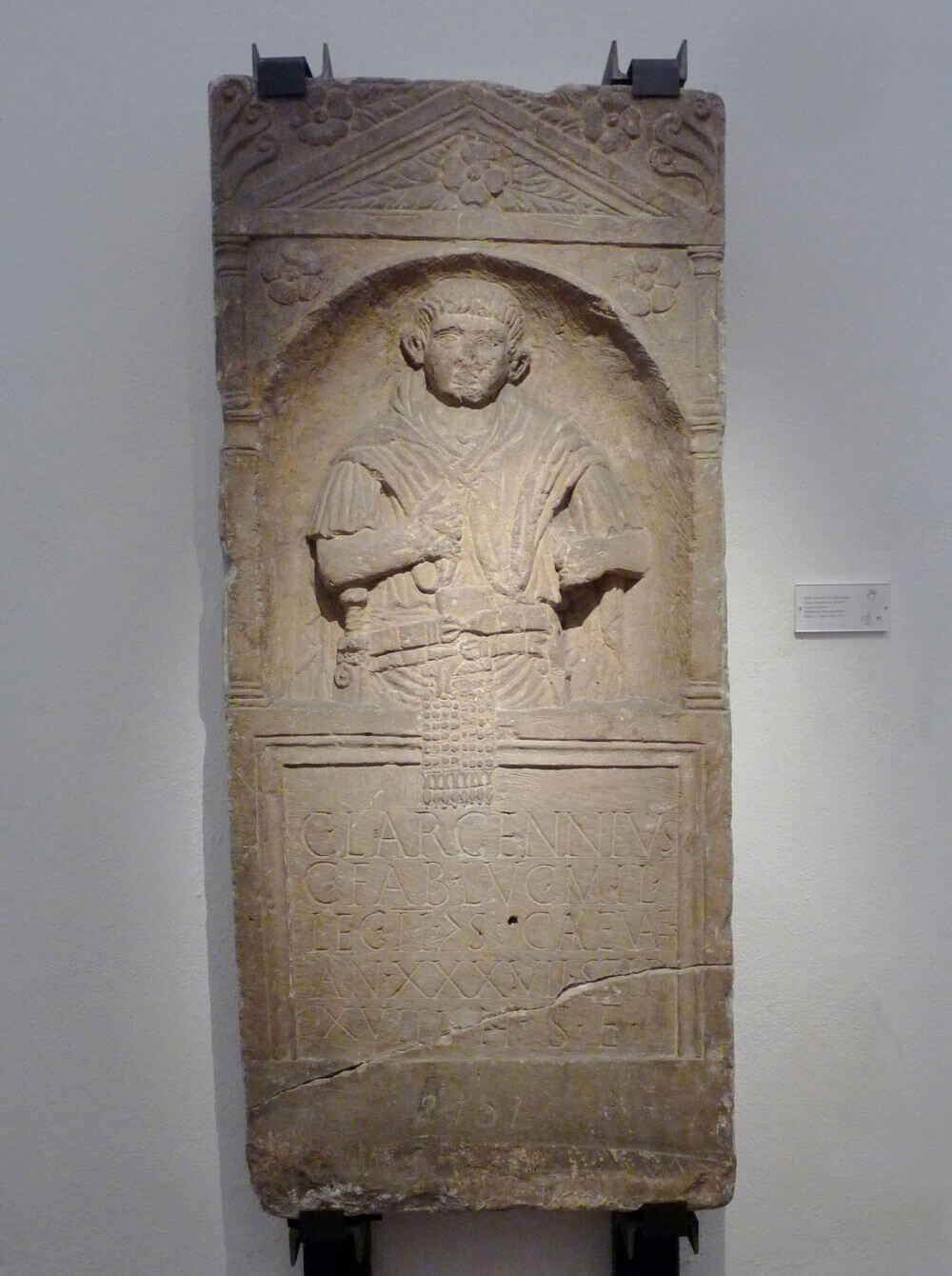
Ji-Elle, CC BY-SA 3.0, via Wikimedia Commons
Funerary stele of Caius Largennius, a legionary soldier of Legio II Augusta
Hispania Invasion and Germania Transfer
Early in his reign, Augustus, in 25 BC, launched a series of lengthy campaigns against the tribes of the Iberian Peninsula, notably the Cantabrians and Asturians. These campaigns were to continue until the year 13 BC.
Seven legions are known to have been involved; I, II Augusta, IIII Macedonica, V Alaudae, VI Victrix, IX Hispana, and X Gemina. Only four of these legions survived; II Augusta was one, and the others being IV Macedonia, VI Victrix and X Gemina, but the final conquest of Hispania was complete, and was now firmly in the control of Rome.
Hispania became the permanent garrison for several years until the Varus disaster in 9 AD. II Augusta was moved to the Rhine to shore up the Germanic border after that defeat in the Teutoburg Forest.
After 17 AD it was based in Argentoratum (present-day Strasbourg, France), where they continued to garrison the fortress there until the rule of Claudius.
Claudian Invasion of Britannia
In 43 AD, Emperor Claudius ordered an invasion of Britain with Legio II Augusta, IX Hispana, XIV Gemina and XX Valeria Victrix (the Legate of the II was Flavius Vespasianus, the future emperor Vespasian).
As with many of the Roman military operations, the invasion of Britain was conducted under the pretense of an appeal for help from a local ruler. King Verica of the Atrebate tribe, an ally of Rome, asked for Rome's protection from the more powerful neighboring Catuvellauni tribe.
Claudius responded by assembling a 40,000 man force of four legions and auxiliary forces in Gaul under Aulus Plautius. They crossed the Mare Britannicum (English Channel) and landed unopposed at Rutupiae (Richborough) and other points along the Kent coastline.
Plautius attacked the Celts assembling on a river bank at Medway. According to the Roman writer Suetonius, Legio II was instrumental in destroying the enemy force. That victory pacified a large enough area that Emperor Claudius personally traveled to Britannia to sign treaties with eleven kings of the largest tribes.
After this initial success, much of the pacification of the rest of the island fell to Vespasian's Legio II. Under his command they became elite troops and, as mentioned at the top of the page, were known as 'Vespasian's Best'. He fought thirty battles, capturing more than 20 towns and Vectis (the Isle of Wight). His most significant battle was the storming of the massive Celtic fortress of Maiden Hill.
With the relative pacification of the local tribes, the legion was apparently split into several smaller vexilli (detachments), which were stationed in several forts in the south-west of Britain. In 48 AD, the legionary base at Isca Dumnoniorum (Exeter) was built, and the legion was again concentrated in one place.
Boudiccan Revolt
When Queen Boudicca of the Iceni revolted against Roman rule in 60 AD, II Augusta was caught in a state of indecision and controversy. In the opening days of the revolt, Legio IX Hispania was ambushed and massacred, and several cities, Londinium among them, were destroyed by the rebels.
When governor Suetonius Postumius asked for help, Legio II was apparently without a Legate and the acting commander, the Praefectus Castorum named Poenius Postumius, ignored the request (with a stained reputation, he later committed suicide).
Eager to clear their record, Legio II fought valiantly at the final battle of the rebellion. While the site of the battle is disputed, Tacitus records that 12,000 Romans faced 100,000 Celts, but at the end of the battle, the Romans claimed 80,000 enemy dead at a cost of only 400 of their own men.
Ultimately, victory over the Iceni ensured Roman dominance of southern Britain for the next three and a half centuries.
Civil War
After the success against Boudicca, the legion was transferred to Glevum (Gloucester) in 67 AD. The post was short-term, however. In 69 AD, the succession of the Emperor Nero sparked a civil war between several would be rulers; Galba, Otho and Vitellius.
II Augusta sided initially with the emperor Vitellius, and several units may have taken part in his march on Rome, and victory over Otho.
Hoever, they were soon disillusioned with the man they had supported, and when their former commander Vespasian made his claim, they openly supported him.
Vitellius demoted all of II Augusta's centurions for their betrayal, but they were subsequently re-instated to their former ranks by Vespasian following his final victory. Legio II Augusta, however, had little real involvement in the entire affair.
Related Page: Year of the Four Emperors
Gnaeus Julius Agricola
In 75 AD, II Augusta was transferred to Isca Silurum (Caerleon) in Southern Wales. Between 78 and 84 AD, Gnaeus Julius Agricola, the governor of Britannia, undertook invasions of the Celtic-controlled regions in the north to stop raids on farms and towns. Legio II Augusta was involved in several of these campaigns including the defeat of the Ordivice tribe in north Wales and the destruction of the Druid stronghold of Mona (Anglesey).
In 84 AD, at the battle of Mons Graupius, (believed to be near Inverurie, Scotland) he defeated the last large Celtic Army. Tacitus (biased in the favor of Agricola as he was his son-in-law) provided the only known literary evidence of the battle:
He [Agricola] sent his fleet ahead to plunder at various points and thus spread uncertainty and terror, and, with an army marching light, which he had reinforced with the bravest of the Britons and those whose loyalty had been proved during a long peace, reached the Graupian Mountain, which he found occupied by the enemy.
The Britons were, in fact, undaunted by the loss of the previous battle, and welcomed the choice between revenge and enslavement. They had realized at last that common action was needed to meet the common danger, and had sent round embassies and drawn up treaties to rally the full force of all their states. Already more than 30,000 men made a gallant show....
The troops were made for action and ready to rush into it, but Agricola marshalled them with care. The auxiliary infantry, 8,000 in number, made a strong centre, while 3,000 cavalry were thrown out on the flanks. The legions were stationed in front of the camp wall; victory would be vastly more glorious if it cost no Roman blood, whilst, in case of repulse, the legions could restore the day.
The British army was stationed on higher ground in a manner calculated to impress and intimidate its enemy. Its van was on the level ground, but the other ranks rose, as it were in tiers, up the gentle slope. The space between the two armies was taken up by the charioteers, clattering on in their wild career.
At this point, Agricola, fearing that the enemy with their great superiority in numbers might fall simultaneously on his front and flanks, opened out his ranks. The line now looked dangerously thin, and many urged him to bring up the legions....
The spectacle that followed over the open country was awe-inspiring and grim. Our men followed hard, took prisoners and then killed them, as new enemies appeared. On the enemy's side each man now followed his bent. Some bands, though armed, fled before inferior numbers, some men, though unarmed, insisted on charging to their deaths.
Arms, bodies, severed limbs lay all around and the earth reeked of blood; and the vanquished now and then found their fury and their courage again. Indeed, when they reached the woods, they rallied and profited by their local knowledge to ambush the first rash pursuers... Only night and exhaustion ended the pursuit. Of the enemy some 10,000 fell, on our side 360.
Despite this victory, Roman subjugation of the highland tribes of Scotland was never complete, and complete occupation was near impossible. The Emperor Domitian, likely jealous of Agricola's success, recalled him to Rome and forced him into retirement, ending the farthest reaching northern campaigns of the Roman legions.
The Hadrian and Antonine Walls
In 120 AD, Emperor Hadrian - understanding both the inability to conquer the northern tribes and the need to protect Roman territory from them - ordered that a 73-mile long wall be built from modern day Wallsend-on-Tyne in the east to Bowness on the Solway Firth in the west.
For this unprecedented task of building a wall spanning the entire length of northern Britain, at 13 to 15 feet high and with interspaced forts, detachments of Legio II Augusta, XX Valeria and VI Victrix were given the job. The construction started in 122 AD and took six years to complete.
A further attempt to subdue southern 'Scotland' was made between 139 and 142 AD on the orders of Emperor Antoninus Pius. Across the narrowest neck of land between the Forth and the Clyde a second wall was built - this time of turf, stone and wood.
This Antonine Wall was thirty-seven miles long, four meters wide and fronted by a ditch approximately twelve meters in width. It had forts on the same pattern as Hadrian's Wall, but was occupied only for a short time.
The years between 155 and 158 AD brought a widespread revolt in northern Britain, which involved heavy fighting by the British-based legions. They suffered severely, and reinforcements had to be brought in from the two Germanic provinces.
By the year 160 AD, these losses, and continued pressure from northern tribes, forced the Romans to abandon their gains north of Hadrian's Wall as they were too difficult to maintain, and so returned to the first, more substantial, wall.
Clodius Albinus and Septimius Severus
In 196 AD, Clodius Albinus - Governor of Britannia - rebelled and claimed the Imperial throne for himself. The British legions were ferried to the continent, but were defeated in 197 AD by Emperor Septimius Severus. Several indecisive and destructive battles leading up to it would have serious consequences in Britain.
When the British legions were returned, they found the province overrun by northern tribes. Punitive actions did not deter the northern tribesmen and, in 208 AD, Septimius came to Britain in another attempt by the Romans to conquer Scotland.
II Augusta moved to the north, where it shared a large fortress with VI Victrix, at Carpow on the River Tay. Severus' campaigns were not to last, however, and ended with the eventual abandonment of any gains and the re-fortification of Hadrian's Wall.
Under Caracalla, Severus' heir, II Augusta received the name Antonina as a reward for faithful service to him and his father in Britain. Soon after the end of the Scotland campaigns, the legion was moved back to Isca Silurum (Caerleon), and would remain on guard there until the eventual collapse and withdrawal of Roman occupation.
Withdrawal from Britannia
While Britain remained at relative comparative peace for centuries, the same could not be said of the rest of the Roman Empire. Political and religious unrest fragmented the empire into East and West in 364 AD. Rival claimants to the Imperial throne often pulled legions out of the provinces to support their claims, further weakening the borders.
At the beginning of the 4th Century AD, II Augusta was part of the coastal defense of southern Britain at Rutupiae (Richborough). Ironically, this was the same place that the Claudian invasion of Britannia began. And in 407 AD, the last of the regular legions were moved out of Britain.
After this point, their history is unknown, but what can be said for certain is that for 400 years, Legio II Augusta advanced and defended Roman civilization.
Did you know...
Boudicca, Queen of the Iceni, led a revolt against Roman occupation of Britain in 60-61 AD. It was the efforts of Legio II Augusta which eventually secured the province for Roman rule.



Legions of Rome: The Definitive History of Every Imperial Roman Legion
by Stephen Dando-Collins
Featuring more than 150 maps, photographs, diagrams and battle plans, Legions of Rome is an essential read for ancient history enthusiasts, military history experts and general readers alike.