

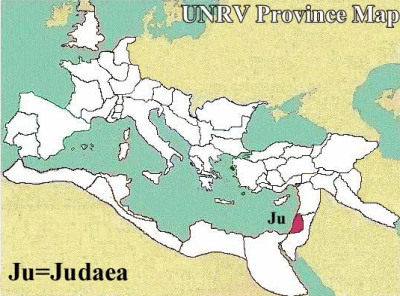
Roman influence in the near eastern provinces of Judaea and Syria Palaestina first came to major fruition with the conquests of Gnaeus Pompeius Magnus (Pompey the Great). In 64 BC, the Jews had maintained nearly two centuries of independent rule from various eastern nations, but internal struggles and succession issues after the death of King Alexander Jannaeus threatened the stability.
His sons, Hyrcanus and Aristobulus, as well as other political and religious factions, all vied for the Judaean crown, and they eventually sought mediation from the great Roman conqueror, Pompey.
Pompey endorsed Hyrcanus, but Aristobulus and his followers bided their time to resist the decision. While Pompey was busy in a minor campaign against the Arabic Nabataeans, Aristobulus seized Jerusalem, and Rome was forced to do more than mediate.
Pompey besieged the ancient city and, within 3 months, officially made Hyrcanus the high priest and established Judaea as a client state. Despite this, Judaea remained independent of Roman authority, provided they stayed within the rules of their status. Nonetheless, some degree of instability beleaguered the state for some time.
Two decades later, Julius Caesar arrived in Judaea while on campaign in the east in 47 BC. The Jews were granted various benefits owing to the uniqueness of their monotheistic religion, and Hyrcanus was officially made the King, or Ethnarch.
Antipater Idumean was granted the first Roman title of the area, being appointed as Procurator. It was his responsibility to see to the day to day management of Roman interests and provincial oversight. However, Antipater was assassinated soon after, and his son, the soon to be famous Herod, took his place.
Shortly thereafter, Parthian invasions from Syria set up Aristobolus II on the throne, but Herod shrewdly garnered the intervention of the Roman Senate, and was confirmed as Ethnarch in 37 BC.
Later, Marcus Antonius - who was given command of the entire eastern empire in an agreement with Octavian (the future Augustus) - bequeathed the province (along with other Roman possessions) to Cleopatra in Egypt.
While Herod remained in a position of authority in this period, he supported Antonius and Cleopatra (understandably so), but with Octavian's victory in the civil war at Actium in 31 BC, the situation changed irrevocably for the entire Roman world.
Herod went to Rhodes to meet the victorious Octavian, and through his political skill (and likely proven ability to stabilize the province), continued in his confirmation as ruler of Judaea. Herod was a brutal king, but this brutality helped keep an often unstable political and religious environment on peaceful terms.
Despite his brutality and apparent disinterest in traditional Jewish customs, Herod was careful not to infringe on these traditions for the people. He found it vital to his own survival to seek the approval of the masses, but the overwhelming reason for his success was the administration of force to suppress open opposition.
The Jews had limited self-rule as it related to their religious practices. The Sanhedrin was established under Herod as a sort of religious council to oversee the affairs of faith and religious law.
Herod's reign ended with his death in 4 BC, and the now Roman emperor, Augustus, was faced with a difficult challenge. At first, he appointed Herod's sons as rulers of smaller districts within the larger kingdom, but misrule forced him to change tactics.
Unfortunately, Judaea offered little in the way of benefits to Rome, as it was poor in both agriculture and mineral wealth. However, its position on the eastern Mediterranean, placed between the Roman provinces of Aegyptus and Syria, bordering the Nabataean territory of Arabia, and with its unstable political history, necessitated firm Roman control in order to facilitate security in the region.
Augustus was forced to place Judaea under the direct control of Roman Prefects, who were responsible to the Governor of Syria. Alhough no legions were directly assigned to the Prefect in Judaea's early formation, there were typically three legions nearby in Syria ready to respond to the numerous revolts of the small province.
Of the most famous of these Roman Prefects was Pontius Pilate. His position in religious history is secured through the word of the Christian faith that saw its start in Judaea. The life of Pilate, and of Jesus Christ, are both highly disputed by scholars, but what is certain is that Pilate was the Prefect between the years 26 and 36 AD.
He was considered responsible for the death and crucifixion of Jesus, though many have argued (including ancient contemporaries) that Pilate was innocent of the whole affair, and that blame actually rested on the high priest, Caiphas, and his conservative Jewish followers.
Regardless, the rule of Pilate was one of difficult circumstances, with several revolts put down by extreme force. Some of his actions regarding religious tradition alienated him from the Jewish population, and even the Emperor Tiberius was forced to intervene. Threatening Pilate if peaceful administration wasn't restored, Pilate's actions in the biblical stories may have been less out of tolerance toward Jesus, than fear of retribution from Rome if new revolts occurred.
By the end of Pilate's term in 36 AD, however, violence and resistance to Roman rule was at dangerous levels. Attempts by Pilate to introduce statues of Tiberius and of Caligula within Jewish temples had the people close to open revolt. Only the wise intervention of Claudius suppressed this and restored a sense of stability.
In 41 AD, Claudius appointed Herod Agrippa as king, restoring some sense of self-rule to the Jewish state. Agrippa, though the grandson of Herod, was extremely popular among the people, and his administration was able to alleviate tension. A devout traditionalist regarding religion, Agrippa upheld the all-important Jewish customs, and maintained some degree of independence from the authorities in Rome. Unfortunately, his death in 44 AD put Judaea back under direct governing by Roman Procurators for another 20 years, and dissatisfaction grew at an alarming rate.
By 66 AD, all-out revolt finally broke out when the Procurator, Gessius Florus, apparently seized seventeen talents from the Jewish temple treasury. This act, paling in comparison to the religious strife that existed between Pagan Rome and the Jewish faith, was simply the final straw that broke the people's tolerance, and armies were raised throughout the province.
The Syrian governor, Gallus, attempted to beset Jerusalem but was soundly defeated, even losing the standard of XII Legion in the process. Religious zealots took hold of forts throughout the region, and ethnic purging took place all over.
By 67 AD, however, the Roman general (and later emperor)Vespasian arrived and things began to go well for the Romans. He invaded Palestine from Syria and stamped out resistance in the north with great speed. By the summer of 68 AD, only Jerusalem and the stronghold of Masada remained in opposition.
69 AD saw the year of the four emperors after the death of Nero, and Vespasian was one of the civil war candidates who took to the field to claim the throne. Successful in his goal, he sent his son, Titus, to finish the subjugation of Judaea. In 71 AD, Jerusalem was finally captured and its great temple destroyed, ending the resistance of the main body of the population. The great Jewish historian, Josephus, was also captured during the campaign, and eventually became a confidant of the emperor.
Vespasian and Titus returned to Rome to celebrate a triumph, but the fortress of Mesada and its militant occupants remained. By 74 AD, Lucius Flavius Silva, then the governor of Judaea, ordered the legion X Fretensis to besiege the mountain fortress to put an end to the resistance.
Building an incredible ramp to allow easy movement for siege engines and infantry, the Romans discovered that their efforts would not require a fight. They found the place abandoned, save for a woman and her children, who informed the Romans that the inhabitants had killed themselves, rather than become slaves to the Romans.
Under the reign of Trajan, a large Jewish revolt broke out in Cyprus and in Cyrenaica on the African coast. Roman pagan temples were destroyed, and the conflict spread to the largest Jewish city in the empire, Alexandria in Egypt. There, more Roman temples were destroyed, along with the tomb of Pompey the Great.
However, Trajan managed to prevent widespread revolt in the home province of Judaea and put down the trouble where it originated. His successor, Hadrian, found matters much more difficult, however, and had to deal with the last and most dangerous Jewish revolt of them all.
Hadrian was responsible for stopping Roman expansion and attempting to bring cultural uniformity throughout the empire. While it brought great success in most places, the religious differences in Judaea were too great. He rebuilt Jerusalem, first razed by Titus, as the Roman city of Aelia Capitolina, and erected a great temple to Jupiter, rather than the Jewish God. Hadrian also forbade circumcision, which the Jews viewed as a direct attack on their customs. By 132 AD, revolt broke out once again.
Under the leadership of Simon ben Kosiba, or Bar Kochba, this 3 year struggle would be the most brutal in the history of Roman rule, and would turn into a clash involving ethnicity, faith and culture. Three full legions were needed to suppress this clash, and extreme measures were taken to end resistance. By 135 AD, the Romans cornered Kosiba and his followers at Bethar where they starved to death, and the war was over.
The Jewish people were severely punished by Hadrian. Prisoners were sold into slavery in massive numbers, and Judaism as a religion was under attack. He forbade the people to teach Mosaic Law or to own scrolls of any sort. Pagan temples and symbols were erected all over the province, and even directly over old Jewish religious sites.
The province itself was renamed Palestine; and of course, Jerusalem was already called Aelia Capitolina to stamp out any reference even to the Jewish names. The people were even forbidden from entering the temple complex to pray at their own sacred grounds, and the outer wall of the complex eventually came to be known as the 'wailing wall'.
Despite the severity of Hadrian's response, his tactics worked, and the Jews fell into a long period of peaceful subjugation. Hadrian's successor, Antoninus Pius, restored many of the religious rites of the people, and that seemingly went a long way towards healing the wounds.
Over the next two centuries, Roman occupation of Palaestina-Judaea was a relatively uneventful period. The territory received some additional notoriety with the acceptance of Christianity by Constantine, and the religion's continued growth throughout the 4th century AD.
The province remained a relatively peaceful backwater of the empire, even throughout the fall of the western Roman Empire in the 5th century AD. It remained a part of the Byzantine Empire until 638 AD, when the region was overrun by the Arab conquest.