

The idea of Roman expansion into North Africa started with the fear and jealousy caused by the great economic power of Carthage. In the 3rd Century BC, Rome and Carthage jockeyed with each other for position and strength along the Mediterranean.
The two had developed an unhealthy rivalry which, in 264 BC, led directly to a series of three wars, the Punic Wars. By 146 BC, Carthage was destroyed and Rome, having taken control of Spain and Africa, was soon to be the undisputed master of the world.

Africa, Numidia and Mauretania
Rome established its first African colony, Africa Vetus, in the most fertile part of what was formerly Carthaginian territory, and established Utica as the administrative capital. The remaining territory was left in the domain of the Numidian client king, Massinissa.
At this time, the Roman policy in Africa was simply to prevent another great power to rise on the far side of Sicily. Therefore, great freedom of rule was granted to Massinissa and his descendents. Upon his death in 148 BC, the territory was divided among his heirs into several smaller client kingdoms.
Jugurtha, a Numidian prince, was the nephew and adopted son of King Micipsa of Numidia. After Micipsa's death in 118 BC, Jugurtha was appointed as joint ruler alongside Micipsa's two natural sons, Adherbal and Hiempsal. Seeking to reunify Numidia under his sole rule, Jugurtha had Hiempsal assassinated and defeated Adherbal in battle, forcing him to flee to Rome.
Initially, Rome was indifferent to the political situation in Numidia, as Jugurtha had served in the Roman legions and had many allies in the Senate. However, in 112 BC, Jugurtha's forces captured the city of Cirta (modern-day Constantine, Algeria), resulting in the death of many Roman citizens. This event prompted Rome to intervene, marking the beginning of the Jugurthine War.
The war lasted for six years, from 112 BC to 106 BC. The conflict exposed corruption within the Roman Republic and highlighted the growing rivalry between two prominent Roman generals, Gaius Marius and Lucius Cornelius Sulla. In 106 BC, Sulla, serving under Marius's command, successfully captured Jugurtha.
Jugurtha was brought to Rome, where he was paraded in Marius's triumph and subsequently executed. The Jugurthine War not only resulted in the consolidation of Roman power in Numidia, but also served as a precursor to the internal struggles that would later plague the Roman Republic.
Upon his death, much of Jugurtha's territory was placed in the control of the Mauretanian client king, Bocchus, and the veterans of Marius' legions were given land and settled all along Numidian territory. The Romanization of Africa was now firmly rooted.
The civil war between Caesar and Pompey briefly brought North Africa into the Roman spotlight once again. King Juba of Numidia was a client of Pompey and resisted the rule of Caesar. Caesar defeated Juba at the Battle of Thapsus in 46 BC and, with this victory, all of North Africa was firmly and permanently in the control of Rome.
Several political and provincial reforms were implemented by Augustus and later Gaius (Caligula), but Claudius finalized the territorial divisions into official Roman provinces.
Thereafter, and until later reforms by Septimius Severus after 192 AD, North Africa was divided into several provinces: Mauretania Tingitana, Mauretania Caesariensis, Numidia and Africa Proconsularis (or Africa Nova and Vetus).
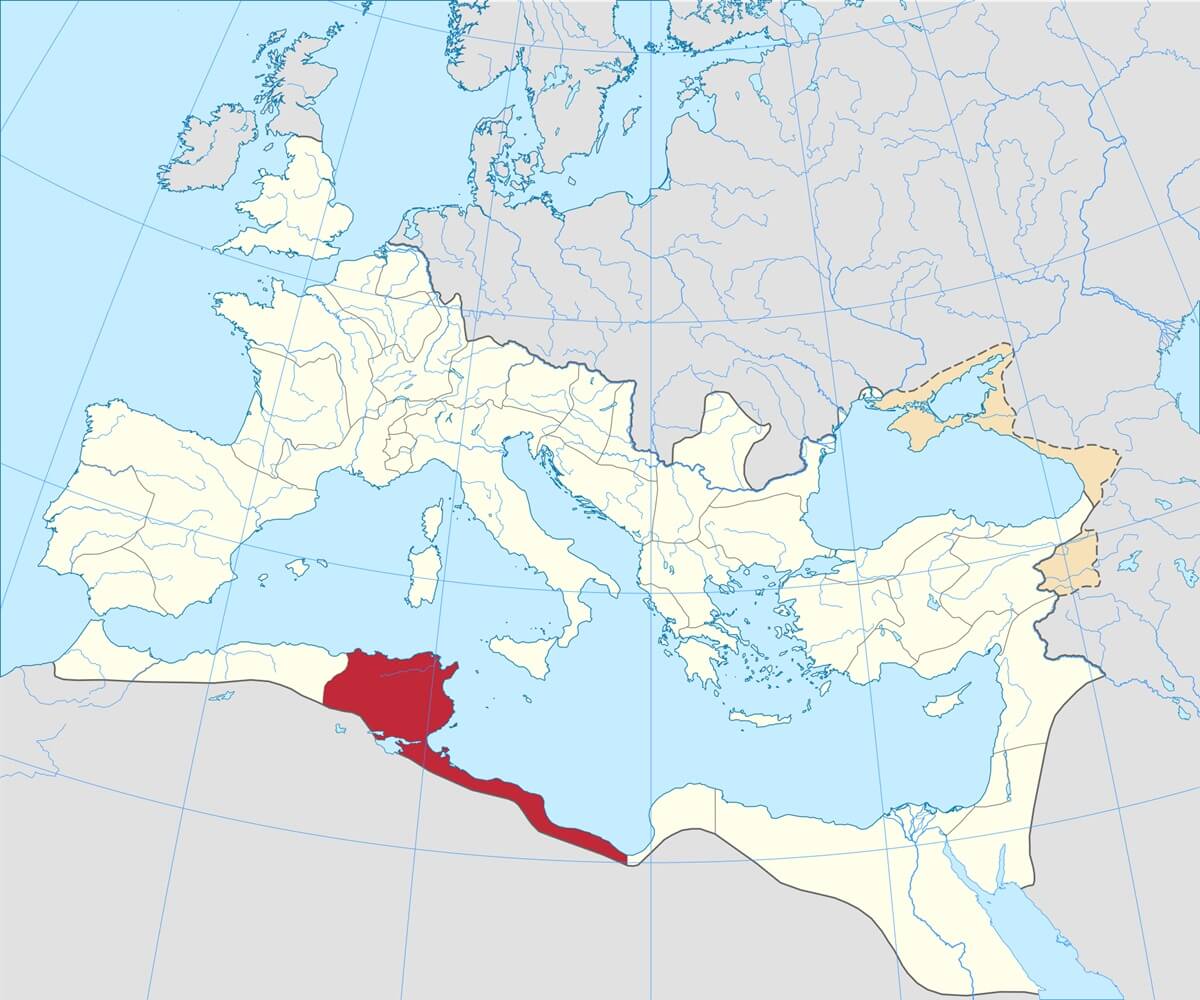
Milenioscuro, Public domain, via Wikimedia Commons
The province of Africa Proconsularis shown in red.
The region remained a part of the Roman Empire until the great Germanic migrations of the 5th century AD. The Vandals overran the area by 429 AD, and Roman administrative presence came to an end.
Within Roman occupied Africa, the bulk of the population of was composed of three major population groups: the Berber tribes (such as Numidians, Gaetulians and Maurusiani), the ancient Carthaginians of Phoenician origin, and Roman colonists.
The Berbers were a dark skinned native African people that spoke a common language and shared ethnic characteristics. Besides the Afri in the regions controlled by Carthage, the tribes that took part in the wars against the Romans were the Lotophagi, the Garamantes, the Maces, the Nasamones, the Misulani or Musulamii, the Massyli and the Massaesyli.
Berber opposition to the Roman presence in Africa was nearly constant. The Roman Emperor Trajan (98-117 AD) established a frontier in the south by encircling the mountain ranges and built a line of forts from Vescera (modern Biskra) to Ad Majores (Hennchir Besseriani) to the south east. The defensive works extended at least as far as Castellum Dimmidi (modern Messaad).
Romans settled and developed the area around Sitifis in the second century AD, but the influence of Rome beyond the original Carthaginian territories, the coastal regions and areas easily accessable by road was slow to develop.
The Roman military presence in North Africa was relatively small, consisting of about 28,000 total troops, mostly auxiliaries in Numidia and the two Mauretanian provinces. Legio III Augusta was stationed in Africa and protected the borders for over four centuries, still being present in the early 5th century AD.
The prosperity of most towns depended on agriculture. Called the "granary of the empire," North Africa - according to one estimate - produced 1 million tons of cereals each year, one-quarter of which was exported. Other crops included fruit, figs, grapes, and beans. By the second century AD, olive oil rivaled cereals as an export item.
In addition to the cultivation of slaves, and the capture and transporting of exotic wild animals, the principal production and exports include the following for each province:
- Africa Province: Olives, corn, cereal, fruits and textiles
- Numidia: Corn, grains, marble, pottery, wine, wool and livestock
- Mauretania: Olives and fruits, marble, wine, timber and livestock



.svg)