

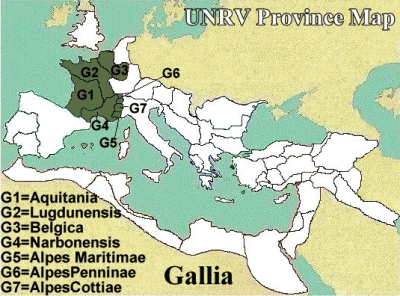
The region inhabited by the ancient Gauls, (Galli, the Roman name for the Celtic people there) comprised modern-day France and parts of Belgium, western Germany, and northern Italy. The region of Italy occupied by the Gauls was called Cisalpine Gaul ("Gaul this side of the Alps") by the Romans.
By the 5th century BC, the Gauls had migrated south from the Rhine River valley to the Mediterranean coast.
Between 600-400 BC, growing populations of Gauls began to spread over the Alps into northern Italy, drawn by abundant food resources.
In 390 BC, the Gauls seized and plundered the city of Rome. While devastating to the young Republic, the Gallic raids also helped to weaken Rome's powerful enemy the Etruscans, which, in time, helped the rise of Rome to dominance.
The Cisalpine Gauls pushed into central Italy by 284 BC. In a series of confrontations, the Romans defeated the tribe of the Insubres, took Mediolanum (Milan), and established colonies in a buffer zone.
During the next century, Gauls remained a constant threat to the Romans. In the last Samnite War of 295 BC, Gallic tribes joined with the Samnites and Etruscans, attempting to stop Rome's rise to power. Only after putting down several revolts by 282 BC did Rome reduce this threat of Gallic invasions.
In 218 BC during the Second Punic War, the Gauls joined with Hannibal as he crossed the Rhine to invade Italy. Upon Hannibal's defeat in 202 BC, the Gauls again tried to organize against Rome, but the Boii, then the dominant Gallic tribe, were subdued by 191 BC. Thereafter, the Gauls were never again able to successfully challenge the Roman military.
In the years following Hannibal's defeat, the Romans expanded throughout the Mediterranean region. After reinforcing the northern colonies of Placentia and Cremona in 203 BC, Roman troops expanded into Cisalpine Gaul. They waged costly, drawn-out campaigns against Gallic and Iberian tribes and finally, in 121 BC, the Gauls were defeated on the lower Rhine, opening up southern France to Roman rule.
An alliance with the Aedui against the Allobroges and the Arverni brought the Romans control of the Rhône River valley after 120 BC. The Roman colony of Narbo Martius (Narbonne) was founded on the coast in 118 BC, and the southern province became known as Gallia Narbonensis.
An invasion by Germanic Cimbri and Teutones was defeated by Gaius Marius in 102 BC, but 50 years later a new wave of invasions into Gaul, by the Helvetii from Switzerland and the Suevi from Germany, triggered Roman conquest of the rest of Gaul by Julius Caesar in 58-50 BC.
During 53-50 BC, Caesar was engaged in suppressing a Gallic revolt led by Vercingetorix. He treated the Gauls generously, leaving their cities with a significant measure of autonomy, and thus secured the allegiance of Gallic soldiers in his civil wars against Pompey in 49-45 BC.
A former religious center of Gallic society, Lugdunum (Lyon) became the capital of Roman Gaul. The country was divided into four provinces: Narbonensis, Aquitania to the west and south of the Loire, Celtica (or Lugdunensis) in central France between the Loire and the Seine, and Belgica in the north and east.
The Romans built roads and towns throughout Gaul and taxed the old Gallic landowning class, while promoting the development of a middle class of merchants and tradesmen.
The emperor Tiberius was obliged to suppress a rebellion of the nobles in 21 AD, and the assimilation of the Gallic aristocracy was secured when the emperor Claudius (41-54 AD) made them eligible for seats in the Roman Senate and appointed them to governing posts in Gaul. He also ordered the suppression of the druids, the Celtic priests. Native deities were amalgamated with Roman counterparts, and emperor worship was encouraged.
The next two centuries were marked by occasional revolts, by increasingly frequent invasions of Germanic tribes, against whom a line of limes, or fortifications, was erected from the middle Rhine to the upper Danube, and by the introduction of Christianity early in the 2nd century AD.
During the reign of the emperor Marcus Aurelius (161-180 AD), Germanic invaders crossed the limes. Frontier legions rebelled along the Rhine, spurring the civil wars that followed the death of the emperor Commodus in 192 AD.
In the mid third century AD, between the years 260 and 274 AD, Gaul saw itself split into its own Gallic Empire under Postumus, and ending with the victory of Aurelian over Tetricus.
Gaul was primarily a bastion of Romanization throughout its history, but eventually fell to the pressures of Germanic migrations. By the late 4th century AD, Germanic tribes pushed across the Rhine into Gaul and slowly began to change the political and military climate. By the invasion of the Huns and more Germanics in the 5th century AD, Gaul was lost to the Roman Empire forever.
The Economy of Roman Gaul
In the 1st and 2nd centuries AD, Gaul flourished through the export of food, wine, and pottery. Other major contributions of the Gallic provinces included glassmaking; metallurgy; woodcraft; textiles, wheat, olives, fruits, corn, oils and cheeses.
The Remi tribe were renowned in the Roman world for the quality of their horse breeds, and there were also large copper deposits in Transalpine Gaul, and Silver in southern Aquitania.
Tribes of Gaul:
Belgica:
Remi -The leading tribe of the Belgae, they were based around Durocortorum (Rheims), and were well known for high quality horse breeding.
Atrebates - Lived around Nemetocenna-Arras.
Bellovaci - They lived around Caesaromagus.
Nervii - One of the most powerful Belgic tribes living east of the Scheldt in central Belgium.
Aided by the Atrebates and Viromandui, they came very close to defeating Caesar in 57 BC. The Atuatuci were marching to join them but did not reach the battle in time.
The Nervii's capital city seems to have been at Bagacum.
Treveri - They lived west of the Rhine in modern SE Belgium and Luxembourg. The town of Treves preserves their name and was probably their capital.
Western Gaul:
Carnutes - A tribe living south-west of Paris between the Seine and the Loire and probably based on Chartres. However, Cenabum (Orleans) was also an important center of theirs.
The Carnutes had in their territory a shrine sacred to all the Gauls, and consequently were highly respected.
Santones - Were found around the river Charente and their capital was probably the town of Mediolanum (Saintes).
Namnetes - A tribe based around the town of Condivincum (Nantes).
Pictones/Pictavi - Located near the town of Lemonum (Poitiers).
Bituriges - A tribe with its capital at Bourges (Avaricum).
Before the conquests of Caesar they had been one of the pre-eminent tribes, but after had declined in importance. Argentomagus was another important oppidum of theirs.
This is one of several tribes that seemed to have split; the Bituriges-Cubi lived near Bourges/Berry, and the Bituriges-Vivisci near Burdigala (Bordeaux).
Lemovices - Lived near the modern town of Limoges whose ancient name is unknown.
Aquitania:
Vocates - One of many small tribes of Aquitania. They lived in the north-west, towards the mouth of the Garonne River.
Elusates - Another of many small tribes of Aquitania. They lived in the center of the region, around the town of Eauze, whose ancient name is unknown.
Tarbelli - One of many small tribes of Aquitania. They lived in the extreme southwest around the town of Dax.
Southern Gaul:
Arverni - A very powerful tribe living in the Auvergne. The most important stronghold of theirs was Gergovia (somewhere near Clermont-Ferrand).
The most notable Gallic resistance leader, Vercingetorix, came from the Arverni. They had been the most powerful Gallic tribe in the 3rd and 2nd centuries BC under their king, Luernios, but when his son, Bituitos, was defeated by the Romans in 123 BC and the Roman 'Provincia' established, their ascendancy passed to the Aedui and Sequani.
Cadurci - A tribe centered on the town of Divona.
Ruteni - Lived near the town of Segodunum (Rodez).
Central Gaul:
Aedui - The leading tribe of Caesar's period, although humbled by the Germans under Ariovistus. Their capital was at Bibracte (Mont Beuvray or Autun).
Branovices - A branch of the Aulerci based at Brionnais.
Mandubii - A tribe whose main stronghold at Alesia (Alise-Sainte-Reine) saw the climax of the Gallic Revolt, when Vercingetorix surrendered there after a long siege.
Senones - A tribe living south-east of Paris around the town of Agedincum (Sens).
Parisii - Lived near Lutetia (Paris).
Meldi - Found east of Paris on the Marne near Meaux.
Eastern Gaul:
Sequani - Based at Vesontio (Besancon). They precipitated the Roman invasion by calling on the help of the German king Ariovistus of the Suebi when in danger of conquest by the Aedui.
Lingones - Lived in the region of Andematunnum (Langres) and Dijon.
Mediomatrici - Were found to the west of the Vosges, south of the Treveri. Their chief town was Divodurum (Metz).
Helvetia:
Helvetii - The major tribe living in Switzerland. Ariovistus' aid to the Sequani prompted them to want to move, something which Caesar didn't want to happen.
Tigurini - Neighbours and fellow travellers with the Helvetii on their failed migration.
The Tigurini had joined the Cimbri and Teutones in the march against northern Italia during the late 2nd century BC, and fled from Sulla after those tribes' defeat by Marius.
Boii - The Boii probably represented remnants of the Boii ejected from Cisalpine Gaul by the Romans. They had also settled further north and then moved to modern Switzerland.
Joining the Helvetii in their migration, they shared their defeat, but the Aedui persuaded Caesar not to send them back but settle them instead on devastated Aeduan lands.
Provincia/Gallia Transalpina/Gallia Narbonensis:
Narbo - This region had been annexed by the Romans in 125 BC. Narbo was a colony planted there. Formerly it belonged to a small tribe called the Atacini.
Massilia - A Greek colony founded about 600 BC, it civilized the area and was allied with the Romans. It had to call them in when attacked by the Sallassi in 125 BC and a province was set up around it.
Massilia made the mistake of supporting Pompey in the Civil Wars at the end of the Republic. Unforgiven by Caesar, it was stripped of its territory and quickly lost its importance to nearby Arelate.
Volcae - There were actually two branches of the Volcae; the Volcae-Tectosages living south of Narbo and the Volcae-Arecomici living north and east. They had a large treasure pillaged from them by the Romans in 106 BC, which then mysteriously disappeared. The Volcae Tectosages had a capital at Baetera (Beziers).
Allobroges - Lived between the Rhone, the Isere and Lake Geneva. Their chief town was Vienne. They had opposed Hannibal's passage of the Alps and failed. In this period, they were not very enthusiastic for Roman rule either.
Tolosates - This tribe lived around Tolosa (Toulouse). From the name, they were likely Aquitanian, and probably forcibly incorporated in Gallia Transalpina.
Gallia Cisalpina/Rome:
Vercellae - Originally an oppidum of the Celtic Libici, they had been brought into the administration. Near here the Cimbri were finally defeated in 101 BC.
Taurini - A Celtic tribe probably based near present-day Turin.
Ingauni - A Ligurian tribe, their center was at Album (Albenga).
Vasconia:
Vascones - The Basques. Surprisingly, there was not fierce resistance to the Romans, probably because Roman rule here was fairly light. Rome's occupation focused far more on the eastern passes through the Pyrenees.
Autrigones - Possibly a sub-tribe of the Vascones and/or dependent on them. This tribe occupied lands between the Vascones to the east and the Cantabrii to the west, and probably had a constant balancing act to perform between these two powerful groups.
Did you know...
The Gaul in north-western Italy was called Cisalpine Gaul [Cisalpine, from Latin "on this side of the Alps", as opposed to Transalpine Gaul. The names Gallia and Galatia sometimes are compared to Gael, which is, however, from Goidhel or Gwyddel, and cannot be directly related. It is uncertain whether the Gal- names are from a native name of a tribe, or if they are exonyms. Cisalpine Gaul was again divided into Cispadane Gaul "on this side of the river Po" and Transpadane Gaul.