

Nero (37 - 68 AD)
Emperor: 54 - 68 AD
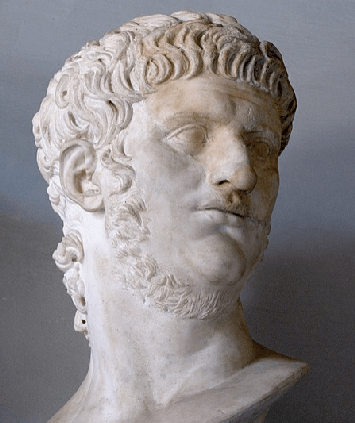
Lucius Domitius Ahenobarbus, better known as Nero Claudius Caesar Augustus Germanicus, was the last emperor of the Julio-Claudian dynasty to rule the Roman Empire. He was the great-grandson of Augustus through his daughter, Julia, and the son of Agrippina the Younger.
Nero grew up in a tumultuous period marked by imperial intrigue. His mother, Agrippina, was exiled by her brother, Emperor Caligula. However, the unexpected accession of Claudius, Agrippina's uncle, allowed for the return of exiled members of the Julio-Claudian family.
Agrippina's marriage to Claudius, her uncle, paved the way for Nero's adoption into the imperial line. Through his mother's influence, Nero took precedence over Claudius' biological son, Britannicus, and later married Claudius' daughter, Octavia.
Agrippina's political maneuvering was instrumental in securing Nero's position as the next Roman emperor. She methodically consolidated power by placing key supporters in influential positions within the government.
Nero ascended to the throne in AD 54 at the age of 16, following the death of Claudius, and ruled until his own death in AD 68, marking the end of the Julio-Claudian dynasty.
Nero Claudius Caesar would eventually take precedence over Claudius' own son, Britannicus, through the scheming of his mother Agrippina, including the eventual marriage to Claudius' daughter, Octavia.
That scheming would also set the stage for Nero to rise as the next Roman emperor unchallenged, as Agrippina methodically took control of the government and placed key supporters into positions of power.
The death of Claudius has been shrouded under the specter of murder (assumedly at the hands of Agrippina) though Claudius was 64 years old and of historically poor health. Still, the systematic seizure of power by Agrippina, through her various political appointments, lends credence to the ancient source stories that Claudius was indeed poisoned.
Regardless, in 54 AD Claudius was dead, and the 17 year old Nero rose as the next Roman emperor. Under the guidance of his mother, his tutor Seneca and the Praetorian Prefect Afranius Burrus, the first five years of Nero's reign was actually considered exemplary (Trajan later said that first five years of Nero's government were considered the happiest and best of the imperial era).
Direct taxation was reduced as well as various restrictive governmental regulations. Capital punishment was outlawed and the games lessened, while provincial administration continued to prosper as it had since the reign of Augustus.
Despite this positive start, it wouldn't take long for imperial intrigue to affect the order of things. A power struggle likely developed between Agrippina and Nero's advisors where, as an ambitious woman, she hoped to continue as a partner with Nero in imperial rule, and they resisted.
Nero hated his wife, Octavia, and began to have an affair with a former slave, Claudia Acte, which was supported by Seneca and Burrus. At this time too, Nero took less interest in the governing of the Empire, and seemed more interested in the pursuance of the arts; singing, acting and playing the harp - indulgences that were considered fit for slaves. He also participated in nights of drunken revelry with friends, including random violence on the streets of Rome.
Agrippina worried that through Nero's excesses and the growing strength of Seneca and Burrus (who privately supported Nero's antics in order for their own power to grow), that she would lose any grip on control of the Roman government.
Not only did she support Octavia over Nero's various objections, but began to show favor to Claudius' son, Britannicus, as a potential replacement.
This backfired, however, and Britannicus was murdered just shy of his 13th birthday in 55 AD, likely through the intervention of Nero and Burrus, and Agrippina's influence would continue to decline.
Moving on from his slave concubine Acte, Nero was introduced to a more permanent relationship through his friend Otho (the future emperor, albeit short-lived). Otho was married to Poppaea Sabina, and Nero was seemingly taken with her. Otto allowed a relationship to develop between the two, and by 58 AD the affair was firmly underway.
Agrippina continued to support Octavia (who, as the daughter of Claudius, helped establish Nero's legitimacy), and Poppaea assuredly complained over the interference. Nero finally made the decision to be rid of his pestering mother (this time without the support of Seneca and Burrus) and solicited the aid of the Prefect of the Fleet at Misenum, a freedman and former tutor by name of Anicetus.
Rather than risk an open murder, which would likely cause terrible shockwaves in a government that was slowly beginning to lose its popular appeal, Anicetus came up with an elaborate plan to have Agrippina brought to a party at Baiae via ship, which the fleet would provide. The ship, however, was constructed as collapsible so as to sink, with the population being none the wiser at this tragic 'accident'.
However, the plan failed. Agrippina was able to swim to safety, and Nero was forced to adopt more direct methods. An assassin was sent to her villa and clubbed her to death, while a fabricated story of Agrippina's involvement in a plot against Nero would be circulated to justify the murder.
In 59 AD, one of the most powerful women in Roman history was dead at the hands of her own son, after having been solely responsible for securing the position of ultimate power on his behalf.
Within a short time following the death of Agrippina, Nero's mistress, Poppaea, began to assert her own manner of control. Nero divorced Octavia, who was banished first to Campania. The public preferred Octavia though, and their hatred of Nero and Poppaea would grow. Octavia was exiled to the island of Pandataria, and beheaded shortly thereafter.
By 62 AD, Poppaea and Nero were married, and political opponents began to disappear, opening the way for more administration officials of dubious quality. Burrus had died in that same year to be replaced by a supporter of Poppaea, Sophonius Tigellinus, and Seneca was forced into retirement under this new regime.
Nero continued to riot through the city with his drunken friends, beating strangers and assaulting women. Without Seneca, Burrus and even Agrippina to dictate some form of controlled or effective government, the reign of Nero devolved rapidly. Extravagance and luxurious spending grew and the treasury was in serious jeopardy.
Still, the worst was yet to come.
Corbulo, Armenia and Parthia
From the very beginning of the reign of Nero in 54 AD, and actually stretching back even further to the later part of the reign of Claudius, the political situation in the east was beginning to show signs of impending danger.
Vologeses, the King of Parthia, had begun interfering with Roman interests in Armenia; although the region was long contested by both great powers, it still retained some level of independence.
In the same year that Claudius died (54 AD), Vologeses installed his own brother, Tiridates, as King of Armenia, in favor of the Roman client who already ruled. This violation of law and peace (Rome had held the right of determining Armenia's governmental authority since the time of Augustus) would eventually lead to war, but the Romans were ill-prepared to conduct a major campaign.
Needing an experienced general to make those preparations, Nero (and Seneca, who introduced a decidedly more aggressive eastern policy than that of Claudius) turned to Gnaeus Domitius Corbulo, an honored commander from the Germanic borders.
Upon Corbulo's arrival, his assessments prevented immediate action against Armenia or Parthia, and he set about training and levying new recruits. Over the course of the next few years (including varying degrees of both military and political jockeying) Corbulo laid the groundwork to re-establish Roman authority.
By late 57 AD, he was finally prepared, and an 11th hour negotiation attempt that ended in failure left the door open for hostilities to commence.
An initial attack by Tiridates was initially successful, but not successful enough to have any lasting effect, and he retreated into the deeper desert of Armenia to avoid direct conflict. Corbulo followed, but was unable to bring Tiridates to battle and broke off direct pursuit in order to focus on the Armenian capitals.
First, Artaxata was captured and sacked, and by the end of 59 AD Tigranocerta surrendered to the advancing Romans without a fight. The following year, a Parthian army under Tiridates' command was repulsed, leaving Corbulo and the Romans to claim victory in the overall affair.
Nero appointed Tigranes (a great-grandson of Herod the Great) as the new pro-Roman King, and Corbulo was appointed governor of Syria as a reward.
All was not over, however. In 61 AD, Tigranes continued the fight against Parthian influences, eventually forcing the Romans to return to his aid. Corbulo sent two legions directly into Armenia, while three more were amassed on the border with Parthia as a warning.
This forced a temporary truce while the Parthian King, Vologeses, send an embassy to Rome to conclude the matter completely. However, not unexpectedly, negotiations broke down, and by 62 AD the war was back on.
The governor of Cappadocia, Lucius Caesennius Paetus, led the Roman side in Armenia for the next season, while Corbulo decided to cross the Euphrates and take the fight directly to Parthia. Though the plan had merit, neither Vologeses nor Paetus complied.
Out of the reach of Corbulo's assistance, Vologeses besieged the poorly prepared Paetus, forcing him to surrender. Though Corbulo was marching to his aid, Paetus' treaty forced Roman withdrawal, while another round of 'executive' negotiations would take place between Nero and Vologeses. These again broke down, and by 63 AD both sides were back at it.
In the new campaign year, Corbulo was given supreme authority (maius imperium), and prepared an invasion using his four best legions. While the Parthians understood that victory for their side was becoming unreachable, Corbulo understood that a Roman victory would be terribly costly.
So, before his considerable force could be brought to bear, the two sides entered a final negotiation, where nearly 10 years of stalemate would end at almost exactly the same position as where it started.
The Parthians conceded that the Romans had overall authority to name the Armenian king, and Tiridates (the Parthian choice) was forced to lay down his crown. However, in an entirely ceremonial gesture, Tiridates was brought to Rome, where Nero would return it himself, thereby proving complete Roman authority in the matter.
Despite the fact that very little had occurred in the entire series of campaigns (other than death and bloodshed) without any change in the result, Roman propaganda staged this as a great victory. Nero was in serious political jeopardy by this point (it was 66 AD before Tigranes showed up in Rome), and he needed a great victory to boost his image.
A grand celebration took place granting Corbulo full military honors, and the doors to the Temple of Janus were shut (symbolically meaning that there was peace throughout the Roman world). However, in an ironic twist of fate and as an indication of the mass paranoia that followed Nero late into his reign, Corbulo was forced to commit suicide just a year later, in 67 AD.
Corbulo's death, along with several other popular generals of the time, would help usher in the massive military revolt that would eventually force Nero's own suicide.
Corbulo's family would remain a part of Imperial intrigue of its own merit though. His daughter, Domitia Longina, would eventually be married to the emperor Domitian, and is suspected of likely involvement in his assassination.
Nero and the Christians
During and after the revolt of Boudicca, Nero continued with his own extravagance in Rome and surrounding cities. Eventually performing on stage as both singer and actor, he indulged his artistic personality while earning the scorn and disrespect of elite society.
In 60 AD, he adopted an Olympic-style series of events (performance based) known as the Neronia, in which he actually encourage societal elite to participate. His eccentricities, coupled with a growing paranoia (resulting in treason trials, accusations, executions etc) continued to push his spiraling popularity to new lows.
In 62 AD, his failed relationship with Octavia finally came to a head. He divorced her on grounds of sterility (though the masses supported her violently), and had her exiled to the island of Pandateria, where she was quickly killed off to put an end to the protest.
Nero immediately married his already pregnant mistress, Poppaea, who soon bore him a daughter, and she began to assert even more influence on her malleable husband.
With the death of the Praetorian Prefect and replacement by Tigellinus in the same year, Nero's stabilizing advisor, Seneca, was soon pushed out of the inner circle, and Nero's behavior would continue to decline.
By 64 AD, a great fire befell Rome, and Nero played a prominent role in its controversial beginnings and now infamous results. According to Tacitus:
"...whether accidental or treacherously contrived by the emperor, is uncertain, as authors have given both accounts, worse, however, and more dreadful than any which have ever happened to this city by the violence of fire.
It had its beginning in that part of the circus which adjoins the Palatine and Caelian hills, where, amid the shops containing inflammable wares, the conflagration both broke out and instantly became so fierce and so rapid from the wind that it seized in its grasp the entire length of the circus. For here there were no houses fenced in by solid masonry, or temples surrounded by walls, or any other obstacle to interpose delay.
The blaze in its fury ran first through the level portions of the city, then rising to the hills, while it again devastated every place below them, it outstripped all preventive measures; so rapid was the mischief and so completely at its mercy the city, with those narrow winding passages and irregular streets, which characterized old Rome..."
Some suggested, as inferred by Tacitus (but not explicitly accused), that Nero himself started the fire for a variety of reasons. One was to make room for his planned Domus Aurea (Golden Palace), while another was that the extravagant emperor simply wanted a fiery backdrop in which to recite poetry while accompanied by a lyre.
While both, considering the greatness of the devastation, are most probably false, at the time Nero was becoming public enemy number one. Despite the fact that Nero did much to restore the city and bring in relief and supplies for the people, the residents couldn't help but believe that the entire tragedy occurred at his orders.
Nero needed scapegoats, and he found them in the little known but generally reviled and subversive cult of Christians. These early Christians were believed to be practicing human sacrifice and cannibalism (the eucharist), wild orgies and any number of disreputable behaviors. Mostly Jews or Greek speaking foreigners who not only rejected the pagan gods, but the Imperial cult as well, they quickly became an easy and hated target for the crime.
Again, according to Tacitus, in a now infamous description of early Christianity:
"Nero fastened the guilt and inflicted the most exquisite tortures on a class hated for their abominations, called Christians by the populace. Christus, from whom the name had its origin, suffered the extreme penalty during the reign of Tiberius at the hands of one of our procurators, Pontius Pilatus, and a most mischievous superstition, thus checked for the moment, again broke out not only in Judaea, the first source of the evil, but even in Rome, where all things hideous and shameful from every part of the world find their center and become popular.
Accordingly, an arrest was first made of all who pleaded guilty; then, upon their information, an immense multitude was convicted, not so much of the crime of firing the city, as of hatred against mankind.
Mockery of every sort was added to their deaths. Covered with the skins of beasts, they were torn by dogs and perished, or were nailed to crosses, or were doomed to the flames and burnt, to serve as a nightly illumination, when daylight had expired.
Nero offered his gardens for the spectacle, and was exhibiting a show in the circus, while he mingled with the people in the dress of a charioteer or stood aloft on a car. Hence, even for criminals who deserved extreme and exemplary punishment, there arose a feeling of compassion; for it was not, as it seemed, for the public good, but to glut one man's cruelty, that they were being destroyed."
So, even in Nero's attempts to pass the blame on a group that was originally despised, he soon found that his excessive punishments earned the Christians some sympathy, and Nero's popularity fared no better. By the following year, construction of his ridiculously opulent Golden Palace, reconstruction of the city center far more magnificently than it had been, and the resulting economic crisis did little to help.
One particular feature of the Domus Aurea carries a legacy forward to the modern day. The Colossus Neronis, a giant 120 ft. (37 m) bronze statue of Nero overlooked the city and would eventually lend its name to the Colosseum, which Vespasian would build nearby to try to erase Nero's memory.
At any rate, the economic crisis was severe (the weight of gold coins reduced by as much as 4%, and the silver content of the denarius was reduced by 10%).
Despite economic conditions, Nero's excesses continued, and a trip to Greece to perform in the Olympic Games and sing before crowds took precedence for him. Plots and conspiracies grew (especially that of Gaius Calpurnius Piso), but yet Nero managed to hold out. Treason trials were commonplace, and unrest began to develop within the provinces (and the legions stationed there).
Poppaea's death in 65 AD, as well as their infant daughter two years earlier, left Nero without an heir. Despite another marriage, there would not be another heir, and the Julio-Claudian line was beginning to reach the end.
The Fall of the Julio-Claudians
Towards the end of Nero's tumultuous reign, things continued to spiral out of control. His excesses in Greece, performing as a singer and as an athlete in the Olympic games, were an embarrassment to Roman sensibilities, but Nero persisted, seemingly oblivious.
He was not, however, completely detached from the government of the state, but daily governance was left to his entourage, leaving his freedman Helius in charge in Rome.
By 67 AD, sentiment in Rome and among the provinces, especially the legions and their now often targeted commanders, was getting dangerously anti-Nero, and Helius traveled to Greece to bring Nero home.
Rather than attempt to ease Roman concerns, Nero arrived in Rome at the head of a strange triumphal procession. Rather than enter in a military triumph, which was certainly undeserved, Nero entered in the manner of a champion athlete, fresh from his Olympic successes.
His behavior openly mocked Roman tradition and culture, especially amongst the aristocracy. Nero marched into the city ahead of a procession of artists and athletes, including trophies won at the games, rather than traditional compliments of soldiers and military spoils, and ended his procession at the temple of Apollo (the patron of art) rather than that of Jupiter (the traditional last stop in a Roman triumph).
The masses witnessing this oddity in full, uncensored view probably thought that Nero had gone completely mad, and even the legions, which since the time of Augustus had grown into loyal peace keeping machines, were beginning to waver under Nero's bizarre leadership.
In Gaul, the governor, Julius Vindex, began openly soliciting a revolt from amongst his fellow governors, but reaction was mild at best. Hindering his cause was the fact that, as governor of Lugdunensis, he maintained no authority over any Imperial troops. However, he began recruiting for his rebellion, and by March of 68 AD, Vindex made it official.
A month later, the governor of Hispania Tarraconensis, Publius Sulpicius Galba, joined the revolt, which soon also gained the support of the governor of Lusitania, Marcus Salvius Otho (ironically Nero's old friend who gave his wife, Poppaea, to the emperor). Not long after, Lucius Clodius Macer, the governor of Africa, joined the revolt as well.
Despite his eccentricities, and the obvious growing danger, Nero reacted swiftly to this new challenge, having previously raised a new legion (Legio I Italica) and ordering the formation of another from naval personnel at Misenum (Legio I Adiutrix). Additionally, troops were called in from the provinces of Britannia, Illyria and Germania, where Nero's men did remain loyal.
Before Nero could bring his new forces to bear against this growing rebellion, one of his governors, Lucius Verginius Rufus of Germania Superior, took matters into his own hands. He marched his regular legions from the Rhine region against Vindex and his fresh Gallic recruits, and crushed him at Vesontio. Vindex survived the battle, but committed suicide in disgrace.
In one quick thrust, Nero's problems may have faded away, but this was not to be the case. The army had lost confidence in their emperor and hailed Rufus as Imperator in the field, but Rufus refused the honor, likely fearing a large and imminent civil war on the horizon.
In northern Italy too, Petronius Turpilianus, the commander of Nero's troops there, was rumored to be wavering between support for Nero and the revolt. With this news, Nero was justifiably panicked, and decided to escape from Rome to Egypt.
This decision not only effectively removed Nero as head of the Roman state, but caused the Praetorians to lose faith and loyalty as well. Their prefect, Nymphidius Sabinus, persuaded the Praetorians to declare loyalty to Galba in Hispania, and the writing was on the wall for Nero.
As Nero fled the city, taking refuge in a freedman's villa outside of Rome, the Senate declared him a public enemy. Rather than risk being humiliated and flogged to death at the hands of the Senate, Nero decided the cause was lost. On 9 June 68 AD, at the age of 32, Nero drove a dagger into his throat, aided by Epaphroditus, his private secretary.
With the death of Nero, the Julio-Claudian dynasty came to an end after over a century of supreme power. The line quite simply no longer existed, as family members had been routinely purged with each new reign. And thus, what began with the great conqueror Julius Caesar, and continued by the ultimate politician in Augustus, slowly came to an end with the eccentric Nero.
According to Suetonius, Nero's parting words, as the empire fell into a state of civil war that would eventually become known as the Year of the Four Emperors, were "What a great artist dies in me" (qualis artifex pereo).
Did you know...
The first five years under Nero became known as examples of fine administration, even resulting in coining the term "Quinquennium Neronis".
Did you know...
Corbulo was married to Cassia Longina and was the father of Domitia Longina, wife of emperor Domitian.
Did you know...
There are modern scholars, such as Gerhard Baudy, who believe that Christians actually were responsible for Rome's great fire. According to Baudy, Christians setting or spreading the fire represented an attempt to fulfill particular Christian prophecies.
Did you know...
If dated from the Dictatorship of Julius Caesar (about 48 BC) until the death of Nero (AD 68) the Julio-Claudian dynasty lasted a remarkable (though interrupted before Octavian's ascension as Augustus) 116 years.