

Vespasian (9 - 79 AD)
Emperor: 69 -79 AD
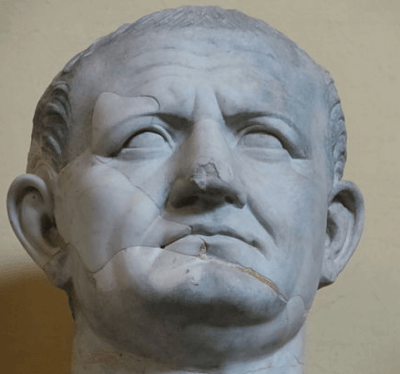
Born in 9 AD, near the end of the reign of Augustus, Titus Flavius Vespasianus was raised an equestrian in the turbulent political environment of Tiberius' reign. Perhaps his youthful exposure to the Senatorial purges of both Sejanus and Tiberius would help make Vespasian into the great stabilizer that he would become.
Though much of the details of Vespasian's youth are unknown, it is widely accepted that his path followed the cursus honorum, and therefore a direct line into the Senate. By the reign of Caligula, Vespasian had been a Military Tribune, a Quaestor, an Aedile and a Praetor, in which capacity he impressed Caligula by calling for games to honor his 'victories' in Germania.
He was married to the rather obscure Flavia Domitilla, but the marriage produced three children, two of whom, the future emperors Titus and Domitian, would continue their father's dynasty.
It was a mistress, however, who seemingly led the way for Vespasian's political growth. Caenis, secretary to Antonia (Claudius' mother), allowed the future emperor a way into the imperial inner circle, and under the reign of Claudius, his star began to rise dramatically.
When Claudius looked to Britannia for imperial expansion, Vespasian, with his imperial ties, became a natural choice as a Legate in the campaign. He was first sent to Argentoratum along the Rhine to take command of Legio II Augusta, which was to be one of four Roman legions making the crossing to Britain.
When the crossing was made in 43 AD, Vespasian served the general Aulus Plautius with distinction. According to Suetonius, he fought thirty battles with the enemy, subjugated two powerful tribes, took more than twenty towns, and also conquered the island of Vectis (Isle of Wight).
His reputation as a master of siege warfare would eventually become a major factor in securing later positions of prominence. For his successes in the conquest of Britain, he received the triumphal regalia from Claudius, two priesthoods and eventually the honorable position of Consul.
However, Vespasian fades from political and military importance in the 50's AD. The power of Agrippina (Claudius' wife and mother of Nero) was growing, and Vespasian's status as a friend to her enemies (Claudius' freedman Narcissus) put him in a tenuous position.
He would not be kept from prominence within the imperial court for too long, though. By 63 AD, he was appointed the Proconsular governorship of Africa (a Roman province with a legion, indicating imperial trust) where Vespasian won a reputation for meticulous administrative skills, tempered by severity that made him unpopular with the people.
Still, upon his return to Rome, the future emperor found himself a highly respected and influential member of the aristocracy. He earned entry into Nero's inner circle, accompanying the emperor on his trip to Greece where Nero pursued his own escapades into the performing arts and athletic competition.
Despite his rise, Vespasian seemingly offended Nero so greatly, either by walking out on or falling asleep at one of the emperors many performances, that Vespasian was forced into a state of hiding.
At this stage, while Nero was becoming ever more dangerous to his legates and members of the aristocracy, fate seemingly intervened to bring Vespasian back into the political limelight. A revolt in Judaea, where the Jews were particularly troublesome for being able to hole up behind walled cities and resist sieges, led this experienced general in siege warfare to be called back into service.
In 67 AD, Vespasian went east, where we was to take command of three legions and reduce Jewish resistance wherever found. Under his leadership the Romans enjoyed much success, though the capital of Jerusalem would continue to hold out.
As he prepared for the siege of the important city, events back in Rome - and throughout the western provinces - would alter the course of the empire, and with it, Vespasian's career.
The revolt of Vindex in Gaul, while proving itself a disaster to the man who started it (he was crushed by Rufus), would eventually lead to the fall of the Julio-Claudians and the suicide of Nero. Though Vespasian maintained an eerie silence in the east, even declaring himself loyal to Nero's first replacement, Galba, the unfolding drama would lead to greater personal glory for the now 60 year old general.
The Flavian Dynasty
As Galba struggled to secure order and support in the west, the governors in the east, including Vespasian, at first offered loyalty to the successive Neronian replacements, but soon began to formulate their own imperial dreams.
As Galba fell to Otho, and then Otho to Vitellius - over a period of little more than a year - it became readily apparent that there was a unique opportunity for an enterprising and ambitious politician/general.
If someone could succeed where Nero's successors had failed, ultimately shoring up the decadence of the last few decadent years of Nero's reign and a year's worth of debilitating civil war, that individual stood to be readily welcomed by the legions and the population.
While Vitellius bumbled in Rome, an eastern plot began to take firm hold. Despite having pledged allegiance to Vitellius after his victory over Otho in April of 69 AD, the governor of Syria, Gaius Licinius Mucianus (bitter over his subordinate status during Nero's reign) and Vespasian began formulating their own plans.
After a series of meetings between the two, and the inclusion of the Prefect of Egypt, Tiberius Julius Alexander, the plans began to shape into a viable alternative to Vitellian rule.
Though there may have been a rivalry over who held the prominent position, Vespasian advanced into the lead role for a few reasons. He already had two male heirs, Titus and Domitian, signifying the potential for a lengthy and stable dynastic rule, while Mucianus had no sons.
Vespasian, a Proconsular Senator, also held a prominent family name (the Flavii Vespasiani were originally of Plebeian stock but had advanced greatly under Claudius and Nero), while Alexander was both an Equestrian and a Jew.
With the two lesser partners understanding and accepting their positions behind Vespasian's lead, the trio was ready to make its move.
On 1 July 69 AD, Alexander ordered his Egyptian legions - III Cyrenaica and XXII Deiotariana - to swear loyalty to Vespasian, while the Syrian legions under Mucianus - IIII Scythica, VI Ferrata, XII Fulminata - did the same shortly after. Vespasian's forces - V Macedonica, X Fretensis and XV Apollinaris - readily supported their commander, while the large contingent of legions bordering the Danube river fell in line for him as well.
With a considerable army sworn to Vespasian's cause, Mucianus was dispatched to march on Rome with his 20,000 men, while Vespasian moved to Egypt with Alexander to control the vital grain supply.
The siege of Jerusalem, and the yet uncompleted subjugation of Judaea, was left in the very capable hands of Vespasian's son Titus, while Domitian - in Rome and aged 18 years old - likely did what he could to garner support in the capital.
Meanwhile, before Mucianus' arrival in the west, the Danubian legions in Pannonia and Illyricum under Antonius Primus and Cornelius Fuscus took matters into their own hands, marching into Italy against Vitellius.
With as many as 30,000 men (perhaps half as much as Vitellius commanded), the Danubian legions met Vitellius at Cremona in October of 69 AD. Primus and Fuscus won a crushing victory, consigning Vitellius' short reign into history. In December, another Vitellian force sent to waylay Vespasian's legates defected, essentially bringing the Year of the Four Emperors to a close.
Vitellius tried to abdicate, understanding that the cause was lost, but enough loyal men remained to thwart any attempt to save his own skin. Vespasian's brother, Titus Flavius Sabinus, tried to take control of the city, but Vitellius' men killed him and his supporters. On 20 December, the legions of Primus and Fuscus entered Rome, ending the life of Vitellius and taking control for Vespasian until Mucianus arrived shortly after.
The combined and turbulent reigns of Otho, Galba and Vitellius lasted a scant 20 months in total. It's little wonder, considering the tired psyche of the masses, that a strong and competent man such as Vespasian was able to establish firm control and the foundation of a dynasty.
On 22 December 69 AD, Vespasian was afforded full imperial honors, matching those of the predeceasing Julio-Claudians. He would work vigorously in the early days of his takeover to not only legitimize his power, but to re-stabilize the legions, social conditions, the treasury, and the public perception of the imperial office itself.
Vespasian, while establishing a rather short-lived 'Flavian Dynasty' that in itself would only last about 30 years, proved to be a vital historical figure, propping up a flailing Roman state at a time of intense need.
Imperial Stability
Immediately upon his Senatorial confirmation as 'Emperor' in December of 69 AD, Vespasian moved with extreme purpose on several fronts, but perhaps none more so than to legitimize his reign.
With nearly two years of civil war having come to an end, certainly the people and the legions were tired of it, but proving himself where his several 'Year of the Four Emperor' predecessors had failed, was a necessity.
With a strong presence, Vespasian could not only restore Roman glory, but secure his position from the pitfalls of recent imperial rivals. Though he risked angering supporters and the Senate alike, Vespasian clearly marked his eldest son, Titus, as his heir, making him a partner in administrative affairs and naming him Caesar in 71 AD.
This designation (marking the first use of the name "Caesar" clearly as a title) angered the Senate, who certainly wished to avoid the Caligulas and Neros of the Julio-Claudian dynasty, but they had little choice in the matter.
Additionally, Vespasian openly promoted various omens that predicted his rise, assuming the Consulship on several occasions. He also tied his own legitimacy to the Julio-Claudians through Claudius, by erecting a temple in his honor on the Caelian Hill.
While Vespasian undertook several building projects, none are as noteworthy as the Flavian Ampitheatre. The Colosseum, so named for the nearby Colossus of Nero, was not only a grand legacy to the culture of Roman 'bread and circuses', but was intended as a showcased gift from the Flavians to the Roman people.
As the home of the ultimate Roman spectacle, it would also help divert attention from the debauchery of Nero's reign and the uncertainty of civil war (despite the fact that it wouldn't be completed until the reign of his son, Titus).
However, the cost for such a project was reported to be 'forty thousand million sesterces' (40 trillion), which would require a serious adjustment to Roman fiscal policy. Nero's extravagance and the civil war had drained the treasury to dangerously low levels, and while Vespasian would earn a bit of a reputation as a miser for raising taxes (especially in the provinces) and manipulation of various market prices, he did succeed in the terribly difficult task of securing Rome's financial integrity.
And despite his concern to prove legitimacy as Emperor, he was no hypocrite. He lived a modest lifestyle in comparison to his predecessors, and readily reported his own family's humble origins. In keeping with that origin, unlike the Julio-Claudians, he refused the Tribunician power and the title 'Father of the Country' until very late in his reign (perhaps in order to secure that power for Titus).
Perhaps Vespasian's greatest contribution was the reformation of the Roman army. It was not a reformation in the sense of massive change, but in restoring its sense of imperial loyalty. (After Vespasian, the legions would remain relatively loyal to the reigning emperor until the death of Commodus some 120 years later). He did punish Vitellius' men by dismissing many from service, but for the most part left the legions intact from their previous positions.
In Britannia, more northern territory was brought under Roman rule, and there were considerable pacification efforts in the Rhine and Danube regions. He increased the number of legions in the east, in part to help Titus finish the capitulation of Judaea, and to stop 'barbaric' invasions into Cappadocia.
In relation to the Jews, Vespasian and Titus were at times brutal, but their victory pacified notable Jewish resistance in that province for generations (until the reign of Hadrian). In fact, the Vespasian coin 'Judaea Capta' commemorating their achievement was an important item of propaganda for the Flavians and remains a highly prized and collectible Roman coin in the ancient numismatics field.
Culturally, the emperor also set about restoring a sense of the Augustan age. The Senate and Equestrian roles were re-ordered to allow worthy men to make political climbs, while replacing those who did not have merit.
In Hispania, Latin rights (a stepping stone to full citizenship) was granted to communities en masse, greatly enhancing that province's 'Romanization'.
Of incredible (if sometimes overlooked) importance was the reduction of the court backlogs, which had been growing to enormous proportions since the waning days of Nero's reign, and were a terrible drain on resources.
Latin and Greek rhetoric tutors were offered a state salary for the first time, and entertainers were paid handsomely by Vespasian's court. (Unlike Nero, the emperor appreciated entertainment and music but did not participate or treat it in a socially non-Roman manner).
The Theatre of Marcellus was built, too, providing a new stage to entertain and to encourage the arts and Vespasian hosted lavish state dinners (despite probably having some personal disdain for spending the money!) in order to boost the various food related markets.
All in all, both Suetonius and Tacitus paint a vividly glowing picture of Vespasian. According to Suetonius, Vespasian was a man of great humor, despite a constant 'strained' look on his face. Reporting a tale in which Vespasian asked a comedian, who was apparently making jokes on several people, to make a joke on him, Suetonius says the comedian's response was: "I will, when you have finished your bowel movement."
Even in his waning days, after 10 years of stable and prosperous rule, the emperor kept his much lauded sense of humor. As he fought of sickness at the end of his life, he reportedly joked, 'Vae, puto deus fio' ('Woe, I think I'm turning into a god.')
The emperor's death came shortly after and again, according to Suetonius:
"...he [Vespasian] had a slight illness in Campania, and returning at once to the city, he left for Cutilae and the country about Reate, where he spent the summer every year. There, in addition to an increase in his illness, he nevertheless continued to perform his duties as emperor, even receiving embassies as he lay in bed. Taken suddenly with such an attack of diarrhea that he all but swooned, he said: "An emperor ought to die standing," and while he was struggling to get on his feet, he died in the arms of those who tried to help him, on the ninth day before the Kalends of July (23 June 79 AD) at the age of sixty-nine years, one month, and seven days."
Vespasian is often overlooked for his contributions to the young principate, but his importance cannot be denied. If not for the rather harsh reign of his second son, Domitian, the period between Vespasian and Marcus Aurelius may have been known as that of the '7 Good Emperors' rather than just five (Vespasian and Titus added to Nerva, Trajan, Hadrian, Antoninus Pius and Marcus Aurelius).
There is no question that Vespasian, despite his dynastic leanings, provided a model of efficient and effective government for those quality emperors that followed.
One can certainly believe that the Roman state was still strong enough in the 1st century AD that it could easily have survived the crippling civil war after Nero, and that any quality leader could've 'righted the ship', but it wasn't any other quality leader who emerged, it was Vespasian.
The Roman people, too, seemed to understand his importance, deifying the former emperor soon after death, and interring him in the Mausoleum of Augustus, an honorable shrine reserved for the original imperial family.
Did you know...
Flavius Josephus, the great Jewish historian, was originally a Roman captive following Vespasian's campaigns in Judaea. He eventually became such an ardent supporter of Vespasian and Titus that he took the name 'Flavius' in their honor.